

► We speak to the boss
► What’s changed – what’s next?
► Going all-electric?
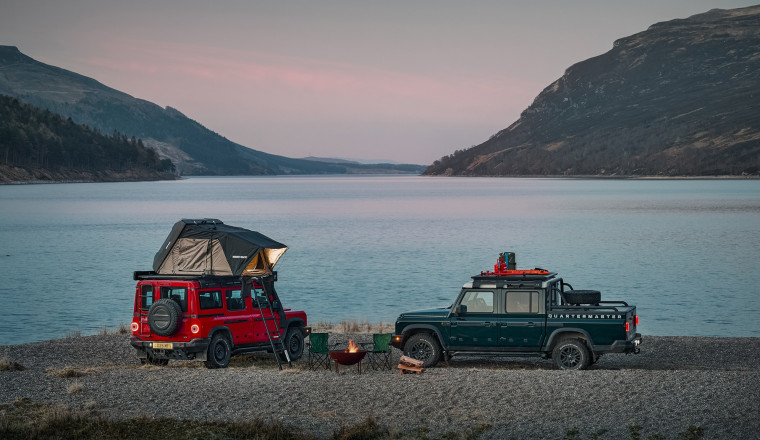
Ahead of the launch of the revised 2026 Grenadier, Ineos Automotive chief executive Lynn Calder spoke to CAR about the challenges and opportunities facing a new car manufacturer making old-fashioned 4x4s in turbulent times.
Despite all the political and economic changes in the seven years since Ineos founder Sir Jim Ratcliffe decided to make a traditional off-roader, Calder says the fundamental mission remains unchanged. But she and her team have needed to constantly adjust the details of their approach, in the face of supply-chain difficulties, tariffs, uncertainty over the electric transition, and various other factors faced by all car makers.
And although she won’t talk sales and production figures, she admits there’s room for improvement – some of which is down to pushing harder to get the message across to people who would like the Grenadier but are currently unaware of it.
‘We’re finding our people, but there are still plenty out there who just don’t know the car exists. It’s not a mass-market car, and it’s never going to be a car that everyone wants. But there are some people who absolutely love it.’
As well as selling to individual enthusiasts who share Sir Jim’s penchant for ladder-frame chassis and big six-cylinder engines, Ineos is also finding increased acceptance among the emergency services, safari companies, aid agencies, mining companies, utilities and now the military too. When reliability and durability are life-and-death matters, those organisations insist on giving the car the toughest of tests before buying: ‘The feedback has been great – they’re finding that the car is unbreakable,’ says Calder.
Criticisms of the Grenadier and Quartermaster pick-up have genenrally focused on the on-road steering, which has been addressed for the 2026 model.
But what is on the cards beyond that? What of the Fusilier that was unveiled as an EV and range-extender nearly two years ago, but then put on ice? Calder says politicians need to stop changing their minds if it’s to stand a chance.
‘Range extender seems to be a great transitional technology, but we need to be confident it’s not going to be banned.’ If a Fusilier-style range extender happens, ‘it’s not going to be to the original timeframe, but late ’27, early ’28, with a fair wind and with clarity from legislators. We think it will be a great seller in Europe and it will do well in the US. Something a bit more electric but without the range anxiety and inconvenience.’
‘I think there will be an electric model, and it might be a Fusilier, but it might be a different model. We need to do it in a cost-effective way. We’ve got to use our investment wisely, and within that offer people choice.’
Current thinking is that the Grenadier and Quartermaster will over the next few years be joined by the Fusilier and perhaps two other models ‘that I think will be better sellers in Europe, more urban sensibilities, better on-road.’
Depending how that all plays out, it might make sense to set up a factory in the US – the Grenadier’s biggest market – in addition to the current factory at Hambach in France.
‘I think we will, but when the circumstances are right. There’s no point in having two factories that are not fully utilised. If you fill Hambach… then at that point we’re very interested in building Grenadier and Quartermaster in the US. Not really because of tariffs, because tariffs come and go. We are manufacturers. You don’t want to be importing or exporting everything. More than about tariffs, it’s about finding ways to make these vehicles where you’re selling them. If you’re selling Grenadier mainly in the US, make it there. If you’re selling Fusilier mainly in Europe, make it there.’
Ambitious? Yes. ‘But I would point to what we’ve achieved today. We’re still a really really small OEM. From that moment of Jim having an idea, seven and a half years later, I don’t think anyone would have believed us then if we’d said we were going to have this very large manufacturing facility in France, we’re going to have tens of thousands of vehicles on the road, we’re going to be in 50 countries, we’re going to have quite a large team, and ready to set off on the next phase of that adventure. When we put our minds to it, when we buckle down and get on with it, I think we can achieve it.’
But market conditions have to be favourable, or a new plan will be needed. ‘As a business leader you shouldn’t waste much time prognosticating right now and imagining things that might happen, because it will be wrong. You should find a way to be agile and resilient.
‘We can get really bogged down in the things we can’t control. There are some things that are entirely within our control. We need to get better at that. We’ve got to do a better job of communicating with customers and partners. How we market the brand. People who own Grenadiers are extremely knowledgeable and passioniate. We need to amplify that.
‘It’s tremendously exciting. It’s a once-in-a-generation challenge. We’ve been a little unlucky but we are a stubborn bunch, and extremely passionate about what we’re doing. We get really fired up whenever we spend time with customers – it’s infectious, a really solid tonic, a reminder of why we’re doing this.
‘We’re absolutely sticking to our guns, making rugged off-road-capable vehicles.’
Colin is the managing editor of CAR magazine – and the man responsible for production and getting the words and pictures on to the page in an engaging, intelligent and high-quality fashion.
By Colin Overland
CAR's managing editor: wordsmith, critic, purveyor of fine captions