
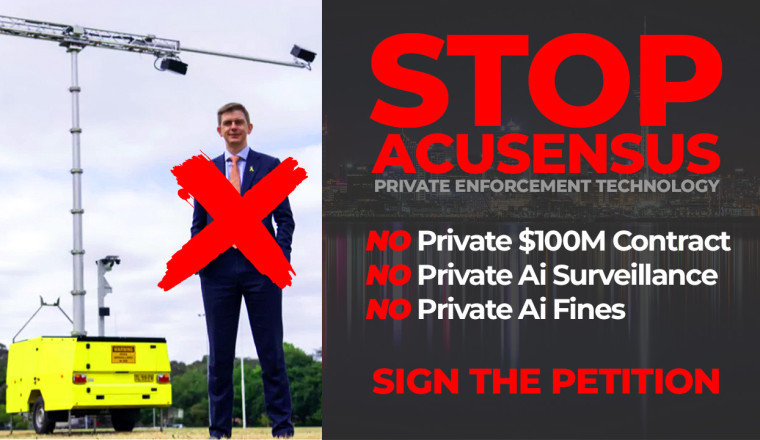

Since July 2025, the vehicle that films you speeding on a New Zealand road is not a police car. It is an unmarked van operated by Acusensus NZ (Slogan: Changing behaviours), a subsidiary of an ASX-listed Australian surveillance company. The camera films you. The AI processes the image. The data goes to NZTA Waka Kotahi, who issues the fine. The money goes to the New Zealand government. The contract revenue goes to Australian shareholders.
New Zealand Police, who were directly accountable to Parliament and to the public, have been removed from the process entirely.
The contract, worth approximately NZ$92 million over an initial five-year term, was signed with NZTA following a competitive tender in late 2024. Acusensus had previously been selected for a NZ$5.2 million statement of work covering full service delivery before the main contract was finalised. The Acusensus Harmony camera system received formal government type approval on 23 March 2025 under the Land Transport (Approved Vehicle Surveillance Equipment) Notice 2025. Full deployment under Acusensus began in July 2025.
The cameras are unmarked. The vehicles are unmarked. The deployment locations are not published. There is no publicly available crash data justifying where specific sites are selected. The AI makes the initial detection. A human at NZTA reviews it and issues the infringement notice. You receive a letter.
Kiwis are not happy about it. And some of them are doing something more productive than complaining.
What Acusensus Is
Acusensus was founded by Alexander Jannink, who has cited the death of a friend in Los Angeles as the founding motivation for the company. It trades on the Australian Securities Exchange under the ticker ACE and describes itself as a world-leading pioneer in AI-enabled driver behaviour monitoring, with products covering speed, mobile phone use, seatbelt compliance, and what the company's investor materials describe as future capability in fatigue and impaired driving detection.
That last point matters more than it might appear. Acusensus's own investor communications describe a business model built on winning contracts and then expanding scope. The company was the first in the world to enforce mobile phone use with camera systems, the first for seatbelt detection, and now operates multifunction enforcement systems that combine speed detection with phone and seatbelt monitoring from a single roadside asset. Those combined systems are already operating in Australia. NZTA conducted trials of phone detection technology in Auckland in 2022, confirmed in NZTA's own OIA responses.
The infrastructure is already in New Zealand. The only barriers to expanding what it detects are legislative ones. And legislative barriers, unlike physical infrastructure, can be changed without public tender or democratic vote.
What the Petition Says
A parliamentary petition and citizen campaign has been running on MotorBuzz since February 2026, with over 1,600 signatures at the time of writing. The petition makes five specific demands: terminate the contract and return mobile camera enforcement to New Zealand Police, conduct an urgent inquiry into how the contract was awarded, require NZTA to publish the full contract terms within 60 days, legislate to prevent private foreign companies from holding traffic infringement issuing powers in future, and establish a public register of camera deployment locations with supporting crash data.
The campaign argues that the issue is not speed enforcement. New Zealand's road toll is real, and no serious participant in this debate is arguing that speeding should go unchallenged. The argument is about who holds the power to do the challenging, under what accountability framework, and in whose financial interest.
New Zealand taxpayers already fund the New Zealand Police. The Police are accountable to Parliament. They are bound by the New Zealand Bill of Rights Act 1990. They can be questioned by select committees. Their deployment decisions can be subject to OIA requests that carry enforceable response obligations.
Acusensus NZ is accountable to its parent company's board in Australia and to its ASX shareholders. Its commercial incentives run toward maximising detection volume and contract renewal, not toward the same set of public interest obligations that govern a statutory enforcement agency.
Like this? Get more MotorBuzz delivered to your phone. Download the app: iOS | Android
The Broader Pattern
New Zealand is not unusual. It is early.
MotorBuzz has tracked this across multiple investigations, documenting how the same commercial model is being deployed across the UK, Australia, and the United States. In the UK, the Acusensus Heads Up system is already operating, and a national AI camera trial that ran without parliamentary debate ended in March 2025 and transitioned directly into standard operational status. Greater Manchester detected 3,200 violations in a trial that was officially classified as a traffic survey rather than enforcement, meaning no prosecutions were pursued and no public consultation was required.
In the United States, nearly 300 bills relating to automated camera enforcement were introduced across state legislatures in 2025. In Australia, where Acusensus operates its most mature programmes, phone detection cameras in New South Wales processed over 100,000 detections in their first year of operation. The company's revenue grew 19 percent year-on-year in the most recent period reported, and its investor communications project significant further growth from international contract wins.
The business model is consistent: identify a road safety problem with genuine public concern behind it, demonstrate detection capability, win a government contract, establish infrastructure, and expand scope as legislative appetite permits. The safety problem is real. The commercial expansion logic runs on top of it.
What You Can Do
The MotorBuzz campaign provides a complete action guide with template letters for Ministers, local MPs, the NZTA chief executive, and Parliament's general correspondence address. Parliamentary petitions in New Zealand are reviewed by select committees, and ministers are required to respond to constituent letters within set timeframes. These are not performative gestures. They are formal mechanisms with legal weight.
The campaign also includes a detailed guide to disputing fines under the Criminal Disclosure Act 2008, covering the specific documentation requirements in the Speed Detection Equipment Operators Manual 2015 that every detection must meet before a fine can be considered evidentially valid. Operator certification, pre- and post-deployment equipment tests, contemporaneous tracking history, line of sight records, and logbook entries are all mandatory. In the campaign's own assessment, incomplete or missing tracking history is the most common evidential failure, and the most common reason fines are withdrawn when formally challenged.
Disputing a fine is optional. The disclaimer on the campaign page is clear and worth reading in full before deciding. If you proceed to court and are convicted, the penalty can exceed the original infringement fee. But the right to request disclosure and require the prosecution to prove its case is a fundamental feature of the legal system, not a loophole. Requiring evidence to be evidence is not evasion.
Why the 2026 Election Changes the Calculus
The next New Zealand general election is scheduled for 7 November 2026, with Parliament required to dissolve no later than 16 November 2026. The current National-led coalition government holds a working majority, but transport policy and infrastructure spending are active political territory in an election year. Ministers write back to constituents because ministers who ignore constituents face consequences at the ballot box. The timing of a growing, organised campaign against a specific and named government contract, in an election year, in a country where electorates are small enough that individual letters genuinely count, is not accidental.
The campaign is asking New Zealanders to do something specific, not just feel something general. Sign. Write. Share. Those three actions, repeated at scale across enough electorates, put the Acusensus contract on the formal agenda of Parliament in a way that vandalism and social media anger cannot.
The angle grinders that have been taken to camera poles in Auckland achieve nothing permanent. Acusensus replaces the equipment with public money and books the repair as contract revenue. The petition achieves something angle grinders cannot: a formal parliamentary record that citizens raised this, that Ministers were required to respond, and that the issue sat on the Transport and Infrastructure Select Committee's agenda in an election year.
That is how democratic pushback actually works. New Zealand is showing it can be done.
Sign the petition and read the full campaign guide here.
Sources: NZTA Waka Kotahi contract announcement, December 2024, Business News Australia, December 2024, NZ Legislation — Land Transport (Approved Vehicle Surveillance Equipment) Notice 2025 (SL 2025/55), Acusensus ASX investor materials, MotorBuzz Acusensus investigation, NZ Ministry of Justice — disputing a fine, Speed Detection Equipment Operators Manual 2015. All contract values in NZD unless otherwise stated. All analysis and editorial commentary is original.