
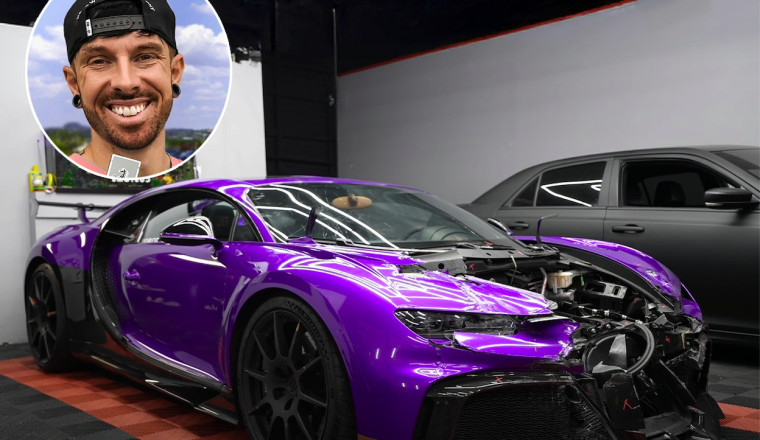

Mat Armstrong, the British YouTube creator known for rebuilding crashed supercars, has encountered his most daunting challenge yet. After purchasing a wrecked Bugatti Chiron Pur Sport and hearing repair estimates approaching $1.7 million, Armstrong visited a Bugatti dealership seeking clarity on whether restoration remains feasible. The answer, documented in a video released on his channel in January 2026, delivered sobering reality about hypercar repair economics.
Armstrong built his YouTube following, currently exceeding 3.2 million subscribers, by purchasing crashed exotic cars at salvage auctions and rebuilding them, often for fractions of dealer repair costs. His projects have included Lamborghini Huracáns, McLaren 720S models, and various Porsches. The Chiron Pur Sport, however, operates on an entirely different scale.
The vehicle in question sustained significant front-end damage in an accident before Armstrong acquired it through salvage channels. While the exact purchase price wasn't disclosed, salvage Bugattis rarely appear on the market, and when they do, bidding typically starts in the hundreds of thousands despite their damaged condition. The Chiron Pur Sport originally retailed for approximately $3.6 million, making it one of the most exclusive and expensive vehicles Bugatti produces.
Armstrong's video documents his visit to an official Bugatti dealership, where he discussed repair feasibility with technicians and service advisors. According to the conversation shown in the footage, Bugatti's official position on crashed vehicles proved uncompromising. The brand maintains strict policies about structural repairs, particularly concerning the carbon fibre monocoque chassis that forms the Chiron's core structure.
"Bugatti informed me that if the monocoque is compromised, they won't certify repairs," Armstrong explained in the video. "Their position is that structural carbon fibre damage cannot be repaired to factory standards, only replaced. And replacing a Chiron monocoque means essentially buying a new car."
The $1.7 million repair estimate apparently stems from this reality. Beyond the carbon chassis concerns, the Chiron Pur Sport carries components manufactured to extraordinary tolerances for a vehicle capable of exceeding 200 mph. The 8.0-litre quad-turbocharged W16 engine produces 1,479 horsepower and costs approximately $250,000 alone if requiring replacement. Bugatti manufactures many parts in limited quantities, with some components built specifically for individual vehicles during original production.
Service departments at Bugatti operate differently from typical car manufacturers. The brand employs what it calls "Flying Doctors," technicians who travel globally to service vehicles rather than requiring owners to visit service centres. This reflects both the brand's exclusivity and the specialised knowledge required to work on vehicles produced in quantities of 500 or fewer.
Bugatti's unwillingness to certify third-party structural repairs stems from liability concerns and brand protection. A Chiron travelling at maximum velocity experiences forces that would destroy conventional vehicles. Any structural weakness could prove catastrophic. The company's position, while frustrating for Armstrong's project, reflects engineering realities of hypercar construction.
Armstrong's predicament highlights the growing divide between conventional supercar ownership and hypercar territory. A crashed Ferrari or Lamborghini, while expensive to repair, typically allows aftermarket or independent specialist intervention. Skilled technicians can source parts, fabricate components, and restore vehicles to roadworthy condition without manufacturer blessing. The hypercar segment, occupied by brands like Bugatti, Koenigsegg, and Pagani, operates under different rules.
"I went into this knowing it would be difficult," Armstrong acknowledged in the video. "But hearing directly from Bugatti that they essentially won't support the repair changes calculations completely. Without their certification, the car might never be legally drivable or insurable, regardless of how well I rebuild it."
The insurance question proves particularly thorny. Specialist insurers covering high-value vehicles typically require documentation proving repairs meet manufacturer standards. Without Bugatti certification, obtaining coverage for a restored Chiron becomes nearly impossible. This reduces the vehicle's utility dramatically, potentially relegating it to static display or track-only use.
Comments on Armstrong's video reflected divided opinions. Some viewers encouraged him to proceed anyway, arguing that independent specialists could restore the Chiron to safe operating condition regardless of Bugatti's official position. Others suggested the project had become financially untenable, with repair costs potentially exceeding the vehicle's post-repair value even if Armstrong completed the work.
The situation differs markedly from Armstrong's previous projects. A rebuilt Lamborghini Huracán, even without factory certification, retains functionality and insurability because numerous independent specialists service these vehicles and insurance companies accept their work. The Chiron's rarity and extreme performance place it in different territory where manufacturer support proves essential.
Bugatti's production numbers explain much of this exclusivity. The company produced just 500 Chirons across all variants, including standard models, Sport versions, and Pur Sport specifications. The Pur Sport itself saw only 60 examples built. This scarcity means independent specialists lack experience working on these vehicles, and aftermarket parts simply don't exist.
Armstrong hasn't yet announced his final decision regarding the project. Options include proceeding with repairs despite Bugatti's position, potentially creating a track-only vehicle or static display piece. Alternatively, he could part out the car, selling undamaged components to other Chiron owners needing replacements. The third option involves selling the entire project to someone willing to absorb the loss or with different plans for the vehicle.
The financial mathematics prove challenging. If Armstrong paid $500,000 for the salvage Chiron, then faced $1.7 million in repairs, his total investment would reach $2.2 million. Even perfectly restored, the Pur Sport's value might not exceed $2.5 million given its accident history. That narrow margin assumes successful completion and buyer acceptance of a vehicle Bugatti won't certify.
Previous high-profile crashed hypercar projects offer cautionary tales. Rowan Atkinson's McLaren F1, which he crashed twice, cost approximately £900,000 to repair after the second incident, taking 18 months and requiring McLaren's direct involvement. The car reportedly sold for £8 million subsequently, but McLaren F1 values appreciated enormously in the interim, and crucially, McLaren supported the restoration.
Armstrong's YouTube channel has documented his learning process across increasingly ambitious projects. Starting with modest vehicles, he progressed to six-figure supercars, developing skills and industry connections. The Chiron represents his attempt to tackle the absolute pinnacle of automotive complexity, a test of whether determination and resourcefulness can overcome manufacturer barriers.
The video's title references "crushing news," and the dealership visit apparently delivered exactly that. While Armstrong maintains his characteristic optimism in the footage, acknowledging the project's difficulty, the reality of manufacturer non-cooperation fundamentally alters feasibility calculations.
Bugatti's position, though frustrating for this specific situation, reflects responsible engineering practice. Certifying repairs on vehicles capable of 218 mph requires absolute confidence in structural integrity. The company cannot compromise safety or brand reputation by approving repairs that might fail catastrophically. This philosophy, while limiting for salvage rebuilders, protects both owners and the broader public.
Whether Armstrong proceeds, pivots, or abandons the project entirely will likely feature in future videos. His channel thrives on documenting challenges and setbacks alongside successes, and the Chiron saga provides compelling content regardless of outcome. For now, the $1.7 million estimate stands as a stark reminder that some vehicles transcend even the most ambitious DIY restoration attempts. Sometimes the manufacturers hold all the cards, and when they refuse to deal, the game ends before it begins.