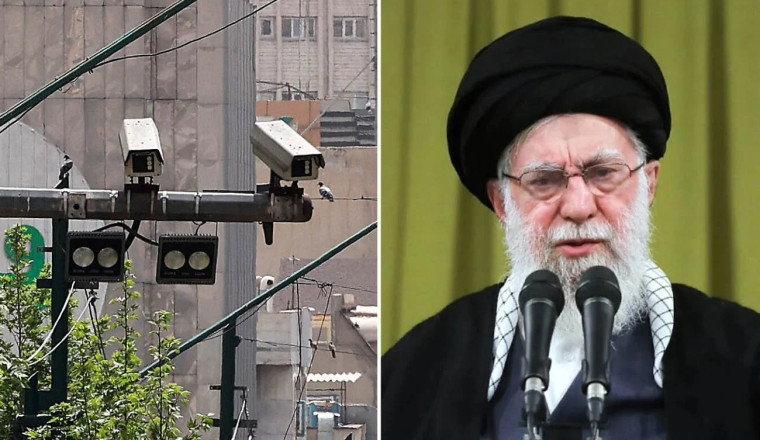

There is a particular irony embedded in the intelligence picture that preceded the death of Ayatollah Ali Khamenei on 1 March 2026. The Supreme Leader of the Islamic Republic spent decades using Iran's extensive surveillance infrastructure to monitor protesters, track dissidents, and suppress opposition. His government had built one of the region's most comprehensive traffic camera networks, repurposing road safety technology as a tool of state control. Iranian Brigadier General Gholamreza Jalali had publicly acknowledged in 2025 that the country knew external actors had inserted code into security cameras to transmit footage to outside servers. The cameras stayed up anyway.
The Financial Times, citing current and former Israeli intelligence officials and others familiar with the operation, reported this week that Mossad had hacked into nearly all of Tehran's traffic camera network years before the strike. Footage was encrypted and transmitted to servers in Tel Aviv and southern Israel. One camera in particular proved decisive: positioned near Pasteur Street, close to Khamenei's compound, it showed exactly where members of his security detail parked their personal vehicles each day.
From that single camera angle, and from hundreds of others feeding the same system, Israeli intelligence built what analysts call a pattern of life. Complex algorithms compiled dossiers on every member of Khamenei's security team: home addresses, duty hours, commuting routes, which senior official each was assigned to protect on any given day. The current Israeli intelligence official who spoke to the Financial Times said, long before the strike, we knew Tehran the way we know Jerusalem.
The Technology Behind It
The traffic camera operation was one strand of a much larger intelligence architecture. Israel's Unit 8200, the military's signals intelligence division, combined the camera data with penetrated mobile phone networks, human assets recruited by Mossad, and large-scale data processing by military intelligence into daily operational briefings. A mathematical method known as social network analysis was used to sift billions of data points, mapping decision-making centres and identifying new surveillance targets as they emerged.
On the morning of 1 March, as senior Iranian officials were confirmed by intelligence streams to be making their way to a meeting at Khamenei's compound, Israeli intelligence also disrupted roughly a dozen mobile phone towers near Pasteur Street. When members of the protection detail tried to call in warnings, they encountered busy tones. Thirty precision strikes were fired at the compound using Sparrow missiles. The planes had been deployed hours earlier to achieve tactical surprise, arriving at the correct location without any window for Iranian air defences to respond effectively.
The CIA contributed a human source who confirmed Khamenei's location at the compound that morning. The combination of signals intelligence from the cameras, mobile network disruption, and the human source satisfied the Israeli military's requirement that two independent senior officers confirm a target's location before a strike proceeds.
Like this? Get more MotorBuzz delivered to your phone. Download the app: iOS | Android
The Surveillance Camera Problem Nobody Wanted to Look At
The piece of this story that will outlast the immediate geopolitics is the one most relevant to the question of what traffic cameras actually are.
Iran's cameras were built, ostensibly, to manage road traffic and enforce traffic law. They were repurposed by the Iranian state to monitor citizens. They were then repurposed again by a foreign intelligence service to monitor the state. The cameras were simultaneously tools of road safety, instruments of political oppression, and ultimately, an intelligence vulnerability that contributed to the death of the man who ordered them installed.
MotorBuzz has spent months investigating the expansion of AI camera infrastructure across the UK, New Zealand, Australia and the United States, covering the Acusensus network in New Zealand, the AI camera trial expansion across UK motorways, and the surveillance infrastructure being built under the language of road safety across multiple democracies. The argument advanced by every government that has expanded roadside camera coverage is that the cameras watch roads, not people, and that their data is protected, anonymised, and used only for the stated purpose.
Iran's government made exactly the same argument about exactly the same infrastructure. The cameras then became something else entirely, twice over, under two completely different actors with two completely different agendas.
The technology does not care about the stated purpose. It records what is in front of it and transmits what it records to whoever controls the server. Who controls the server is the only question that matters. And as Iran discovered, the answer to that question can change without anyone on the ground knowing it has changed.
Sources: Financial Times, 3 March 2026 (primary reporting, cited by all secondary sources), Times of Israel, 3 March 2026, Iran International, Ynetnews, Jalopnik, Nairametrics. All intelligence claims attributed to Financial Times sourcing. All analysis and editorial commentary is original.