

► Limited run of 25 centenary editions, all sold
► Two-tone paint and grooved wheels on the outside
► … a whole world of squiggly strangeness on the inside
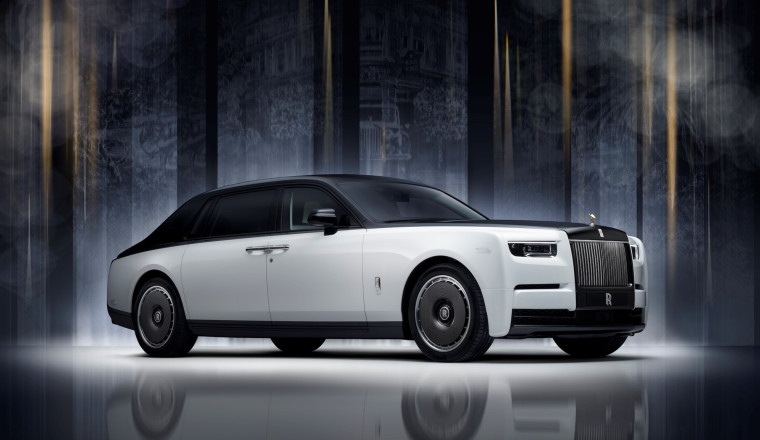
Rolls-Royce has just revealed a limited run of centenary-edition Phantoms, all 25 of them sold already. From the outside, it looks like a current Phantom with a striking black and white paint scheme and a head-spinning wheel design. But inside it couldn’t be more different.
The seats, doors and roof lining are all adorned with elaborately embroidered, printed, sculpted and laser-etched representations of places significant in the Phantom’s century. Looming large on the rear seats is a scene depicting the Rolls-Royce HQ in Conduit Street, Mayfair, in 1913. There are also various coastlines, animals, roads and other squiggles, some of them easily grasped, others with a more Easter egg quality, for the owners to discover in the years and decades ahead. The creation of this remarkable interior has involved various craft techniques never previously employed at Rolls-Royce.
Bespoke design manager Matt Danton said: ‘This started three and a half years ago with a blank sheet of paper. Before any pen touched paper we did a lot of research, working with our historians and the archives. We found some incredible stories we didn’t know, and characters within the brand.’
At the time of the first Phantom’s creation, Henry Royce was the project’s driving force, at the peak of his powers, said Danton.
‘His cars had a strong sense of location, and we’ve tried to reflect where they were built. We started to embellish and build on those stories, turning stories into visuals, and came up with a master artwork. It’s like a time capsule, travelling through 100 years and capturing bits of the story on the way.’
The design team ended up with 77 sketches that were digitised and then incorporated into the interior. It’s a lot to take in, so let’s break it down into a few of the most remarkable features of the Phantom Centenary Private Collection.
It’s black and white because the Phantom was a big deal in Hollywood’s monochrome golden age, often being used for whisking stars to and from premieres. The two-tone paint emphasises the length of the sides, which evokes the long, clean look of the earliest Phantoms.
Seen up close, the paint has a metallic shimmer, the result of tiny particles of crushed glass in a clear coat on top of the paint.
Based on the 1925 casting – as used on the first Phantom – the Spirit of Ecstasy hood ornament is solid 18-cart gold, plated with 24-cart gold, and hallmarked. The figurine’s enamel base is inscribed with the words Phantom Centenary.
The RR ‘badge of honour’ on the sides, front and rear is 24-carat gold and white enamel, which has never been done before.
The wheel discs are engraved with 25 lines. That’s because there are 25 of these cars, and 25 times four – the number of wheels – gives you 100, for the centenary.
Mechanically unchanged, the familar 6.75-litre V12 engine gets a special cover, finished in white with detailing in 24-carat gold.
The back seats are printed fabric, adorned with 160,000 stitches. (We took their word for it.) There are three layers: the background is a print showing the Conduit Street HQ and other significant scenes; on top of that is another layer of printing, depicting some old Phantoms; the topmost layer is embroidered, abstractly representing owners from the Phantom’s previous seven generations.
There’s a total of 45 panels covering the back seats, meticulously curved and fitted together.
The front seats are in leather, but the rears are fabric, a nod to olden times when the chauffeur’s seat got a lot more wear than the passengers’.
The front seats are laser-etched, based on hand-drawn images inspired by 100 years of heritage. Details to spot here include a rabbit, which alludes to Roger Rabbit, the codename given to the Rolls-Royce project after BMW took over the brand but before it went public. And there’s a seagull, the codename used for the 1923 prototype version of the first Phantom.
Among the historically significant delights depicted are a mulberry tree from Henry Royce’s garden in West Wittering, and honey bees – 250,000 of which live in the apiary at Goodwood, Rolls-Royce’s home in the 21st century.
The doors are part-wood, part-leather. On the leather sections, the artwork takes the form of golden thread embroidery with black stitching.
The wood has patterns at three diferent depths, adding a sense of movement and texture. This involved three crafting firsts for Rolls-Royce: 3D marquetry (raised motifs), 3D ink layering (adding fine textures and intricate patterns), and 24-carat gold leafing (a traditonal cabinet making skill, taught to the Rolls team by nearby West Dean College: gold leaf typically 0.1 micrometres thick is hand laid then sealed with a protective coating, highlighting a road on a map).
The door panels depict significant journeys in Phantom history, featuring maps, landscapes, flowers and cars. In the back, the coastline of Le Rayol-Canadel-sur-Mer, where Henry Royce wintered. In the front, West Wittering, his home in summer. The driver’s door artwork refers to a 4500-mile drive undertaken by the first BMW-era Phantom.
The first Phantom, from 1925, and the current Mk8 are etched on the picnic tables built into the backs of the front seats, visible when they’re folded down. When they’re folded up, similar images can be seen on the embroidered leather covering the tables.
Look up and the Starlight Headliner is even more special than the roof linings that have become a familiar feature of modern Rolls-Royces, with LEDs shining through tiny holes in the roof lining, carefully arranged to artistic effect. The centenary car goes further, by combining the lights with embroidery, all 440,000 stitches of it.
The squiggly metal thing ahead of the front passenger consists of 50 brushed aluminium fins, created by 3D printing, and is meant to look like pages of a book. The pages are etched with praise for the Phantom from 100 years of road tests.
It’s lit in a way meant to evoke falling fireworks.
Colin is the managing editor of CAR magazine – and the man responsible for production and getting the words and pictures on to the page in an engaging, intelligent and high-quality fashion.
By Colin Overland
CAR's managing editor: wordsmith, critic, purveyor of fine captions