
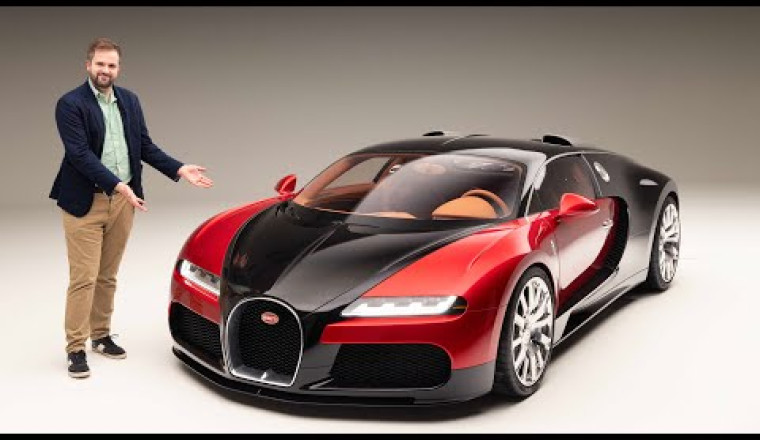

► Bugatti marks 20 years of Veyron with new one-off
► FKP Hommage is named after its creator, Ferdinand Piech
► Produced to match customer’s own Veyron
Bugatti is marking 20 years of its Veyron by making a one-off recreation that pays tribute to not just its hypercar but also the man who enabled the project to happen, Ferdinand Karl Piech.
Named in his honour, the FKP Hommage is the second model made as part of Bugatti’s Solitaire program, which was established last year to create one-off cars for its best and richest customers. Its first model, the Bugatti Brouillard, was shown last year at Pebble Beach, and the FKP Hommage is its latest, revealed to mark 20 years since first deliveries of the Veyron started.
We’ve had a walkaround the FKP Hommage ahead of its reveal at Retromobile 2026 in Paris and spent time with Bugatti’s head of exterior design Jan Schmid to get the full lowdown on this new one-off hypercar.
Ferdinand Piech was an engineering mastermind. He was the man behind the Porsche 917 and original Audi Quattro, but his most ambitious project was the Bugatti Veyron.
Piech was chairman of the Volkswagen Group in the late 1990s and, while on a bullet train in Japan, he penned the idea for an 18-cylinder road car, something he had wanted to create for some time. He needed a brand with enough stature to host such an engine and purchased Bugatti in 1998 to enable it to happen. Prototypes quickly followed, with the Veyron 18.4 Concept being shown at the 1999 Tokyo Motor Show.
Though Bugatti eventually had to settle on only 16 cylinders, Piech soon set out his vision to create a car capable of 1001hp (987bhp), 400km/h (249mph), that could accelerate from 0-62mph in under three seconds and yet still be comfortable enough to take him and his wife to the opera. It was a highly ambitious project, and Piech wouldn’t ever for settle for anything less than his vision, with the Veyron being shown in production form in 2005 and customer cars arriving a year later.
Bugatti’s Solitaire programme uses the firm’s latest technical platforms, so rather than the FKP Hommage being a restomod version of an existing Veyron, it is based on the last W16 underpinnings, the same as the Chiron Super Sport and Mistral. It’s too early for the V16 engine and chassis from the Bugatti Tourbillon to feature in this new car.
That brings with it more power and technology, yet it’s still wrapped in a compact package that retains the same unmissable Veyron styling.
‘I really love the Veyron, even before I worked with Bugatti,’ says Schmid.
‘I feel the relevance of the car is only growing, and to be able to do a homage was really something special, it’s a once in a lifetime thing.’
Solitaire also enables Bugatti’s customers to work in closer collaboration with the design team, including the firm’s head of design Frank Heyl.
The engine was always the centrepiece of the Veyron and the same is true here. The original target of 987bhp was achieved with the original, before being turned up to 1,184bhp for the Veyron Super Sport. But here the 8.0-litre quad-turbo W16 engine is putting out 1,578bhp.
Performance figures will likely not be released, but it’s worth a reminder the Chiron Super Sport’s top speed is 273mph and it can do 0-62mph in 2.4 seconds.
Yes, and it’s even more deliberate as the red and black colour scheme of the FKP Hommage has been done to matching the owner’s original Veyron 16.4. It introduces some design details that were penned to go on a facelift version of the Veyron, which never materialised as Bugatti instead decide to focus on the development of the Chiron.
These include new LED daytime running lights, as well as tinted ‘tunnel’ LED rear lights. It’s slightly wider, and though it retains many of the Veyron’s signature design elements – the air ducts about the occupants’ head, horseshoe grille and its ‘leaning back’ stance, which was very different to wedgy and aggressive supercars of the time – every line and surface is in a different place to the original.
Jan Schmid, head of exterior design at Bugatti, said: ‘We consider this the pinnacle of Veyron. This would be the very last iteration of Veyron [if it had been continuously made] and we wanted it to look like a Veyron at first glance.
‘To commemorate [the 20 years] in a proper way we wanted to do something to honour the man who envisaged the Veyron, not only the Veyron but a very big influence on the car industry as a whole.’
The Veyron’s interior was always angled more towards comfort than it was outright sportiness and the same is true with the FKP Hommage, which has been modernised without tarnishing the look.
A bespoke centre console is created from solid aluminium blocks and is now in more of a teardrop shape. New digitalised controls are introduced but not at the expense of style, while the seat fabric is borrowed from the Tourbillon but the pattern for the FKP Hommage has been specifically created for this car and won’t be used again.
But the centrepiece of the FKP Hommage’s interior is the clock – a 43mm Audemars Piguet Royal Oak watch custom created for the car at the request of the owner. Bugatti wouldn’t tell us how much but a quick search shows it’s likely to be somewhere in the region of half a million pounds. Just for the clock…
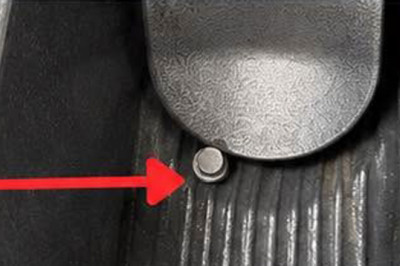
Other noteworthy details include Ferdinand Piech’s date of birth etched into the knee rest of the footwell, while the Veyron’s renowned aluminium steering wheel has been retained.
Schmid adds: ‘This is a remix. It’s not the same but it’s still the same. The Hommage doesn’t make the Veyron look bad, they look really good together. To pull that off was equally difficult as coming up with an original design.’
Good question, and one we can’t answer. The fact it pays so much tribute to have Ferdinand Piech you might assume the idea came from his family, though Bugatti said the name of the car was an idea from them.
We do know the car will be staying in Europe, though whether the owner is publicly announced remains to be seen. Bugatti Solitaire’s first creation, the Brouillard, went to a well-known collector of the brand’s models based in The Netherlands.
New cars editor, car reviewer, news hound, avid car detailer
By Ted Welford
New cars editor for CAR and Parkers. Loves a car auction. Enjoys making things shiny