
► BYD?
► Xpeng?
► Or Xiaomi?
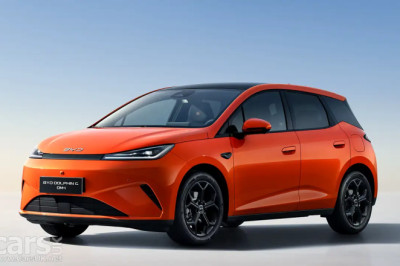
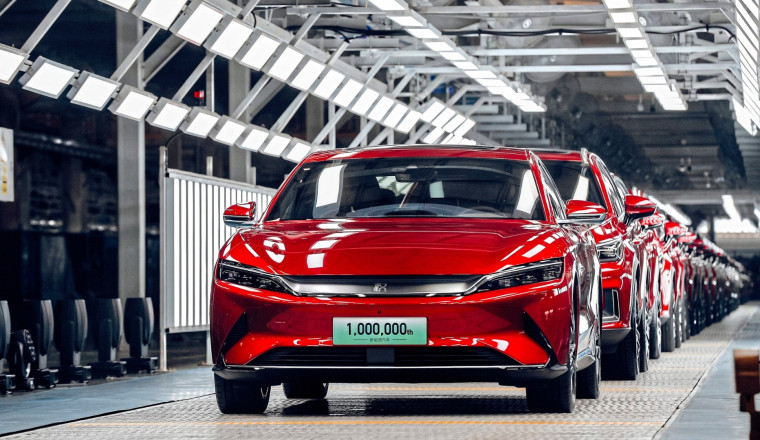
The first candidate, BYD, will be no stranger to readers of CAR. Its sales in the first half of 2025 totalled 2.14 million (of which 1.02m were EVs). In the first quarter of 2025, its profits were equivalent to £1.1 billion.
If Tesla is the global EV alpha male – all outspoken arrogance – then BYD is its nerdish counterpart. Armed with their own batteries, the nerds overtook Tesla and became the biggest global maker of electric cars in the first half of 2025. CEO Wang Chuanfu and his team have cut costs and thus lowered prices, and it’s working.
Unlike Tesla, BYD isn’t trying to reinvent the car industry – just to dominate it. Tesla ripped up the rulebook on sales, software, charging networks and claims of autonomy. But as BYD grows in confidence, however, that innovation is coming.
Is it the new Tesla? Four out of five. In terms of measurable success, yes. But it’s not even trying to follow the Musk.
If BYD has had Tesla rivalry reluctantly thrust upon it, Xpeng ate up Tesla’s Silicon Valley playbook. CEO He Xiaopeng owned one of the first Teslas in China and set out in 2014 to establish a local equivalent with an emphasis on ‘smart’ EVs with semi-autonomous capability and vast screens delivering a cloud-hosted digital experience.
How’s that going? Good and bad. Xpeng hasn’t turned a profit yet, but VW is so impressed that it bought an Xpeng platform to help boost its ailing performance in China. In the first half of 2025, Xpeng’s sales – all EVs – came to 197,189.
Xpeng’s own Model Y, the G6, got a muted reception in the UK, but the company has actually done what Tesla baulked at and launched a lower cost model in the Mona 03 saloon that’s tearing up the charts in China. The company is diverging from Musk’s two-model mission to satisfy a tricky Chinese market. Now comes the tricky bit: impressing the rest of the world.
Is it the new Tesla? Four out of five. It’s a proper Tesla rival waiting for the world to take notice.
It’s not that long ago that Nio was going to be THE global rival to Tesla. With a glitzy launch in 2016, the company had the backing and the vision, and in Bin Li the inspiring CEO to make it happen. It even had the killer tech in the battery-swapping mechanism that Tesla originally promised, but backed away from.
But despite nailing the swapping tech with 3408 stations (mostly in China), Nio still hasn’t sold a million cars after almost 10 years, and doesn’t make a profit.
That could change with the cheaper Onvo brand and with the Firefly small hatchback. But the electric competition is now frighteningly good in China, its only serious market; Nio sold 114,150 in the first half of 2025.
The stock price has bumped slowly downwards from its stellar high in 2020 in the opposite direction to Tesla’s, which is now propelled by something mystical and far removed from market realities.
Is it the new Tesla? Two out of five. Nio assembled the A-team to challenge Tesla domination but the results have been C-grade at best.
Leapmotor was started in 2015 because founder Jiangming Zhu saw cars as a rolling platform for his beloved electronics. The C10 and B10 SUVs are, like Teslas, cars that are ‘software-defined’.
Leapmotor has yet to profit from this cleverness but the cars are gaining traction, with sales doubling in the first half, helped by Stellantis spotting an opportunity and setting up a European sales network. Plug-in hybrid alternatives are helping. To the end of June, total sales for 2025 came to 221,664.
Like all Chinese ‘smart’ EV companies, Leapmotor is touting its own version of Tesla’s ‘FSD’ semi-autonomy but with the back-up lidar sensor that Tesla pooh-poohs. Reworking all that cleverness into something Europeans find palatable enough to pay extra for will take, we suspect, longer to achieve.
Is it the new Tesla? Three out of five. All the pieces are there, but making them Tesla shaped will take some work.
Arguably Tesla’s biggest competitive edge was its cultish momentum, largely derived from Musk’s bombastic claims and the loyal echoes from the stockholding faithful. If that’s the metric to beat then Xiaomi is the most fearsome rival yet.
Adding electric cars to the company’s smart appliances in 2024 was a perfectly timed move from founder Lei Jun, and the guy is now treated as a rock star. Profits for the first quarter of 2025, including smart appliances, came to £1.36bn.
Designed with a knowing wink in the direction of the Porsche Taycan, the SU7 has been a hit in China and accounted for all Xiaomi’s 152,657 sales in first six months. Add the YU7 SUV (with its whiff of Ferrari Purosangue) and the company is primed to tear past Tesla’s falling Chinese sales (264,498 in the first six months).
Even a slew of dashcam videos showing the SU7’s unfortunate inability to avoid crashing hasn’t tempered the buzz. The 690bhp version of the YU7 can nail 0-62mph in 3.2sec, for the equivalent of just £33,500.
Xiaomi’s highest profile fan in the automotive world is Ford CEO Jim Farley, who has heaped praise on the SU7. The stage is set but winning over a global crowd won’t be easy.
Is it the new Tesla? Five out of five. Global hype, influencer fave, just two models, absurd speeds, whiff of danger: Xiaomi lays the greatest claim to being the next Tesla.
Nick Gibbs is CAR magazine's go-to newshound. An experienced automotive news reporter and analyst who's on first-name terms with the industry decision-makers who are shaping the cars of the future.
By Nick Gibbs
Contributor and newshound who specialises in unravelling the machinations of the car industry