

Stepping out of the 2026 Honda Prelude, the smile couldn’t be wiped from my face. I originally slid behind the wheel with low to no expectations and came away in shock. It’s delightful.
Last week, Honda allowed me to get behind the wheel of the 2026 Prelude for the earliest, and incredibly short, first impression of what its reborn sport coupe is like to drive at its R&D facility in Tochigi, Japan.
Here’s what I was able to gather in three short laps:
The Prelude left U.S. shores back in 2001, but don’t call it a comeback, just celebrate its return. Honda’s executive engineering team said the Prelude’s return brings together the automaker’s DNA and heritage to provide the joy of driving and fun while moving towards its goal of a carbon-neutral future. That’s why it’s a hybrid. When orders open later this month, the car will sit above the Civic Si and below the Civic Type R in the lineup.
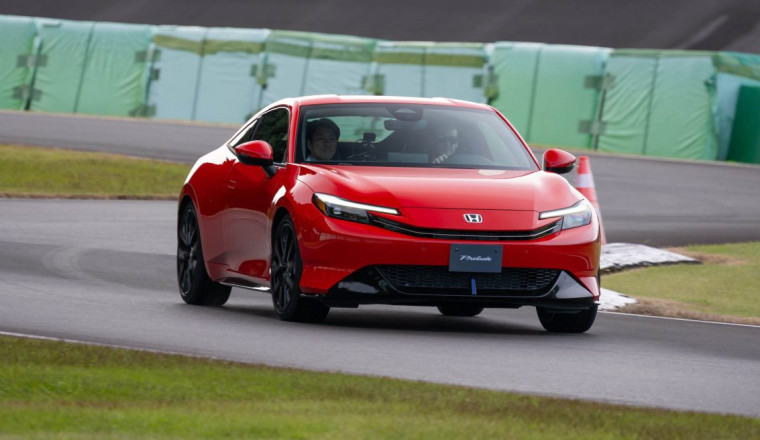
This was the first time I had seen it on pavement, and it looks very different from the auto show floor. The proportions, surfacing, and stance are all terrific, with a low hood line, a fast roofline, and a lovely little spoiler integrated into the hatch. Built on the Civic Type R’s chassis, the Prelude is wider than the Civic Si, but has a shorter wheelbase, giving it squatter proportions.
Inside, the Prelude looks and feels mostly like a Civic, right down to the honeycomb air vents on the dashboard. The 10.2-inch digital gauge cluster and 9-inch touchscreen infotainment systems, along with the climate control buttons and knobs, are all out of the Civic. That’s not a bad thing, as this is user-friendly material that feels good in the hand and has solid clicks when engaged. However, the infotainment system’s interface feels outdated compared to what’s found in a Hyundai at this point, with its iPad-like buttons and basic graphics. The white and blue stitching along the center console and across the dashboard gives the Prelude a hint that it’s more than just a Civic, though, and the moniker stitched on the suede dashboard trim reminds occupants that this is something new, something special. The manually operated leather-wrapped sport seats are the most significant change from a Civic, and they coddle and grab in the right places for my 5-foot-10 frame.
I focused solely on using Sport mode with the two-motor electric hybrid powertrain’s new S+ shift logic for my three short laps.
Pulling away from a stop in Sport mode instantly engaged the 2.0-liter gas engine, which ran in the background to ensure all the power was being transferred to the electric motors that replace what many people would think is a CVT transmission. Technically, the Prelude doesn’t even have a transmission. The first lap served as recon familiarization, but after Turn One it was clear this Prelude induced joy as I snaked my way on the picture-perfect pavement that had slight banks to turns two and three. After lap one, things felt lit, and I was ready to push as far as allowed without getting kicked out of this facility.
View this post on Instagram
A post shared by The Drive (@thedrive)
The suggested speed for going into turn one was 18 mph. I looked down and was going about 80 mph, so it was time to engage the Brembo brakes quickly. As I rounded the first corner, the chassis felt neutral and almost begged for the tail to kick out. Is this a front-wheel drive vehicle equipped with standard Continental all-season tires? I was told that summer tires will be one of the few options for the U.S., and only the wizards at Honda know how much better they make this car go around a corner. It already seems like a gem.
Snaking through the next couple of turns at a quicker pace, the steering went from good to great with the extra speed delivering surgical precision. The steering mechanism is ripped out of the Civic Type R, but it is 3% quicker in the Prelude. Feedback from the wheel was transmitted directly to my hands, indicating what was happening with the chassis and tires. The suspension, too, is from the CTR, and it’s paid dividends despite the shorter wheelbase.
Heading into Turn Seven, I braked heavily, and the programming for S+ mode acted as if the non-existent transmission was rapidly downshifting. I felt the shifts in my backside as if they were real, but they were smooth. My ears detected the change in the powertrain as the engine noise was amplified and then piped into the cabin through the speakers. Frankly, it all sounded and felt like one would expect a Civic Si with a perfect automatic transmission would sound and act like. That was inside the cabin. Outside, the Prelude was shockingly quiet even at full tilt. As other journalists drove the prototype, it sounded nothing like a Civic Si to bystanders—it was more like a Civic Hybrid even under hard acceleration.
Power response in S+ and Sport mode was immediate, as both the gas engine and electric motors were engaged. The only time the gas engine runs alone and clutches directly to the wheels without the electric motors is at high-speed cruising with light throttle, for the sake of efficiency. The gas engine turns off completely at low-speed cruising with light throttle engagement. Combined, the powertrain is rated at 200 horsepower and 232 lb-ft of torque, which is sent to the front wheels only.
Forward visibility was terrific with a low-set hood that Honda specifically designed to even make the Prelude easier to park.
After an all-too-short stint, the party was over. The gas engine shut down, and the Prelude silently cruised into the staging area with just the electric motors’ whir and a low-speed pedestrian alert sound found on the Civic Hybrid.
Chief Engineer Yoshiharu Saito told The Drive that the packaging in the Prelude would allow for a limited-slip differential, which it currently doesn’t have. However, he added that an LSD was deemed “not necessary.” He noted the team wanted to offer fun in everyday life and didn’t want to focus entirely on speed or power. “If we wanted to focus on power, it would be a different concept than this model,” Saito added.
He’s not wrong. The Prelude is best described brisk off the line thanks to the instant torque from the electric motors, though it seems like a momentum machine through corners. It’s not exactly fast.
Honda hasn’t released pricing yet, but expect the 2026 Prelude to cost about $42,000 when it goes on sale later this month.
That price might give many enthusiasts sticker shock or induce scoffing, especially when the phenomenal Type R isn’t that much more. While not the fastest car, the Prelude gifted me a smile that was hard to wipe from my face. Furthermore, there’s no direct competitor in existence today to the reborn Prelude, and maybe that’s a good thing.
If the future is a car that can sound like a Civic Si inside, handle similarly to a Civic Type R, get similar fuel economy to a Civic Hybrid, and look like a flowing sporty coupe, I’m all in. The joy of driving lives on in Honda’s electrified era.
Honda provided The Drive with travel, accommodations, and access to the vehicle for the purpose of writing this review.
The 2026 Honda Prelude won’t be for the masses, but all early signs point to enthusiasts who buy one being rewarded with a fun, efficient, and modern sports coupe.
As Director of Content and Product, Joel draws on over 15 years of newsroom experience and inability to actually stop working to help ensure The Drive shapes the future of automotive media. He’s also a World Car Award juror.

Car Buying Service
By Joel Feder
By Adam Ismail