

How we test cars
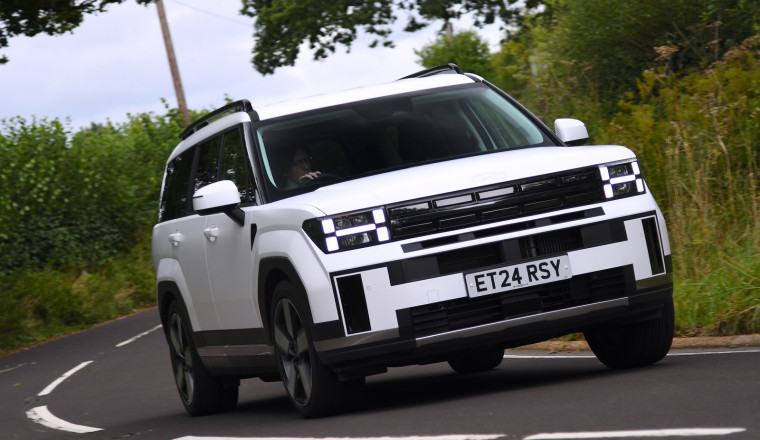
Large, seven-seat SUVs like the Hyundai Santa Fe have generally superseded people-carrier MPVs in Europe. While some may lament the loss of the clever use of space for which MPVs were known, it takes only one glance at the Santa Fe to see why buyers aren’t looking back.
Here stands not a fancy van but something that trades an MPV’s excessive head room for a raised ride height, to give some off-road ability (or the suggestion thereof) and no small degree of road presence.
The latter is enhanced by the Santa Fe’s sheer size, which is close to that of a BMW X5. It's no longer the biggest car in Hyundai’s UK range, though. That distinction belongs to the Santa Fe's electric counterpart, the Ioniq 9.
Let’s see if it has the cleverness and sophistication to match the design appeal.
The new one builds on the foundations of the previous-generation Santa Fe, which somewhat unusually had a platform change midway through its life, so it’s not exactly old.
This N3 platform is shared with the Kia Sorento and, as a result, the two Korean SUVs have a similar engine line-up.
Hyundai has a weird relationship with its brand name. It no longer appears on the steering wheel, but the headlights boldly display an H as the daytime-running lights, which then turn orange to function as the indicator.Illya VerpraetRoad Tester
At the core of that sit a regular strong hybrid and a plug-in hybrid, which both use a turbocharged 1.6-litre four-cylinder with an electric motor inside the six-speed automatic gearbox, although the specifics vary by version. From launch in 2024, the engine had 158bhp and the motor had 58bhp in the Hybrid or 90bhp in the PHEV. For 2026, both hybrids got an upgrade, with the engine henceforth producing 177bhp and the motor 64bhp in the Hybrid or 105bhp in the PHEV.
Hyundai also tweaked the mechanical layout. The broad strokes are the same, with a transverse engine, a six-speed automatic (traditional planetary but with a clutch instead of a torque converter) and drive going to the front wheels in the first place or all four by way of a propshaft in the four-wheel-drive versions.
The difference lies in the configuration. Originally, there used to be a starter-generator-style motor on the front of the engine that would also provide the power for pulling away by turning the engine. On the revised version, this motor is inside the gearbox, on the engine side of the clutch. It still has the same function, for starting the engine and pulling away, but the changed position means it doesn't need to turn the engine to pull away, making it more efficient.
For this generation, the Santa Fe is no longer offered with a diesel engine, so if you're looking for a tow car, the Sorento or Skoda Kodiaq may be a better choice. The 2026 update has brought a useful upgrade in that respect, though. Previously, all versions of the Santa Fe were limited to towing 1100kg, but now that has increased to 2000kg for the Hybrid and 1700kg for the PHEV.
Compared with the old Santa Fe, Hyundai said it worked on the suspension bushes to improve ride isolation and retuned the steering for better on-centre feel. Mainly, though, this was a design and interior makeover. The whole car is 45mm longer for additional interior space but – thankfully – the overall width hasn’t grown, remaining at 1900mm without the mirrors.
As we have seen with many of its recent models, Hyundai doesn’t exactly value design continuity. The Santa Fe doesn't really look like previous generations or other Hyundais, embracing right angles and looking a little like a supersized Volvo 240. As admirers of the Swedish brick will know, it’s a practical shape that maximises boot space and visibility (Hyundai says the quarter glass has grown by 48%). It certainly stands out from the pebble-shaped modern crowd.
While some rivals are engaged in a game of one-upmanship over how many touchscreens they can fit into a cabin while quietly downgrading the material quality and number of features, common sense continues to prevail at Hyundai.
The necessary mod cons are all present. There’s a curved array of two 12.3in screens – a driver display and central touchscreen – with a head-up display on higher trims, but it’s complemented by a selection of physical controls for infotainment shortcuts (including a pair of customisable buttons), climate controls and vehicle functions (auto hold, drive mode). All of that means you need little familiarisation to operate the Santa Fe.
The interior is stylish, brilliantly practical and usable. Two small lapses, though: the offside rear side window creaked in its seals and there’s nowhere to store the boot’s roller blind cover when using the third row of seats. Matt PriorEditor-at-large
None of this comes at the expense of material richness or standard features. Even the entry-level Premium has particularly comfortable and widely adjustable seats with heating and memory functions, as well as a wireless phone charger and enough USB ports to power a small data centre. Most of the stuff that looks like leather, wood or metal actually isn’t, but that would be too much to ask in this price class. More to the point, it’s all convincing enough.
Neither can the Santa Fe be accused of style over substance, because this is a brilliantly well-considered cabin. The clever MPVs of old may be dead, but their spirit lives on in cars such as this. There are two gloveboxes with a shelf between them, as well as storage space under the centre console and room for two phones. Rear passengers aren’t forgotten: they get an extra drawer and the armrest cubby can be opened from both the front seats and the back.
The style arguably results in substance, because the Santa Fe’s squared-off proportions and straight sides mean that very little space is wasted. It goes without saying that second-row passengers aren’t short of space to stretch out, but the third row isn’t compromised on head room either. Those occupants get their own cupholders, charging ports and an air vent with fan control.
Getting in and out isn’t too onerous, either, because the second row slides, mostly manually but with some electric assistance. There are multiple buttons and levers that do the same thing, so you never have to look for the right one.
We would stick with the Premium, because the upper-level trims don't feel like a massive upgrade, either in terms of materials or features. The second-row captain's chairs aren't quite as adjustable as you might hope.
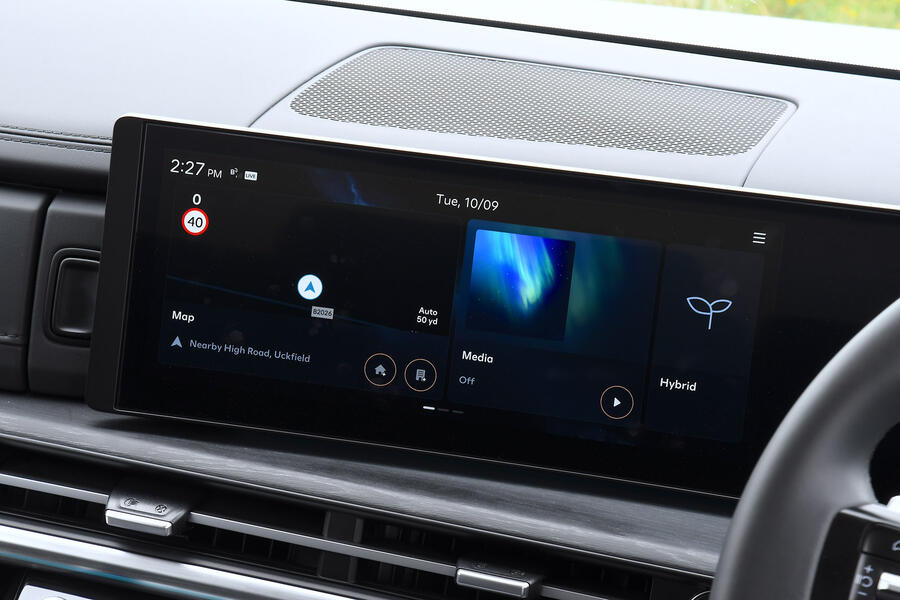
The infotainment in the current generation of Hyundais is carefully considered to simply give you what you need, without any extraneous gimmicks. What’s there works well too. The outgoing generation of Hyundai systems could be a bit laggy and was showing its age in the graphical department, but those issues have been solved now. The new interface looks attractive and responds quickly to prods and swipes, and there’s always the physical shortcut buttons to help you get to where you need to be.
Apple CarPlay and Android Auto can finally be connected wirelessly, and proved reasonably stable and reliable during our test. Hyundai’s built-in navigation system is excellent, with clear directions and accurate traffic updates. It also has one particular feature we like a lot: as well as the fastest, shortest and most economical routes, you can tell the system to favour motorways.
The standard audio system in our Premium car was all right, although we expect the Bose hi-fi on higher trims to represent a decent upgrade.
A 1.6-litre engine sounds a little weedy for a two-tonne SUV, even if it is enhanced by an electric motor. Weirdly, that makes it one of the bigger engines in the class: the Peugeot 3008 makes do with a 1.2 and the Skoda Kodiaq gets a 1.5 as standard. Even so, this type of car used to be powered by a big diesel engine by default, and for good reason. While we don’t miss oil-burners in superminis, hybrids are struggling to fill the gap in big cars. While the Santa Fe's level of performance is perfectly acceptable, you wouldn't decribe the way it goes about delivering it as effortless.
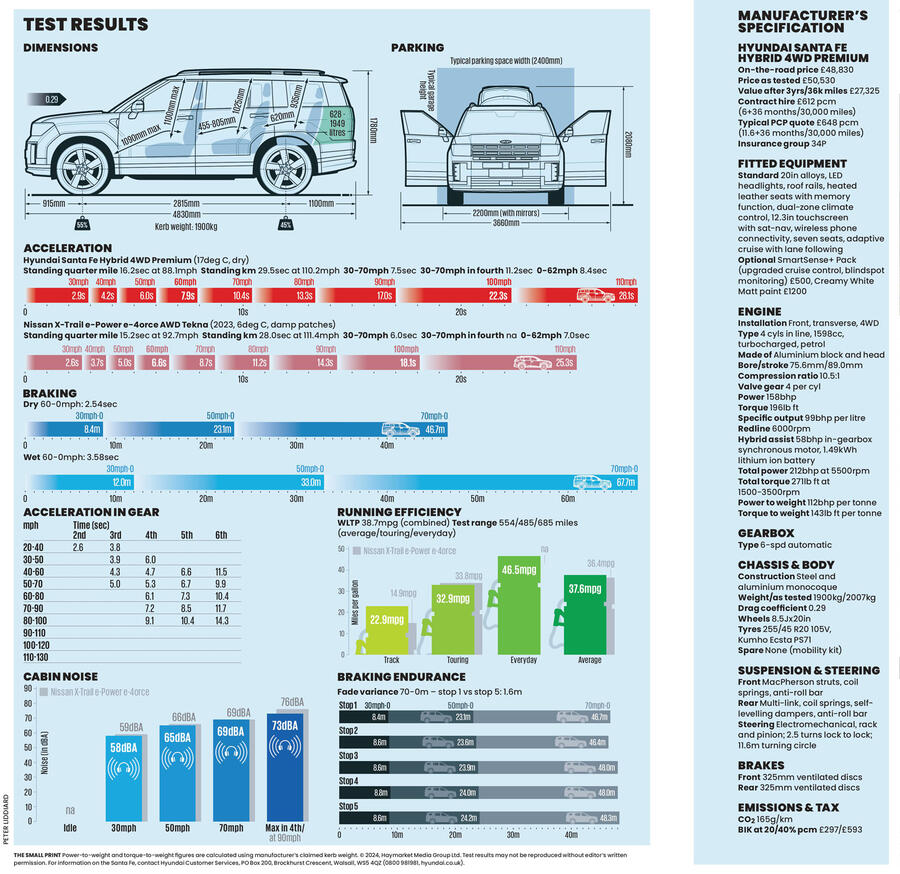
For 2026, the Santa Fe's power output rises from 212bhp to 236bhp, dropping its quoted 0-62mph from 9.8sec to 9.2sec. When we performance tested the 212bhp model, it actually beat it's quoted time by quite some margin, needing just 8.4sec, so we would expect the new version to do the same. Note that the published test data is for the old 212bhp version.
Hyundai has a habit of underrating the performance of its ICE cars. The Kona we tested last year was 0.8sec quicker to 62mph than advertised and this Santa Fe took over a second less. Meanwhile, its EVs struggle to match the claims. Weird.Matt SaundersRoad test editor
Subjectively, though, it's a different story, and the new upgraded version doesn't feel all that different from before. While the timing gear doesn’t lie, the Santa Fe doesn’t actually feel that quick in everyday driving. We have observed similar with other Hyundai and Kia hybrids, and hybrids that are short on electric power in general.
The Hyundai usually tries to set off on the electric motor but, because of its modest power, the engine quickly has to step in. And anyway, with a battery capacity of just 1.49kWh, electric-only running wouldn’t last long anyway.
When the petrol four-cylinder comes in, it does so with plenty of mechanical thrash – the easy mid-range torque you would want in a car like this just isn’t there. The situation is exacerbated by the wide spacing of the six gears, which means that if you demand even moderate acceleration, the engine will rev quite high before going into the next gear.
Wider test experience tells us that the PHEV doesn’t suffer from these issues as much because it benefits from a stronger electric motor. Compared with its peers, however, it could also do with some more electric power and range. It will of course also need plugging in regularly to work properly.
Most of the time, you can drive around the drivetrain’s prickliness by just taking it very easy. Once up to cruising speed, the long gears prove their worth and the engine quietens down. It’s worth remembering that the 5008 Hybrid is similarly afflicted but has less flat-out performance and the Kodiaq 1.5 is hardly over-endowed with grunt either, although it is better behaved under load. The Nissan X-Trail’s e-Power series hybrid system is the most refined in the class but not very efficient.
Braking performance in the dry was as expected, with no notable fade, but a stopping distance of 67.7m in the wet is rather long. Pedal feel in normal driving is nicely progressive, and when not in Sport mode you can use the steering wheel paddles to control the level of regen, which is a nice feature in a hybrid.
The chassis set-up of a heavy seven-seat SUV, particularly one at a price point that doesn’t allow air springs, is a delicate balance. Too soft, and you risk making passengers seasick. Too firm, and you compromise comfort with little gain in driving enjoyment.
In the Santa Fe, it has been struck reasonably well. It’s clearly quite soft overall, so there’s plenty of body roll, but big bumps on choppy roads are ironed out quite deftly, without the whole thing feeling especially floaty.
At the same time, you can fling this car into a corner at relatively high speeds and it will cling on. The steering, while not the most precise, responds intuitively and predictably, and weights up progressively as you load up the chassis. For what it is, the Santa Fe is surprisingly enjoyable down a twisty road.
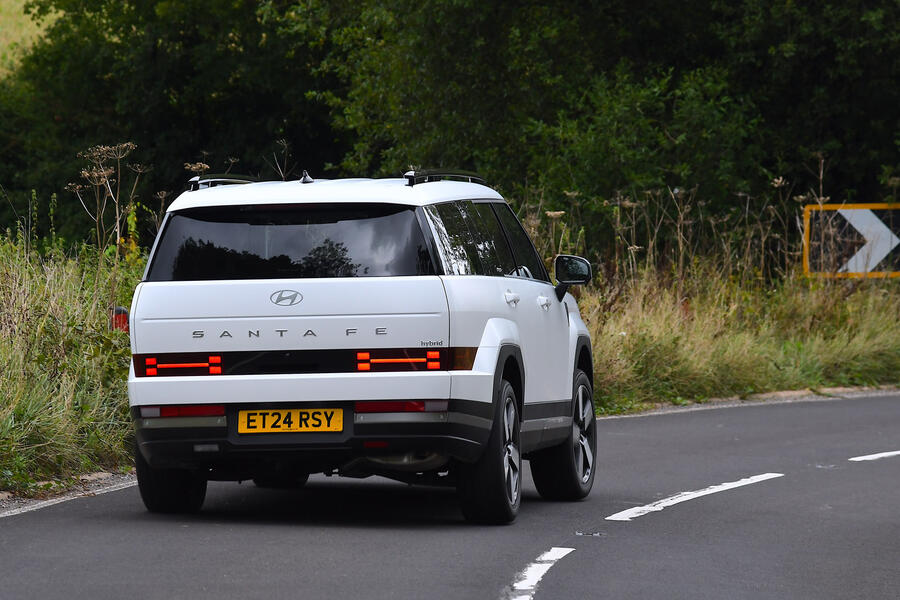
It helps that despite being 2.2 metres wide across the mirrors, it’s quite easy to place thanks to the long bonnet, the square shape and the tall driving position that lets you see the edges of the car.
Our test subject was equipped with four-wheel drive, which on dry roads doesn’t contribute a great deal. However, on a slippery, wet road, it lets the Santa Fe accelerate positively out of tight corners, and it will give the car a degree of off-roadability.
Where there is some room for improvement is in the wheel control. Despite the soft suspension and reasonably tall tyre sidewalls, the wheels tend to thump clumsily through potholes. This is mitigated to some extent in a standard Hybrid car with the smallest wheels. In a PHEV with bigger wheels, the secondary ride is annoyingly tetchy.
Noise refinement is decent but unremarkable at a cruise: 69dBA at 70mph is on a par with the X-Trail. Under hard acceleration, the Hyundai is actually slightly quieter (73dBA versus 76dBA), but it’s the coarse quality of the engine noise rather than the volume that grates.
When our test car arrived, we were greeted with a message on the screen that said an over-the-air (OTA) software update was available. Having left it to do its thing overnight, it announced the next morning a new feature had been added. From that point, we could simply hold the mute button on the steering wheel to disable the overspeed warning.
It’s an excellent use of OTA technology, but in this case it’s also a cure for a symptom instead of the disease. It's continually surprising how Hyundai, a company of substantial engineering means, keeps getting assisted driving so wrong.
The speed limit recognition is incorrect a lot of the time (it’s particularly bad at catching national speed limit signs on motorway gantries) and its warning noise quite intrusive. The lane keeping assistance (also easily turned off by holding a steering wheel button) just can’t deal with country roads that lack centre markings and will randomly yank the steering.
The new Santa Fe gets a camera on the steering column to monitor whether the driver is paying attention, but the system is way too sensitive. Even when turned off (which takes a few taps of the centre touchscreen every time you start the car), it will occasionally complain that the sensor is obscured.
The adaptive cruise control is smoother than on previous generations but still a bit too keen to get on the brakes. It also takes quite a bit of menu diving to get rid of the audible warnings for speed cameras (these stay off) and to stop the semi-autonomous lane following system from coming on automatically with the cruise control.
The Santa Fe is priced from £46,775 for a front-wheel-drive Hybrid in Premium trim. That’s quite a bit more than a Kodiaq, 5008 or X-Trail, but then it does come very generously equipped with three rows of seats, heated leather seats with electric adjustment, keyless entry, adaptive cruise control with lane following and 20in wheels.
Four-wheel drive, like on our test car, adds a further £2055. Even when specced like for like, most rivals are a bit cheaper, however. At £51,885, the PHEV costs another £3055 extra.
The hybrid powertrain proved reasonably efficient, recording an average of 37.6mpg over the course of our test, putting it between the very economical Kodiaq and the disappointingly thirsty X-Trail e-Power. Unlike in some hybrids, the fuel tank is quite large too, resulting in a 554-mile cruising range. The 70mph touring economy came out curiously low and we usually saw better during actual motorway usage. Clearly, it makes good use of its regenerative braking. The updated version from 2026 ought to do slightly better still.
At five years, Hyundai’s factory warranty doesn’t sound as impressive as Kia’s or MG’s. However, that’s still longer than most, and with no mileage limit, it could be worth more for long-distance drivers.
The PHEV version is looking rather behind the times. Like the related Sorento, it offers seven seats and four-wheel drive but at the cost of battery size. With its relatively small 13.8kWh unit, it musters only 33.6 miles of EV range, which puts it in the 12% BIK tax band. Company car drivers would therefore be much better off with longer-range rivals like the Kodiaq or 5008.
As with other recent mainstream Hyundais, the Santa Fe is quite an uneven performer. It handles better than most drivers will ever need it to and is pretty refined at a cruise, but it can’t maintain that refinement away from the motorway, in terms of both comfort and engine noise.
Even with the recent upgrades, the powertrain lets it down. Flat out it’s quite quick, and it musters acceptable economy, but a mild-hybrid Kodiaq is more flexible and uses less fuel.
Facelift fixes? Give the hybrid some more mid-range grunt and get the economy up to diesel level. Improve the ADAS. And add some damping sophistication.Illya VerpraetRoad Tester
Crucially, the Santa Fe manages to score where it matters for a seven-seat SUV. The interior has all the design and material appeal you could wish for and combines it with clever practicality solutions and excellent usability. It’s cavernous too, and that still earns it a recommendation.
As a road tester, Illya drives everything from superminis to supercars, and writes reviews and comparison tests, while also managing the magazine’s Drives section. Much of his time is spent wrangling the data logger and wielding the tape measure to gather the data for Autocar’s in-depth instrumented road tests.
He loves cars that are fun and usable on the road – whether piston-powered or electric – or just cars that are very fit for purpose. When not in test cars, he drives an R53-generation Mini Cooper S or a 1990 BMW 325i Touring.