
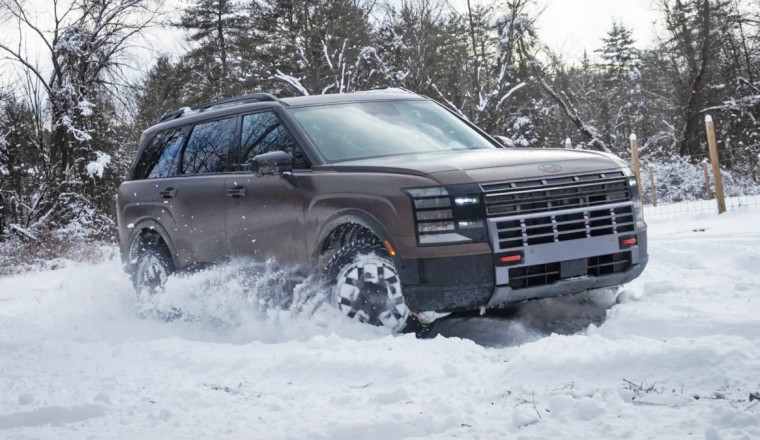

The 2026 Hyundai Palisade XRT PRO was giving me Temu Range Rover vibes when it was first announced. But after living with it for a week, in really rough winter weather, I’m doing a full 180. It’s no knock-off; it’s an awesome SUV and a solid value at its $50,000 list price.
Hyundai’s XRT trim level has basically been an appearance package designed to make some of its SUVs look a little sporty. The new XRT PRO trim, however, which is making its debut here on this Palisade, adds some actual tough-terrain capability with meaty tires and surface-specific traction-control logic.
It’s effectively the minimum viable product as far as an “off-road model” goes, which is exactly the right move for Hyundai here.
The second-gen Palisade is all new for 2026. Like the first model, it’s a large three-row SUV with a modern interior. This is a true three-row vehicle that can carry six people (especially if at least two are kids) and luggage over significant distances in reasonable comfort.
The biggest news for this model is that there’s now an electrified hybrid version, which claims 29 mpg in combined driving—impressive for a brick-shaped behemoth like this.
The main Palisade line, including this new XRT PRO, still runs a good ol’ V6. The new 3.5-liter rated to 287 horsepower and 260 lb-ft of torque, claiming a middling 20 mpg in combined driving. Base-level front-wheel drive versions get slightly better fuel economy, but I’m sure everyone reading this is more interested in all-wheel-drive specs.
The XRT PRO, specifically, is a little worse on fuel, claiming 19 mpg in combined driving, 16 city, and 22 highway. That’s about what I can squeeze out of my 28-year-old Mitsubishi Montero with a light foot and light tires.
Speaking of tires, the OEM 30-inch Continental Terrain Contact A/Ts are the main reason for both the XRT PRO’s enhanced off-road performance and its fuel-economy penalty. They give this model an extra inch of ground clearance over standard Palisades, and of course, a much better bite on slippery surfaces. But they also take more energy to move, steer, and stop than road tires.
The XRT PRO stands out visually with some nice-looking 18-inch wheels, red front and rear recovery hooks, black exterior accents, and a cute, subtle mountainscape sewn into the seats.
I loved the Hyundai Palisade’s ergonomic experience so much that I wrote a whole separate post about it—I really believe that the 2026 Palisade’s interior is pretty much perfect. Read that if you want the deep-dive, here’s a speedrun:
As for the driving experience, it’s not special, but entirely appropriate for a vehicle of this type. Steering is soft but reasonably responsive. Power’s not abundant, but I never felt the bus was too slow. Braking’s adequate, and at speed limit-ish speeds, I found nothing to complain about.
The surround-view camera is gloriously high-resolution, making it quite simple to park and maneuver around pedestrians or pets.
At night, headlights drench the world in front of you in light.
The sunroof is disappointingly small, which, whatever. The only real complaint I had with the Palisade’s driving experience is road noise. It’s actually pretty loud in the cockpit, even at 55 mph. Not a dealbreaker at this price, but it definitely breaks the “this is just as good as a Land Rover” spell.
Without overly gushing over the Palisade’s interior layout again, I’ll just call out how excellent the digital displays are. They’re both crisp and pretty without doing too much or not enough. Some modern cars have giant screens with minimal information, while others clutter their UI with decorative imagery. The Palisade cuts the perfect balance—highly legible screens that look great and make excellent use of their digital real estate.
I also really liked the comfort level of the seats in this thing, and its overall look. The XRT PRO wheels are awesome; the little Pikachu-ears spoiler over the tailgate adds a nice splash of personality.
The protruding exterior door handles are easy to grab with heavy gloves on and look good.
Only one thing visually turns me off—the XRT PRO badge on the back. It looks like a puffy sticker from a mediocre toy. This is not as bad as the die-cut stickers Ford uses for its Bronco trim emblems, but it detracts from the vehicle’s otherwise impressive appearance. Hyundai could have spent a few extra cents per unit to make that more appealing.
I described the XRT PRO as a “minimum viable product” for an off-roady model in the intro, and now I get to discuss what that means, why it makes sense for Hyundai, and what this vehicle’s realistic capabilities and limitations are.
The short story is: This rig can work magic on slippery surfaces, making it great for people who want an SUV to get through awful weather, dirt roads, and even soft sand. But I wouldn’t trust it against the kind of hard impacts you need to expect on trails.
The Terrain Mode Select system optimizes traction control for mud, snow, or sand and comes standard on all all-wheel-drive V6 Palisades. In addition to its aggressive tires, the XRT PRO’s unique rough-terrain traction trick is its electronic limited-slip differential (eLSD).
The eLSD is a multi-plate clutch pack that uses an ECU to monitor wheel sensor inputs and identify when a certain wheel needs torque to enhance grip. The practical advantage of Hyundai’s system over brake-based torque vectoring, which you often see in soft-roaders, is that it’s proactive rather than reactive. It can lock the rear axle before the driver feels slippage, helping maintain momentum, which is critical for progressing through slippery terrain.
That piece of hardware, combined with good tires, gives a Palisade XRT PRO driver an appreciable advantage in bad weather without adding much weight to the vehicle.
I also absolutely love the off-road display mode you can call up on the infotainment screen. It is simultaneously cool-looking and practical, giving you useful info like trans temp right there next to your pitch-and-roll and traction indicators.
Now, for the weak spots.
Underbody protection is nonexistent. Since the vehicle’s also quite long and low (it still has under nine inches of clearance, even with 30-inch tires), that’s a real danger vector if you find yourself on a rocky, uneven trail.
And while I was climbing under the Palisade, I noticed a lot of components that are, well, light-duty. The tie rods are tiny. Control arms are spindly. That’s all fine for road use. In fact, you want all that stuff to be as light as possible for normal driving.
But real wheeling puts a lot of stress on those components. As such, I could see the Palisade XRT PRO putting you in an “it’s fine until it’s not” situation on an off-road expedition. A severe impact that might bend the lower control arm on a 4Runner (bad, but you might still be able to make it to a trailhead) could snap that same component on a Hyundai and leave you stranded.
Granted, this is an ocular pat-down, not a metallurgical analysis. But I’ve broken enough vehicles to have a decent sense of what can take a whack and what can’t.
All that said, heavy underpinnings and armor plating cost weight. Weight costs efficiency and yields crappier driving dynamics. Ultimately, I think Hyundai made the right choice by not saddling the XRT PRO with hardware that would let it keep up with more serious off-roaders. The trade-off doesn’t make sense for how this thing’s going to be driven.
As a professional car critic, few things make me happier than a pleasantly surprising vehicle. And the Palisade XRT PRO really put a big smile on my face.
Hyundai has created a nice package that offers a lot of luxury and capability for the money. It doesn’t have the refinement or ruggedness of a Land Rover, but it offers drivers practical storm-beating benefits in a great-looking vehicle that’s very pleasant to ride in. I loved it, and I think Hyundai’s product planners should be proud of how well they threaded the needle between “capable” and “cost-effective” here.
And hey—if you end up buying one and want to address the shortcomings discussed above, you could definitely improve fuel economy by switching to road-bias tires while still taking advantage of the eLSD. And if you want to be able to get a little braver off-road, you might be able to add even a slightly taller tire. You could even have your own skid plates custom-made and mounted. Not trivial, but certainly possible with some research and measurement-taking.
Good luck out there!
Awesome all-weather SUV for big families, and a particularly cool addition to Hyundai’s lineup.
Hyundai provided a one-week loan of the vehicle for this review.
Automotive journalist since 2013, Andrew primarily coordinates features, sponsored content, and multi-departmental initiatives at The Drive.
- Car Reviews
- Hyundai Reviews

Car Buying Service