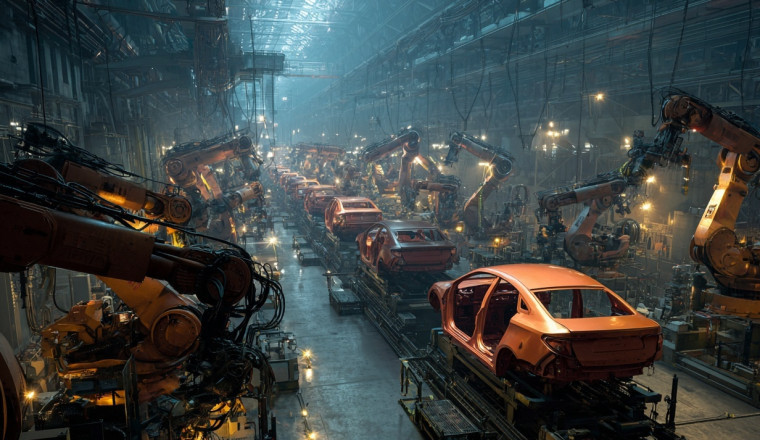

A dark factory is a manufacturing facility where machines handle every aspect of production without human intervention, eliminating the need for human centric infrastructure, including lighting, heating, air conditioning, break rooms, and other worker accommodations. The term refers to the literal absence of lighting needed for production, as robots and AI systems handle all tasks using sensors, infrared cameras, LIDAR, and machine vision that don't rely on visible light. Inside these eerily quiet plants, robotic arms weld, cut, and assemble products nonstop while fleets of autonomous vehicles deliver materials across factory floors without human oversight.
China installed 290,367 industrial robots in 2022, representing 52 percent of the world's total. By 2023, China's robot density reached 392 robots per 10,000 manufacturing workers, surpassing the global average of 141. State backed investments exceeded $1.4 billion in robotics research and development in 2023, creating the infrastructure for what amounts to an industrial revolution without workers.
The results are spectacular. Xiaomi operates a $330 million factory in Beijing spanning 81,000 square meters and capable of producing 10 million smartphones annually, with 11 robotic lines operating continuously and managed by the company's proprietary HyperIMP AI system that can manufacture one smartphone every three seconds with zero human involvement on the production floor. Jetour's Fuzhou facility produces SUVs with near total automation using over 300 robots that carry out welding, painting, tire installation, and even CNC bonding of windshields, building a car every 100 seconds.
Gree Electric Appliances collaborated with China Unicom and Huawei to transform its Gaolan factory in Zhuhai into what they describe as the world's largest 5.5G lights out factory, reportedly increasing production efficiency by 86 percent. Foxconn replaced 60,000 workers with robots in a Kunshan factory in 2016 and plans to automate 30 percent of its operations by 2025. BYD uses robotic systems for EV battery and chassis assembly in plants in Shenzhen and Xi'an.
The energy savings justify part of the cost. The International Energy Agency estimates that such automation can lower industrial energy use by 15 to 20 percent by removing human centric infrastructure needs. China's National Bureau of Statistics reported a 1.7 percent drop in industrial energy consumption in 2022, partially due to increased automation. Without requirements for lighting, climate control, or safety equipment designed for human workers, these facilities operate with dramatically reduced environmental footprints.
But the human cost is substantial. Manufacturing employs over 100 million people in China, and automation threatens widespread job losses, with Oxford Economics projecting in 2017 that 12 million Chinese manufacturing jobs could be lost to robots by 2030. A 2023 strike in Guangdong highlighted worker fears of robotic replacements, underscoring potential social unrest if retraining programs lag.
The push for dark factories aligns with China's Made in China 2025 strategy, an initiative launched to make the country a leader in high tech manufacturing. Other nations are responding. The US had a robot density of 274 per 10,000 workers in 2022, while Germany reached 415, but both trail China's momentum and state backed investment.
While factories in some countries may be fully or nearly automated, experts say that's going to be less common in the US for the near future, with American manufacturers pursuing gradual automation rather than building entirely new dark factories. Tesla's heavily automated gigafactories come closest to the dark factory concept, with the company reporting 90 percent automation at its Nevada plant and even higher in China.
While the concept originated in Japan with Fanuc's automated lines in 2001, China has aggressively scaled it in the 2020s, positioning itself as a global leader in industrial automation. The scale and speed of deployment separate pilot projects from industrial reality. China isn't testing the concept. It's implementing it at a pace that makes Western manufacturing look like it's standing still. The factories run in darkness because nobody needs to see what's happening. The machines know exactly where they are.