

The Audi Formula 1 Team hasn’t turned a single lap of pre-season testing—let alone packed the containers headed to the Australia Grand Prix—but it has already halted the development of its 2026 drivetrain.
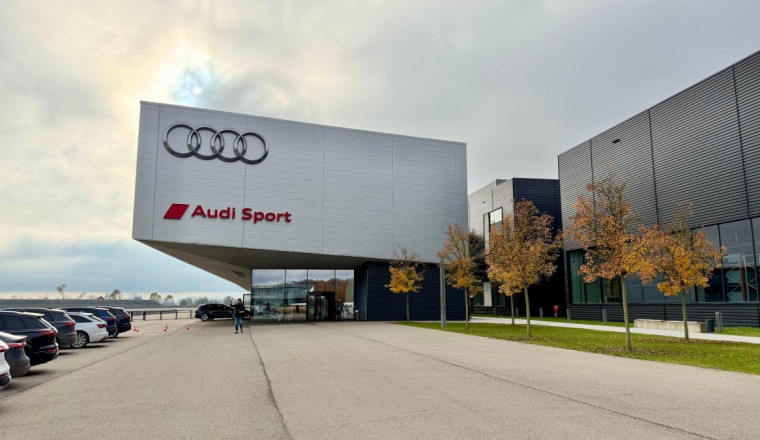
During a tour of the newly expanded Audi Sport complex in Neuburg, Germany, where the internal-combustion and electrical components for the new F1 power unit are made, The Drive learned that despite being in a race against the clock to have everything ready for the maiden race, the facility’s 430 employees are primarily focusing on the team’s sophomore and junior years in the series.
“Development of the 2026 drivetrain has concluded, and we’re already focusing on 2027 and 2028, Audi F1’s Chief Technology Officer Stefan Dreyer told The Drive. “Development of components truly never stops in Formula 1, but considering the limited amount of data valuable to us from the current Sauber and Ferrari setup [and the 2026 regulation changes], we’re looking past our first year now.”
Dreyer explained that, despite Audi’s purchase of Sauber and most, if not all, of its assets, the drivetrain IP belongs strictly to Ferrari, and not a single line of data is shared with Sauber itself, let alone Audi. He described the arrangement as a “Chinese wall,” implying that all data gathered by the team from this and previous seasons is not shared with the new drivetrain team. Even if it did, it’s unclear how useful it would be due to the incoming regulations.
When asked how engineers can focus on improving something that hasn’t been tested yet—given that there is still no real data from real driving on real tracks—Dreyer admitted that it was a challenging situation they found themselves in. He explained that they’re relying on simulator testing and will obviously be working double-time as the cars start racking up miles in Spain at the end of January, and then in Bahrain mid-February.
I asked Dreyer what the Neuburg team will be focusing on for the time being since the 2026 development is wrapped up, and he simply said, “manufacturing.” The team will need to stock up on vital components ahead of embarking on a grueling season around the globe, which begins in January with pre-season testing and ends in December with the Abu Dhabi GP.
The Neuburg facility has been in existence for some time, but it recently underwent a sizable and extremely expensive remodel and expansion to accommodate the new F1 facilities. Dreyer led me and a select group of media through the complex, though, like most assembly facility racing or otherwise, any photography or recording of any kind was prohibited. What I can tell you, however, is that after having been inside Ferrari’s Gestione Sportiva in Maranello (F1 HQ) and most recently, McLaren’s Technology Center in Woking, I can assure you that Audi’s facilities are first-rate and no expense has been spared.
Dreyer did not divulge a number for the investment made in Neuburg, though he laughed and said he “did not want to think about the number.” That said, later that evening, when I asked the same question to Audi AG’s Finance boss, the answer was “a three-digit-million amount.”
Got a tip? Email us at tips@thedrive.com
As deputy editor, Jerry draws on a decade of industry experience and a lifelong passion for motorsports to guide The Drive’s short- and long-term coverage.