

► What’s next for Renault?
► How the 500bhp Turbo 3E fits in
► What it can learn from Stuttgart
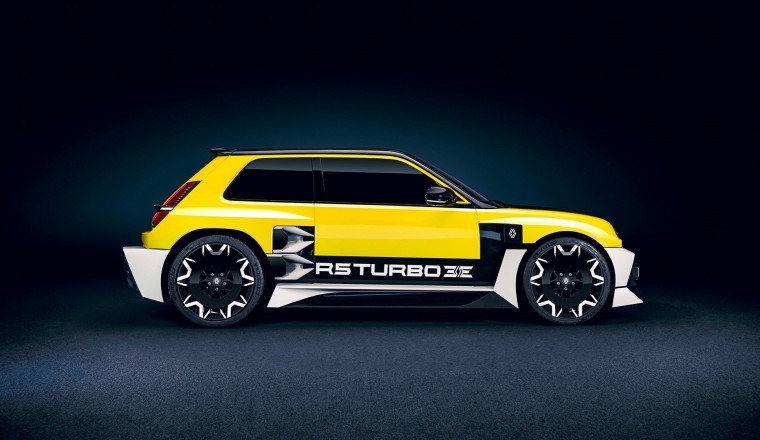
You thought the Renault 5 was cool? Meet the rear-wheel-drive, all-electric, 500bhp Renault 5 Turbo 3E. It’s part of a confident new phase for Renault – the brand and the wider group – as it builds on recent successes.
The 5 Turbo 3E is a production car that Renault calls a ‘reinterpretation’ of the original 1980 Renault 5 Turbo and the later Turbo 2. It follows on from the Turbo 3E concept that we saw at the Paris Motor Show in 2022, which celebrated the 40th anniversary of the original Turbo 2 with a caricature of the Turbo style cues, wrapped around a 42kWh battery and powertrain set up for huge performance and gymkhana-style drifting ability.
While the Pikes Peak-style wing of the concept has gone, this production 5 Turbo 3E keeps plenty of that butch caricature design. Renault will produce 1980 examples, which use a bespoke platform and carbon composite body, with two in-wheel motors at the rear to cover 0-62mph in under 3.5 seconds.
‘The Turbo 3E hops between inspiration from the original R5 Turbo, and the new Renault 5,’ explained Sandeep Bhampra, Renault’s chief designer advance design. ‘The dimensions are key to the design, too. The body is over 2.0 metres wide, so it’s supercar width. It also has the performance to back that up; it’ll be a drift champion.’
There are plenty of neat details, from the facia that nods to the regular 5, to the vast rear diffuser and air scoops, one of which houses a hidden charging socket. Details of what battery will power the Turbo 3E are undisclosed, but it’s safe to assume that it’ll be a mid-sized li-ion NMC battery offering the best possible energy density, given that we were told that this will be one of the lightest EVs on the market.
Renault remains close-lipped on further details, including the range, price and when the Turbo 3E will go on sale. Given that various company executives referenced cars like the Audi R8 and Porsche 911 as rivals, we wouldn’t be at all surprised if the 5 Turbo 3E comes in at £150,000 or more; not unreasonable for a collector’s car like this.
The 5 Turbo 3E may well go on sale at a similar time to the new Alpina A110 – a very different kind of electric performance car expected to arrive in 2026. Former Renault Group CEO Luca de Meo told CAR in 2025: ‘The A110 will be lighter than a comparable combustion-engine car, and for performance there will be no comparison.’
De Meo went on to explain that Alpine will launch at least one new model each year up until 2030, but that the A110 would use its own platform. Sounds like an expensive way to go about business, especially when Dacia in particular has thrived by re-using Renault hardware. De Meo’s thinking big, though: ‘We look at Porsche as inspiration. They do the 911 on its own platform and then they share platforms for other models.’ That’s reflected in the Alpine A290, which shares the Renault 5’s platform, and the forthcoming A390 fastback that shares the Renault Scenic’s AmpR Medium platform.
What will the electric A110 will look like? Nobody has seen the final car yet, but we know it will have the distinctive twin, round headlights of the existing A110 and will have evolutionary design.
‘Would Porsche make a square 911?’ de Meo pointed out. ‘No. Great brands nurture their classics. It doesn’t have to be about performance cars but it has to be about emotive cars.’
Key to the evolution of both Renault and Alpine is its battery technology. Currently, Renault uses lithium-ion NMC batteries in most of its EVs, with lithium-iron phosphate LFP batteries powering Dacia models and the more affordable versions of the Renault 5. It was announced this summer that Renault’s battery and EV development company, Ampere, was introducing cell-to-pack and LFP technology from 2026 and would assemble the batteries at the ‘Ampere ElectriCity’ in Douai, France.
We’d speculate that the cell-to-body tech could even make an appearance on the A110 and Turbo 3E, given that these are the company’s weight-saving champions and would warrant the latest, most expensive battery tech. Added to this is another key aspect of the company’s battery tech evolution is the falling cost of NMC technology.
‘NMC efficiency is the most important thing, right now,’ Phillipe Brunet, SVP of powertrain and EV engineering at Ampere, told CAR. ‘We have a lot of discussions about whether we focus on longer range, or smaller batteries with better efficiency and faster charging. We also expect NMC battery cell costs to come down to the same as LFP cells by 2028, which affects decisions we must make. As for solid state? There are a couple of steps before we get to solid state, which we won’t see before 2030.’
This is critical not only as it potentially means more efficient electric cars at lower prices, but also that it may give manufacturers a fraction more wriggle room to carve out profit margins in the more affordable electric cars. It’s no secret that plenty of brands are currently making a loss on cheaper electric cars, but with the ZEV mandate forcing manufacturers to have EVs accounting for 28 per cent of their sales in 2025 (33 per cent in 2026), or face crippling fines. More electric car sales also means more petrol car sales, as one company source said.
Like this? Get more CAR delivered to your browser! Click here to add CAR Magazine as a preferred source on Google.
Overall, the Renault Group is in better shape than most to weather the troubled industry, not least thanks to the instant success of the Renault 5. Since it went on sale in France (the first market to receive the 5) in the last quarter of 2024, Renault’s share of the electric car market in its home country has risen from 16.8% to 23.3%, in the space of a couple of months. Significant early demand suggests similar levels of success to come in a lot of other markets, the UK included. It’s been extremely well received for its bold design and highly rated by road testers – check out the new EV ranking on CAR’s Apple News+ channel for confirmation.
De Meo wasn’t finished with his plans yet: when asked whether Renault was now the innovative brand he wanted it to be, the answer was ‘not yet, no’. Let’s see what happens under the new boss.
Even so, the Renault Group now has bases covered (or soon to be covered) from the ultra-affordable electric hatchback to the family SUV, the purist sports car and all the way up to the collectable retro-modern supercar. In industry terms, former chief Luca de Meo’s ‘Renaulution’ plan has transformed the French brand; problem child to poster child in just a few years.
By Vicky Parrott
CAR contributor, long-time road tester, COTY juror and keeper of a shabby old SL