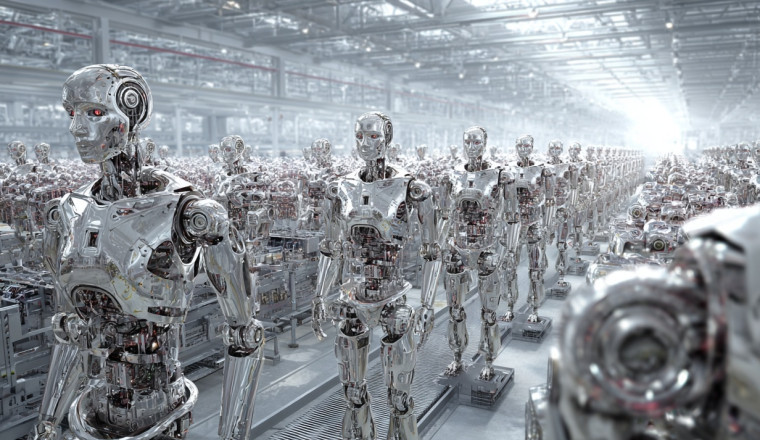

Elon Musk dropped two words on Twitter that sent robotics experts scrambling for their textbooks: "Von Neumann machine." He was talking about Tesla's Optimus robot, and if he means what mathematicians think he means, we're looking at a future where robots build robots without any human hands touching the assembly line.
The reference comes from John von Neumann, the Hungarian mathematician who in the 1940s theorized about machines that could construct perfect copies of themselves. Not repair themselves or upgrade themselves, but literally build new versions using raw materials from their environment. Von Neumann's concept required four components working in harmony: a constructor to build things, a copier to duplicate information, a controller to manage the process, and what he called a universal constructor that could build anything given the right instructions.
Tesla's Optimus robots currently walk around, pick up objects, and perform basic tasks. The second generation prototype demonstrated in December 2023 showed improved dexterity and mobility, but these machines are nowhere near constructing copies of themselves. The gap between folding laundry and manufacturing precision robotics components spans decades of technological development.
But Musk's comment suggests Tesla is thinking bigger than household chores. The company has stated goals of producing millions of Optimus units, and traditional manufacturing methods hit bottlenecks when human workers need to assemble complex robotics. If robots could build robots, those bottlenecks disappear entirely.
The economic implications make traditional automation look quaint by comparison. Manufacturing costs could plummet when the most expensive component, human labor, gets removed from robot production entirely. A single facility could theoretically scale from producing hundreds of robots to hundreds of thousands without hiring additional workers or expanding floor space significantly.
Like this? Get the app: iOS | Android
This creates what economists call exponential scaling. Instead of linear growth where doubling production requires doubling resources, self replicating systems could theoretically double their numbers using only raw materials and energy. The mathematics become staggering quickly. One robot becomes two, two become four, four become eight, and within twenty cycles you have over a million robots.
The automotive industry provides the clearest example of what this could mean. Tesla already uses extensive automation in vehicle production, but final assembly still requires human workers for complex tasks. Optimus robots capable of building other Optimus robots could eventually handle every aspect of car manufacturing, from stamping body panels to installing interior components.
Labor economists studying automation impacts typically focus on job displacement happening gradually over years. Von Neumann style robot replication could compress that timeline dramatically. Manufacturing employment could shift not over decades but potentially within years once the technology reaches viability.
The technical challenges remain enormous. Self replicating machines need to handle materials science, precision engineering, quality control, and supply chain management without human intervention. Current AI systems struggle with tasks far simpler than coordinating the thousands of components needed to build functional robotics.
Robotics researchers at MIT and Stanford have been working on self assembly and self replication problems for years, but their most advanced systems can only replicate simple structures or perform basic manufacturing tasks. The jump to full robot construction requires breakthroughs in multiple fields simultaneously.
Control mechanisms become critical in any self replicating system. Von Neumann himself recognized that without proper safeguards, self replicating machines could potentially consume available resources indefinitely. Science fiction explores these scenarios regularly, but the mathematical realities create genuine concerns about maintaining human oversight over exponentially scaling production systems.
Whether Musk actually means true von Neumann replication or simply robots assembling other robots using human designed manufacturing processes remains unclear. The distinction matters enormously. Robots following predetermined assembly instructions represent advanced automation. Robots capable of constructing functional copies of themselves represent something categorically different.
Tesla's track record with ambitious timelines suggests caution about any near term von Neumann capabilities. The company has consistently delivered innovative products while missing initial deployment targets by years. Full self driving capabilities, originally promised for 2017, remain in testing phases. Optimus robots building Optimus robots likely face similar timeline realities.
For now, Musk's comment remains more aspiration than technical specification. But the implications of genuine self replicating robotics extend far beyond Tesla's manufacturing goals. When machines can build machines without human intervention, the fundamental economics of production change forever.
Sources: John von Neumann's "Theory of Self-Reproducing Automata" (1966), Tesla Optimus demonstrations and technical specifications, MIT and Stanford robotics research publications