

► High-RPM road car engines hit a high
► Why development is increasing
► What challenges do they bring?
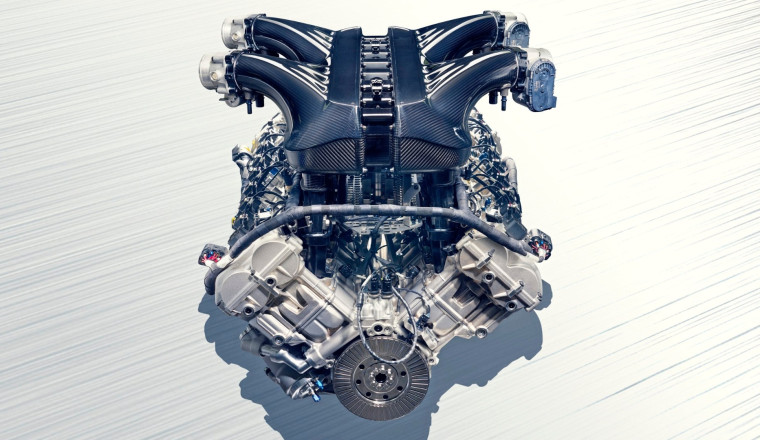
One of the more surprising trends in road engines has been the rapid increase in engine speeds. Porsche’s GT3, various Ferraris and Lamborghini’s Temerario are all in a select club offering 9000rpm or higher redlines. Bugatti’s new Cosworth-aided Tourbillon V16 has joined them. The Aston Martin Valkyrie and GMA’s T.50 and T.33 are even more extreme. Restomod engines have also steadily pushed up their rev ranges.
We have had high-speed engines in motorsport and in motorcycles for years – so why has this begun to happen for road cars only now?
For enthusiasts the desire for more power is a constant, never going away, however much they already have. Since power is essentially torque times engine speed, increasing either will get you more of it. You can get more torque either through increasing displacement or by boosting (or both), but revs are more difficult and a signifier of engineering excellence. Hence some car makers are determined to go higher, whatever the challenges.
Meeting those challenges has always been very tough, and costly too. Look at the high-revving Formula 1 cars of the 1990s. They involved components made from expensive materials, using expensive machining and assembly techniques, and they were replaced frequently. Finite element analysis (FEA, which calculates an object’s likely lifespan) was in its infancy then, so engineers tended to be conservative, erring on the side of caution in how they would ‘life’ a critical component, rather than be over-optimistic and face dire consequences.
And on the road, where it’s not realistic to replace components so frequently, high-revving engines were truly exotic. Very few manufacturers rose to the challenge, most notably Honda with the S2000, and
BMW with the E46 M3.
I’d claim that engineering high-performance engines for the road is far harder than building pure race units. My argument is that F1 engineers are highly constrained by the regulations. A race engine does not have to meet any emissions limits, and so doesn’t have any of the kit required for road cars.
I know what I’m talking about. I have experience as an engineer for both race and road cars (okay, so my racing experience is not recent, but I was in F1 ‘back when it was interesting’). And like pretty much everyone working in automotive engineering, I was fascinated by the horrors Mercedes went through with the AMG One. The fact that it took so long to get it into production, despite their immense resources and experience, was essentially down to the difficulties of passing road emissions with an F1-derived engine – they walked straight into this, and everyone I know with road experience just sat back and enjoyed the show, my point proved.
That said, there have definitely been some benefits flowing in the other direction, from racing to road. Topflight motorsport’s ever-tightening durability rules have had a major effect in pushing up the life of their powertrains. This has driven improved methods in general and the development of engineering tools in particular. FEA has steadily improved, enhancing component design: parts can be made stronger and lighter – both important in reaching high revs safely.
And in mass production, ‘digital twins’ – where work on a virtual replica happens simultaneously with realworld testing – is becoming the norm. There’s a continuous looping of developments: experience in the real world is fed into the software, and learnings from the simulations lead to tweaks of physical prototypes.
Materials have markedly improved too. Composite reinforced parts have come into production – including even cylinder blocks and pistons. Pistons with steel ring carriers allow a shallower distance between the top of the first ring groove and the piston crown, to the benefit of mass and hydrocarbon emissions. Steels have improved, and we regularly use titanium in the valvetrain to allow higher revs there. Controlling friction – a particular challenge for high revs – has also come on in leaps and bounds as materials and tribology (the science of friction and lubrication) have improved.
Combine all of these mechanical and materials developments and you come to a point where high revs, and the forces they produce, can be mastered far more easily than in the past.
I’ll give the example of connecting rods. When I was just starting out as a Lotus development engineer, on the original Corvette ZR-1 engine, it was part of the normal sign-off to conduct extended high-frequency ‘pull tests’ (applying a force to test a material’s strength) to gain confidence in the fatigue strength of conrods. It was laborious and expensive, but vital. Now, however, we are at a point where rods can be designed and made in (comparatively) utter confidence, with their individual component-level sign-off rarely requiring dedicated tests – they are signed off as and when the complete engine assembly passes its firing durability tests. Similar points can be made about the rest of the cranktrain components – crankshaft, pistons, flywheel, etc.
We now have a very clear understanding about what it takes to confidently get to high engine speeds. But in reality that’s the easy bit, and this is where we return to my contention that doing a roadgoing high-output engine is harder than one for racing. This is because, as well as being mechanically safe, a road engine also has to be durable and affordable, and most importantly, it has to emit cleanly – there are zero waivers on that.
Here is where the importance of ever-improving control systems comes in. Rapid cam phasers allow optimisation of cam timing with respect to driveability and emissions. Exhaust gas recirculation helps too, as does very tight and fast control of the air-fuel ratio. Don’t forget, direct injection as we know it started in road engines and then migrated to racing.
Cold-start strategies have developed massively: since an emissions test is fundamentally passed or failed in the first 20 seconds or so you have to get the catalyst ‘lit’ in this time. That’s extremely difficult, demanding enormous computing power, not previously available.
Another enabler of higher engine speeds has been the steady rollout of automatic gearboxes, and especially high-speed dual-clutch transmissions. We used to have to engineer in overspeed protection for valvegear because of mis-slotting manual gearboxes. Now, control systems stop that happening, so there’s no longer any need for the extra headroom we traditionally built in: revving 20 per cent above the redline was usually possible without blowing the valvegear. Removing that slack has tightened up cam profiles, to the benefit of emissions.
A brief word about restomods. They modify already registered cars so the emissions challenges are nowhere near as difficult. Modifiers can benefit from all of the low-volume suppliers’ experience and know-how in racing, and can afford it all because of the high prices of their conversions. They also benefit from having a small, enthusiastic cohort of customers who likely don’t use their cars hard and/or a lot, greatly mitigating the chance of in-use failure – and if that does happen they can manage the situation on a one-to-one basis. I am not denigrating what has been achieved by some of these companies – by heck, I’d love a Singer-reimagined Porsche, for instance – but it’s just that, like racing, they work in another world to mass-production road cars.
Now that Cosworth has shown that it is possible to confect fully-homologated road engines with redlines over 11,000rpm, it’s tempting to believe a new bar has been set for the others to meet. Yes, Cosworth’s experience is a translation from F1 back in the day, but the challenges are still very modern ones. If electrification doesn’t kill it first, let’s hope that the internal combustion engine can continue to evolve. Faster!
Jamie Turner is a specialist in automotive propulsion, having spent a career in the area spanning industry and academy. He spent 28 years in the auto industry, with over 21 working at Lotus Engineering, where he led Powertrain Research for a decade.
By Jamie Turner
Specialist in automotive propulsion, having spent a career in the area spanning industry and academy