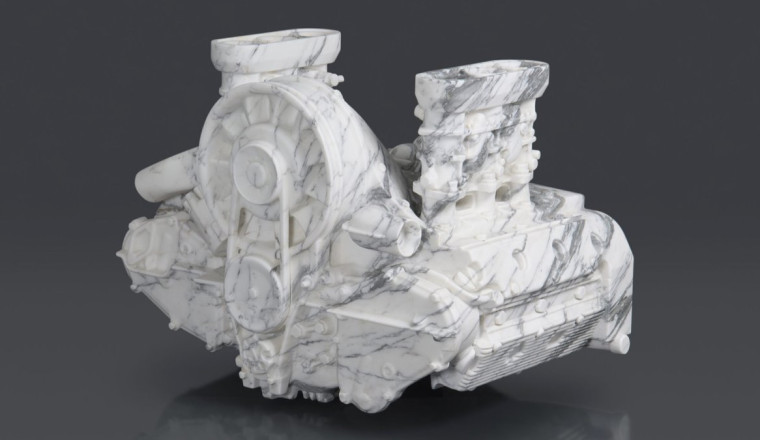

Jelle Braat carves Porsche parts from marble. Not moulds for casting, not decorative interpretations, but meticulously accurate reproductions of 911 components rendered in stone. A Fuchs wheel, complete with the correct five-spoke pattern and centre lock. A front bumper with proper curvature and mounting points. An entire flat-six engine, cylinders and cooling fins intact, frozen in Carrara marble.
The Dutch artist has spent the past five years building a collection of air-cooled 911 sculptures, documented on his Instagram account where 47,000 followers track his progress. Each piece takes weeks or months to complete, carved from blocks of Italian marble using traditional hand tools alongside modern diamond-tipped equipment. The results blur boundaries between automotive parts and fine art.
"I've always been fascinated by everyday objects elevated through craft," Braat explained in a 2024 interview with Dutch design magazine Frame. "Porsche represents the intersection of engineering and aesthetics. Their parts possess sculptural qualities even before I touch them. My role is revealing permanence in objects designed for motion and wear."
His process begins with measurements and photography of genuine parts, often borrowed from Porsche specialists or classic car enthusiasts. He creates detailed drawings, identifying angles and proportions before selecting marble blocks. The initial roughing uses power tools, removing bulk stone to establish basic forms. Refinement follows with chisels, rasps, and patience, gradually exposing details like bolt holes, ventilation slots, and surface textures.
The Fuchs wheel, one of his earlier Porsche pieces from 2021, demonstrates his approach. The iconic five-spoke design, standard on countless 911s from the 1960s through 1980s, translates remarkably to white Carrara marble. Braat preserved the dished profile, the hollow spokes, even the Porsche crest centre cap. Weighing approximately 30 kilograms compared to the aluminium original's 8 kilograms, the marble wheel serves no automotive purpose yet captures the design's essence.
His 2023 engine sculpture pushed ambition further. A complete flat-six from a 1970s 911, carved as a single piece of stone, required eight months of work. Every cylinder fin, every cooling passage, every mounting bracket appears in marble. The result sits on a custom plinth in a private collection, purchased for an undisclosed sum rumoured to exceed €40,000 according to Dutch art publication Kunstbeeld.
Braat studied sculpture at the Royal Academy of Art in The Hague, graduating in 2015. His early work focused on classical subjects and abstract forms before shifting toward contemporary objects around 2019. A commission to reproduce a client's vintage motorcycle tank sparked the transition, revealing how familiar mechanical objects could surprise viewers when rendered in unexpected materials.
"Stone carries historical weight that metal doesn't," he told Frame magazine. "A marble engine suggests archaeological artifact, something excavated rather than manufactured. It makes you reconsider the object's cultural significance beyond its function."
The Porsche obsession emerged naturally from his automotive interests. Braat owns a 1978 911 SC, purchased partly as research material and partly from genuine enthusiasm. He photographs components during maintenance, studies how light plays across surfaces, and occasionally borrows parts for extended periods to capture measurements. His Instagram feed alternates between workshop progress shots and drives through Dutch countryside in the silver 911.
Other contemporary artists explore automotive themes through different media. Richard Phillips paints glossy, hyperrealistic car imagery. Cynthia Greig photographs abandoned vehicles in surreal contexts. Robert Longo creates massive charcoal drawings of cars and engines. Braat's three-dimensional approach occupies different territory, transforming functional components into sculpture through material contradiction.
His work has attracted attention from Porsche itself. The company's museum in Stuttgart contacted him in 2023 about acquiring pieces for their collection, though negotiations apparently stalled over pricing and exhibition terms. Braat declined to discuss specifics when asked by Dutch newspaper NRC Handelsblad, saying only that "institutional collections move slowly, and I'm content selling to private collectors who genuinely appreciate the work."
Pricing varies dramatically depending on size and complexity. Smaller pieces like door handles or gear knobs sell for €3,000 to €5,000 through galleries representing Braat in Amsterdam and Brussels. Major components command significantly more. The engine sculpture represented months of labour and hundreds of kilograms of premium marble, justifying its five-figure price to collectors willing to pay for automotive art.
Whether he'll complete an entire car remains speculation fuelled by his growing parts inventory. Beyond Porsche components, he's produced a marble door, front bumper, engine cover, headlight, dashboard segment, and various trim pieces. Assembling them wouldn't create a functioning vehicle, obviously, but the installation possibilities intrigue curators and collectors.
"A full car would be conceptually interesting," Braat acknowledged on Instagram in response to follower questions. "Whether it's practically achievable is another matter. The engineering challenges of supporting multiple tonnes of marble in car-shaped configuration are substantial. But I'm accumulating parts, so we'll see."
The air-cooled focus proves deliberate. Modern Porsche designs, with their complex curves and integrated electronics, lack the mechanical clarity of vintage models. Early 911s reveal their engineering through visible components: separate bumpers, bolt-on panels, exposed engine architecture. These qualities translate well to sculpture, where viewers can comprehend form and function simultaneously.
Braat's workshop in Utrecht contains blocks of marble in various stages of transformation. Some still bear quarry markings from Italian suppliers, others show emerging shapes as stone yields to tools. Dust coats every surface despite extraction equipment, the inevitable byproduct of subtractive sculpture. Finished pieces await collection or shipping, wrapped carefully for transport to galleries and private buyers.
His next project involves a complete 911 door, hinges and window mechanism included, carved from black Belgian marble rather than his usual white Carrara. The darker stone will emphasise shadows and depth, highlighting the panel's curves and engineering details. Completion is expected sometime in 2026, assuming no interruptions or commission work.
Not everyone appreciates the concept. Online comments occasionally question whether marble car parts constitute legitimate art or elaborate craftsmanship. Braat seems unbothered by the debate, posting new work without commentary or justification. The pieces speak adequately without artist statements or theoretical frameworks.
For Porsche enthusiasts, the sculptures offer a different appreciation route. These aren't parts to install or restore. They're permanent tributes to designs that defined automotive culture, removing functionality to emphasise form. A marble Fuchs wheel will never corrode, never crack, never wear out. It simply exists, beautiful and useless, exactly as the artist intended.