

The Breakdown
- The Kia EV2 comes with two battery options: 42.2 kWh and 61.0 kWh.
- It has a maximum range of 278 miles (448 kilometers) in the WLTP cycle.
- Kia claims a 10 to 80 percent charge in 29 minutes.
The glory days of traditional auto shows are long gone, but that doesn’t mean automakers are completely ignoring the few remaining events. Kia has chosen the 2026 Brussels Motor Show to roll out the newest entry point in its ever-growing electric vehicle range. The EV2 becomes the brand’s sixth model based on a bespoke electric platform, and as with its bigger siblings, the styling is daring, to say the least.
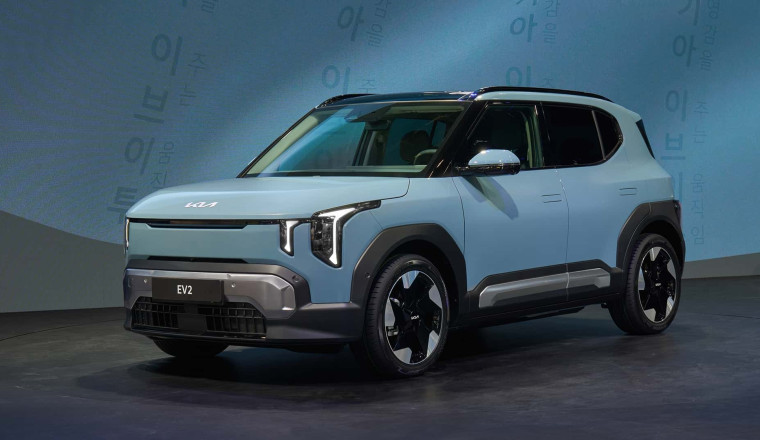
In a sea of swoopy crossovers, the Kia EV2 is refreshingly boxy and is offered with a GT-Line trim that adds slightly sportier styling from day one. The taillights, pushed into the lower corners of the body, are an outlandish touch that recalls the Chrysler PT Cruiser. Up front, the split vertical headlights look as though they were lifted straight from a concept car, helping the electric runabout stand out immediately in a crowded segment.
Although some exterior details make the EV2 look as if it traveled back from the future, the interior hasn’t gone full sci-fi. There are still plenty of real buttons, providing quick access to climate settings and other frequently used functions. Kia has also fitted a physical roller for volume control and manual air-vent adjustments, sparing drivers from having to fumble through submenus.
At first glance, the dashboard appears to house just two screens, but there’s an extra display hiding in plain sight. The 12.3-inch digital instrument cluster and 12.3-inch touchscreen flank a 5.3-inch panel dedicated to climate controls. Although it sits at the bottom of Kia’s electric lineup, the EV2 still packs plenty of goodies, including wireless smartphone charging, 100-watt USB-C ports, a Harman Kardon sound system, over-the-air updates, and even a Pet Mode.
In the back, buyers can choose either a two- or three-seat configuration, along with a respectable amount of cargo space for such a small vehicle. Despite measuring just 159.8 inches (4,060 millimeters) in length, the EV2 can swallow up to 14.2 cubic feet (403 liters) behind the rear seats when they’re slid fully forward. That figure applies to the four-seat model, however, as the five-seat version is limited to 12.7 cubic feet (362 liters). Up front, a small frunk adds another 0.5 cubic feet (15 liters), enough for odds and ends.
Riding on the E-GMP platform that underpins many of Hyundai’s and Kia’s electric vehicles, the EV2 is offered with two battery options. The base 42.2-kWh pack delivers a WLTP range of up to 197 miles (317 kilometers), while the larger 61-kWh battery stretches that figure to 278 miles (448 kilometers) on a single charge.
As expected, the range varies depending on wheel size. The regular EV2 comes with 16- or 18-inch alloys, while the flagship GT-Line rides on 19-inch wheels wrapped in 225/45 R19 tires. All versions are strictly front-wheel drive, but output differs by battery size. The standard-range model produces 144 horsepower, enabling a 0-62 mph (100 km/h) sprint in 8.6 seconds, while the larger-range model sacrifices 10 hp and needs 9.5 seconds to reach the same mark. Both are electronically limited to 99 mph (159 km/h).
DC fast-charging from 10 to 80 percent takes 29 minutes with the smaller battery and 30 minutes with the larger one. The EV2 forgoes the 800-volt charging architecture of the EV6 and EV9, but that’s hardly surprising given its position in the lineup. With pricing expected to start below €30,000 ($35,000), some compromises were inevitable, including a 400-volt system.
Charging works both ways: the EV2 supports V2L (Vehicle-to-Load) to power appliances such as a toaster and other devices. Its bidirectional charging capabilities also extend to V2G (Vehicle-to-Grid), allowing owners to feed energy back into the grid.
Kia will build the EV2 at its Žilina factory in Slovakia, where the EV4 is also assembled. The standard-range model enters production in the first quarter of the year, while the larger-battery version arrives later in 2026. The GT-Line is also coming later this year.
Motor1's Take: The EV2 certainly has its charm, though some buyers may be put off by its unconventional exterior styling. If that isn’t an issue, the technical specifications are more than respectable for an entry-level electric car. Its bespoke EV platform delivers excellent packaging, making the most of a diminutive footprint.
Downsides? There’s no dual-motor, all-wheel-drive version at launch, and the EV2 also skips a multi-link rear suspension in favor of a simpler torsion-beam setup to keep costs down.
Life won’t be easy for the EV2, as it will have to battle the retro-themed Renault 4 and Volkswagen’s upcoming ID. Polo Cross. Those are just two of many rivals in a tough segment that also includes the Peugeot E-2008 and the Ford Puma Gen-E.