

PROS ›› Genuinely quick, nimble handling, faithful design features
CONS ›› Tight rear seating, Uncharted undercuts it, limited cargo space
A quick look around the automotive industry would have most thinking that EV adoption is slowing down. Whether that perception holds true or not, Toyota is moving ahead full steam with not one, but three new electric vehicles, and the C-HR might be the most playful of the bunch. Yesterday, we talked about how the bZ Woodland is a great improvement on the old bZ4x.
Review: 2026 Toyota bZ Woodland Is Quicker Than A GR Corolla, But That’s Not Its Real Trick
Today, the focus shifts to the C-HR, a revived nameplate that now returns exclusively as an EV. It’s a huge deal beyond just the fact that it’s going electric. It’s the first formerly gas-powered Toyota nameplate to go fully electric. Sure, it only beat the new Highlander by a few months, but that’s more than enough. Both will have a big impact on Toyota moving forward.
While we don’t know what the Highlander will end up selling for, the C-HR is clearly aimed at a different demographic. With a starting price shy of $38,000 before destination and handling, it’s aimed at Tesla Model Y buyers wanting something a touch smaller. Packing standard all-wheel drive, 338 hp (252 kW), and almost 300 miles of range, it’s a new face in the segment that will no doubt blow up one day.
Now, all that’s left is to figure out if it’s good enough that it’ll gain a foothold for a long ride, or if it’s still a battery cell or two away from a fully-formed EV. Thankfully, a week of testing it in hilly Ojai, California, helped us figure out the good from the bad.
Styling
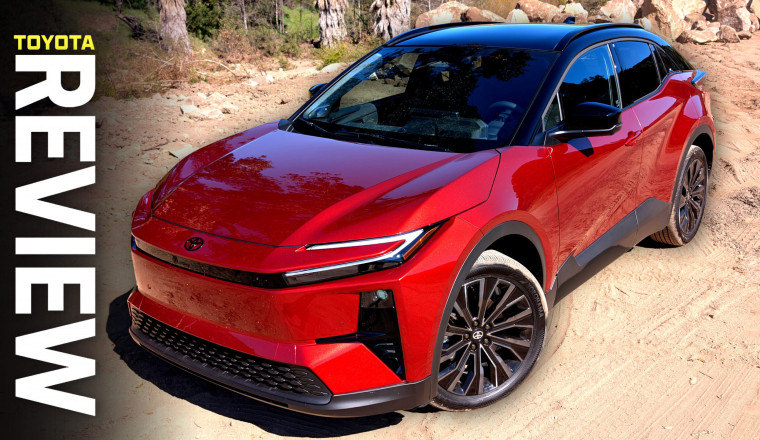
Let’s not play coy. While the C-HR’s nomenclature has always invited comparisons to Honda’s HR-V, the exterior designs couldn’t have been much more different when it first arrived. We’re happy to report that the same playful attitude carries over to this new electric version of the crossover.
The front end adopts Toyota’s newer hammerhead design language, with a low, aggressive nose and slim lights that visually widen the car. The coupe-like roofline flows cleanly into the rear, and from certain angles, the C-HR almost looks more hatchback than crossover, which works in its favor. It feels athletic despite being clearly compromised on that front.
Also: New Toyota Highlander Drops Its Biggest Tradition, And I Got A Front-Row Look
Compared to the bZ Woodland, the C-HR looks tighter and more urban. It’s clearly aimed at buyers who want something sporty and expressive rather than rugged or adventurous. The wheel options help sell that image, too, with 18-inch alloys on the SE and aggressive 20-inch wheels on higher trims.
If the old C-HR was bold but polarizing, this one is more mature. It’s still stylish, but it’s less desperate for attention and more apt to provide an experience worthy of an offbeat appearance.
Cabin Space
Photos Stephen Rivers/Carscoops
Toyota told us early on that we’d see a lot of crossover between this and the bZ Woodland, and it was right. It leverages supportive front seats, an intuitive infotainment setup, a steering wheel that feels good in your hands, and visibility that’s better than the sloping roofline suggests. The driver’s position feels good, though; we’d love a little more adjustability from the steering wheel.
The 14-inch touchscreen dominates the dashboard and comes standard across the lineup. It’s responsive, cleanly laid out, and avoids the over-complicated UI issues that plague some competitors. Dual wireless charging pads and practical storage touches reinforce that Toyota still knows how to design for daily life.
Material quality is a step up from Toyota’s earlier EV efforts, too. Soft-touch surfaces and ambient lighting keep things modern without crossing into gimmicky territory. And then you climb into the rear seats. Things go from perfectly livable to suddenly only for the smallest around us.
How Tight Is Too Tight?
I get that as a taller-than-average guy, I won’t fit everywhere, but I was sincerely shocked at just how tight the back seats of the C-HR are. This is a compact crossover, and that’s clear as soon as we compare it to another new crossover in the form of the Mazda CX-5.
The Mazda has a wheelbase that is just 2.5 inches (63 mm) longer. Despite that, the CX-5 offers 7.7 inches (195 mm) of additional legroom, up to 2.8 inches of headroom, and in total over 10 cubic feet of extra space in the rear seats. Put simply, rear-seat occupants won’t be happy in the C-HR unless they’re relatively small. That said, they’ll fit kids just fine.
Cargo space fares better, with 25.3 cubic feet behind the rear seats and nearly 60 cubic feet with them folded. That’s perfectly usable for daily life, but the passenger packaging tells you clearly where Toyota’s priorities were.
Driving Impressions
Here’s where the plot thickens, in the best way possible. EVs are well-known for their instant torque, but that doesn’t automatically make one good to drive. The way the C-HR moves about the world is with more authority than one might expect. It’s sharp. The short wheelbase helps it manage bends with confidence. And the steering is more communicative than in the larger bZ Woodland.
Toyota claims 0-60 mph in 4.9 seconds, and it absolutely feels believable. This thing moves… not with the aggressive chaos of a GR Corolla, but with the smooth, relentless urgency only an EV can deliver. In fact, this might be the quickest pseudo-practical car in Toyota’s lineup right now. It’s not trying to be a sports car, yet it’s faster in a straight line than many cars that are.
The low battery placement keeps the center of gravity down, and the chassis feels planted through corners. Steering is light but accurate enough that you want to push a little harder than you probably expected. There’s a maturity to the tuning. It’s composed, predictable, and easy to trust. The brakes are excellent, too.
The regenerative braking paddles let you adjust deceleration on the fly, which adds a layer of driver involvement often missing from mainstream EVs. It’s not revolutionary, but it does make the driving experience feel more interactive.
Ride quality strikes a nice balance, too. It’s firm enough to feel sporty without punishing you over rough pavement. The C-HR doesn’t feel like a small SUV pretending to be sporty. It just feels like a well-sorted EV with some genuine personality. No, it’s a far cry from a Hyundai Ioniq 5 N or a Tesla Model Y Performance, but it’s the EV I’d pick from Toyota’s lineup if driving feel was all that mattered.
More: Toyota Made An Electric Subaru Outback As Powerful As A Supra
From a more practical standpoint, range tops out at 287 miles on the SE trim, dropping slightly with the larger wheels. Charging speeds max out at 150 kW DC fast charging. That’s enough to go from 10–80 percent in roughly 30 minutes under ideal conditions. As we’ve seen in the past, ideal conditions can be rare, but the inclusion of Tesla’s NACS port should help.
Competition
The C-HR lands in an increasingly crowded space, but its personality gives it, like the bZ Woodland, a unique angle. The Tesla Model Y remains the benchmark for space and usability. It’s roomier, more versatile, and easier to live with if rear-seat comfort matters. The Model 3, while technically a sedan, also beats the C-HR for rear-seat comfort despite looking smaller.
Frankly, comparing it on paper to most cars in the segment makes the C-HR look like a middling choice at best. Even pairing it against its badge-engineered sibling, the Subaru Uncharted, it costs more and isn’t available with front-wheel drive, which unlocks more range. That said, I’m not about to start complaining that we need more front-wheel drive cars.
Where the C-HR stands out is key, though. All-wheel drive is something that plenty of folks want and or need where they live. Second, it’s probably the easiest car in the segment to park, thanks to great sightlines and one of the shortest wheelbases here. That matters.
No, it’s not the quickest, cheapest, or most spacious. Instead, it’s leaning into the vibe of a compact, economical electric vehicle to the best of its ability in its current form. And that form just so happens to be quite attractive and fun.
The Verdict
Toyota just launched the new Highlander in all-electric form, which is a huge deal in itself, but let’s not forget that this new C-HR is the first formerly gas-powered Toyota to go all-EV in America. That’s also a big deal, and it makes this little commuter car an important inflection point in history.
To that end, it’s great to see that Toyota didn’t hold back here regarding performance. The C-HR is properly quick, genuinely fun to pilot, and even fun to look at. The front seats, infotainment, and overall driving position are all excellent, and on the road, it feels composed, lively, and far more engaging than many electric crossovers in its segment.
That said, it’s not without compromise. Rear-seat space is tight enough to be a real consideration, especially if you regularly carry adults. This is a crossover that prioritizes style and driving feel over maximum practicality. And honestly, that might be exactly the point. Here, the fun comes first, and the practicality, while important, comes in second place. Will it be a mix that sells well? Only time will tell.