
► Skoda’s on the fence about the Superb’s future
► There might not be enough space for it and the Octavia…
► … so they could end up merging into one product
The future of the Skoda Superb Estate is hanging in the balance. In the short term, Skoda will look to prioritise its best-selling combustion cars to make the most of its allocated CO2 credits. Then, as electrification washes over its product range in the long term, it seems likely the brand will consolidate its two wagon offerings into one electric estate car.
At the preview of the upcoming Skoda Epiq SUV, we chatted to Martin Jahn, the company’s head of sales and marketing. He hinted at the internal struggle he faces in trying to keep both the Octavia and Superb in showrooms, saying: ‘We are waiting for the final say about the CO2 laws and that will decide.
‘I think it’s logical that, given the volumes, the Octavia is a more important car. But we want to keep both and we will keep both as long as it’s economically viable and as long as it’s legally possible to the business to sell them.’
Jahn told us the Superb still matters – at least for now. ‘With the Superb, we are the one of the last few Mohicans in this in this segment,’ he said. ‘The car is important for us, not only in Europe, but for example in Turkey. And that’s why we keep the limousine, because it’s a key model for some other non-European markets.’
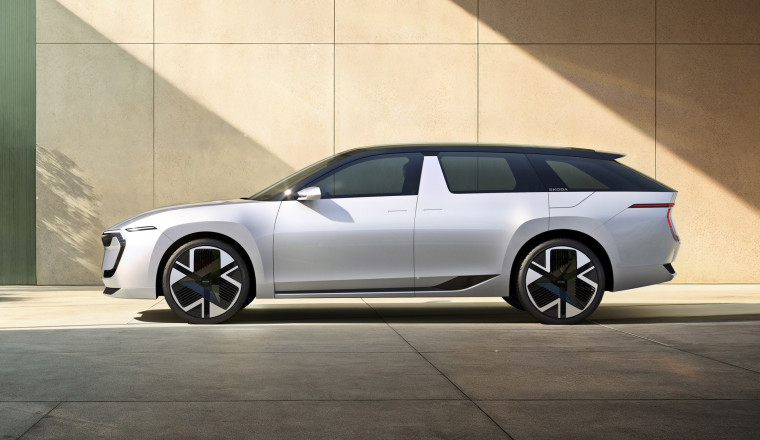
But Skoda’s Vision O show car suggests that could all change when the company properly embraces electrification. The fact this EV estate concept is sized between the Octavia and Superb shows Skoda isn’t confident there’s enough space in the market for both models. The Vision O represents a compromise, designed to serve both sets of customers.
At the launch of the Vision O concept, CAR magazine spoke to Johannes Neft, Skoda’s head of technical development. When asked if the concept’s convenient sizing was mere coincidence, Neft gave a strong ‘no’ as an answer before a PR cut in to stop him saying anything further. That’s mightily suspicious.
Neft said: ‘We have not decided if the Octavia and Superb will both continue. We have to check and this will also depend a bit on the size we want the car to be, and if we are going more in the direction of Superb or are we staying with Octavia.
‘But if you grow the Octavia, you are getting very close to a Superb.’
Unfortunately, yes – and the Superb’s case looks even weaker when you start browsing Skoda’s sales figures. Despite the popularity of SUVs, the Octavia was the eighth most popular car in Europe in 2024, racking up 200,000 sales. The Superb lags far behind, with only 34,000 estates finding homes in the same year. That’s not an insignificant number, but it’s not enough to secure the Superb’s long-term future.
Skoda’s boss Klaus Zellmer said he ‘very much believes’ in the estate car segment but stressed that getting the value right on that car is ‘one of our highest objectives’.
‘We need to stay in that price bracket [of the Octavia],’ he said. ‘Because if not, our customers will go somewhere else and we don’t want that.’
Skoda first previewed an electric estate car three years ago when it showed models of its six new EVs – also including the Elroq, Epiq crossover, Vision 7S seven-seat SUV.
While an electric estate was expected to materialise sooner, Zellmer said it was delayed so it could sit on Volkswagen’s new Scalable Systems Platform (SSP) which unlocks more potential than its current MEB underpinnings. It will also allow for more electric range, a must for Skoda’s high-mileage estate car customers.
‘We postponed [the Vision O] because that car has to come with a new platform because with this long-distance driving you need the autonomous driving functions that are easier to realise in a new platform and not in the current platform,’ said Zellmer.
We’ll have to wait and see how European environmental politics develop in 2026. The enthusiasm Skoda’s executives show for the Superb suggest CO2 regulations will be the defining factor for the car’s short-term future.
I’m not confident the Superb will survive long enough to become an electric car, as it doesn’t make sense from either an R&D or production perspective to build two different sizes of car for what’s already a niche market. One would suffice.
However, in the same way that Volkswagen plans to extend the life of the petrol Golf GTI beyond 2028, Skoda could keep the current combustion Superb around with a series of cosmetic and technological updates. Perhaps even a second facelift.
The Superb has fate on its side, too. Because it’s based on the Volkswagen Group’s MQB Evo platform (rather than the older MQB architecture found under the aging Karoq), Skoda could drop the latest T-Roc’s full hybrid powertrains into the car with minimal effort.
That’d drag the Superb’s average fleet emissions down and allow Skoda to keep it on sale while avoid hefty penalties from the EU. It should also be reasonably cost-efficient to engineer, which adds further credence to the business case.
Time will tell. We just hope the Superb doesn’t run out of it before Skoda can find a solution.
Luke is the Deputy Editor of our sister site Parkers, but he spends plenty of time writing news, reviews and features for CAR. He's been a motoring journalist since 2018, learning his craft on the Auto Express news desk before joining the Parkers/CAR team in 2022. When he isn't yoked to his laptop, he's tearing his hair out over his classic Mini restoration project or pinballing around the country attending heavy metal gigs.
With contributions from
Ted Welford New Cars Editor
By Luke Wilkinson and Ted Welford