

Honda’s next-generation hybrid system is expected to arrive in 2027. It’ll be found in either a Honda Civic Hybrid or CR-V Hybrid that, if a recent prototype drive is anything to go by, will be a pleasure to drive.
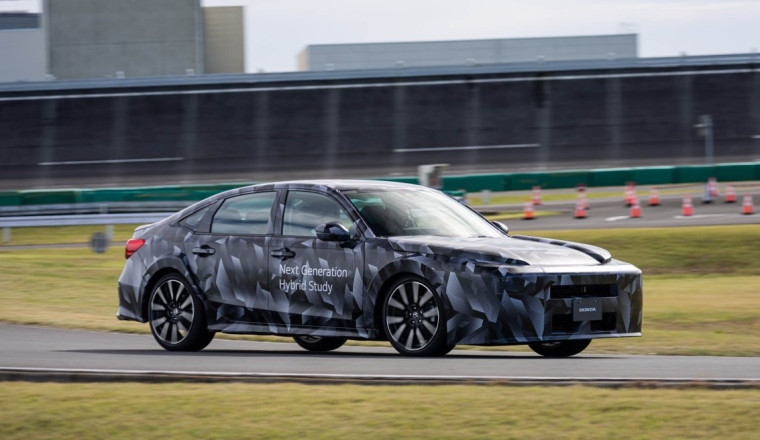
Last week, while at Honda’s R&D facility in Tochigi, Japan, I slid behind the wheel of a camouflaged next-generation Honda Civic Hybrid prototype for four short laps around a track. Here’s what I learned about what’s to come:
Honda is considering this upcoming hybrid powertrain to be its fifth-generation system, but in reality, it’s a heavy evolution of today’s fantastic fourth generation. It will likely find its way into the new Civic, CR-V, Accord, and possibly other vehicles.
The powertrain’s formula is the same as today’s Civic Hybrid, as well as the 2026 Prelude I also drove on the same test track. A naturally aspirated gas engine is paired with two electric motors and a battery pack to drive the front wheels. In the CR-V, a third electric motor will be mounted in the rear to deliver all-wheel drive. The setup means there’s no transmission in the traditional sense. In low-speed driving, the electric motors power the drive wheels. At higher, constant speeds with low throttle input, the gas engine will clutch in to drive the wheels in the name of efficiency. With heavy throttle engagement, the gas engine kicks on to provide power to the electric motors, which then drive the wheels. It’s both a series and parallel hybrid system in one.
Honda hasn’t discussed power output or overall fuel efficiency yet, but stated that the engine and cooling systems have been developed to meet global regulations and mentioned an expected 1.3 mpg combined improvement in the U.S. CR-V Hybrid application. The gas engine itself is said to have an expanded high-efficiency range of 30% compared to the system introduced in 2018. The electric motors up front and battery pack have been repackaged to provide more space in the cabin, though the cabin of the car I drove was covered entirely in cobbled-together camouflage, and I couldn’t tell you how much space was in this car.
Honda claims that the fifth-generation system and new platform reduce the car’s weight by 180 to 200 pounds compared to today’s models.
That platform structure is Honda’s new modular design that rethinks how the front end is designed and built. The structure’s reinforcement points for rigidity have been relocated and moved up and back rather than being centralized down low beneath the engine cradle. This design allows the structure to deform and bend as it navigates corners, pushing the outside wheel and tire contact patch down into the pavement, while the main cabin resists twisting. It’s a complete rethink of how a car is both designed and handled.
The fenders of the camo-clad prototype bulged, and the front end had quite a makeshift nose on it to trip spy photographers. The rear looked like today’s Civic Hybrid, but with dual exposed chrome exhaust tips coming out the passenger side.
The interior was covered entirely in black camouflage, and Honda asked me not to discuss what little I could see. It’s not even clear which parts were just added to this car versus which ones are headed to production.
The entire four laps were driven in Sport mode with the newly developed S+ shift logic, which debuts in the Prelude.
As I quietly crept out of the makeshift paddock, the low-speed pedestrian alert sound, which was essentially the same as today’s Civic Hybrid’s hum, played along. It could be heard because the engine was off and the car was silent. The second the front wheels hit the track’s perfect pavement, I hit the throttle, and the gas engine fired to life. It was louder than I expected, and it sounded great.
After a quick familiarization lap, I hammered down and started pushing the prototype’s powertrain harder than I imagine most people will in daily driving. The S+ shift logic kept the powertrain on boil with revs hanging, multiple rapid “downshifts” occurred that aren’t really being performed as I hit the brakes to shed speed into corners. It was all accompanied by a pleasant sound, though only some of it was natural, while part of it was amplified through the speakers. Frankly, if you told me this was a Civic Si powertrain, I might have believed you based on the sound and off-the-line performance. I say that because instant torque can be felt both off the line and as a fill coming out of corners. I also would’ve believed that this was a Civic Si with an automatic transmission.
The downshifts were smooth and weren’t felt in my lower back, but the upshifts could be felt and were similar to those I experienced in the Prelude. The Civic Hybrid prototype felt a hair slower than the Prelude. My guess is that the feel of the “shifts” hasn’t been finalized for production yet.
I would be lying if I said that Honda’s new morphing front end could be felt at the wheel, but the entire car felt light on its rubber feet with sharp turn-in.
Four laps in the books, and I was instructed to come in. As I pulled off the track and the aggressive throttle inputs stopped, the speed lowered, and the gas engine instantly shut off—silence, except for the low-speed pedestrian alert sound.
Possibly more interesting than how the prototype drove was the sound it made. I say this because inside the Civic Hybrid prototype, the sound was similar to that of the Prelude, and possibly even the gas-powered Civic Si. However, the Prelude is designed to be remarkably quiet from the outside. It passes you on the street at full tilt, and it’s not loud. The next-gen Civic Hybrid? It’s loud both inside and out at full tilt.
Ito Koji, Honda’s development manager for the midsize hybrid, told The Drive that this was done intentionally, as the Prelude is a “glider concept,” while the Civic is intended to be a sporty midsize hybrid. We’ll have to wait about two years from now to get our hands on the production version of this next-gen Civic Hybrid (and CR-V Hybrid). Firm details about efficiency, power, and speed will have to wait.
However, one thing from the all-too-brief encounter was made clear to me: These Honda engineers are enthusiasts and have developed a next-generation hybrid system that should be a pleasure to drive.
Honda provided The Drive with travel, accommodations, and access to engineers for the purpose of writing this story.
As Director of Content and Product, Joel draws on over 15 years of newsroom experience and inability to actually stop working to help ensure The Drive shapes the future of automotive media. He’s also a World Car Award juror.

Car Buying Service
By Caleb Jacobs