
the breakdown
- Customer demand is pushing a return of tactile controls in vehicles.
- BMW Group and Mini will balance digital and physical interfaces, using screens alongside buttons.
- Mini’s plans to improve its OLED display while preserving the brand’s analog character.
Touchscreens are still a hot topic. Shortly after the rise of the iPhone, automakers went all in on screen technology, adding massive, all-encompassing displays to the center of their vehicles. It was all in an effort to appeal to the next-generation of buyers.
Here’s the problem, though: customers quickly bucked against touchscreen overload, demanding automakers return even the most basic of tactile controls back into their vehicles. So far, brands like Audi, Hyundai, and Volkswagen—some after being called out publicly—have already obliged, with other companies also feeling the heat.
BMW Group has been bullish on touchscreen technology. Yet, the company still understands that buyers don’t necessarily want to be inundated with screens at every turn. The new iX3, for example, features a massive 17.9-inch central display, but it keeps many of its tactile controls. Mini plans to follow a similar strategy.
I recently spoke with Mini’s newest head of design, Holger Hampf, who assumed the role in 2024. Echoing the sentiment of the larger BMW Group, Hampf believes that screens and tactile controls can live together in perfect harmony.
"I think it's a general trend that some customers are asking to bring physical buttons back," Hampf told Motor1. "For Mini, I believe it's a very good thing, because we are looking for that mix of digital interface and physical affordances."
"It’s of the utmost importance to find a good balance between digitality and an analogue experience," Hampf continued. "If you go too digital, you lose the connection or the character that the brand is known for… we always need to retain that analog quality that a Mini is known for."
'It’s of the utmost importance to find a good balance between digitality and an analogue experience.'
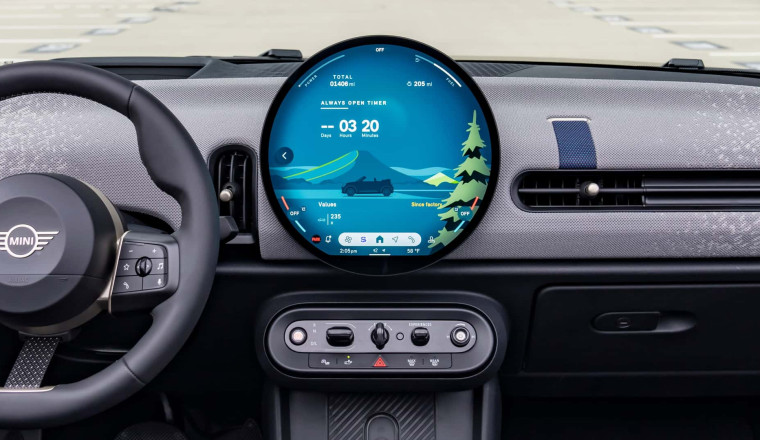
Central to the identity of Mini’s interior is the signature round touchscreen display. Introduced in 2023, the circular OLED measures 9.4 inches in diameter and comes with a handful of quirky features. Having used it previously, I can say that it’s a pretty nifty setup.
Thankfully, that screen isn’t going anywhere. Hampf says that the company plans to design around its rounded central display, and he’s even thinking of ways to improve on it in the future.
"Mini has enough touch interface, if you ask me," Hampf said. "That round display is everything we need. I would like to actually celebrate it even more in the future because it's so unique… The display size is perfect, refining the digital interface and then pairing it with physical interaction is perfect for Mini."
Motor1's Take: It’s great to see that more companies are planning to keep tactile controls in their vehicle. Even with a large touchscreen display, Mini believes that buttons and knobs are crucial to its identity.
Long Live Buttons