

► New Ferrari Luce – Maranello’s first EV – officially revealed
► Quad motors, bold design inside and out from LoveFrom
► Plus ‘authentic’ sounds, paddle shifts and circa-£440k price
The most controversial new car in years? That could quite possibly be this: the new Ferrari Luce. Why? Because you’re looking at Maranello’s first electric car.
The Luce has had a rather long gestation period, with development officially kicking off in 2021 (Ferrari had been pondering making an EV for a few years before then), when EVs were riding high and increasing in popularity in the premium, sport and luxury space. At that time, Ferrari announced it was creating an entirely new ‘e-building’ to manufacture it and that more than one would be on the way.
The world slightly reassessed that overly positive attitude to EVs not long after and so did Ferrari, confirming it would remain ‘multi-energy’ with its iconic V12 engines remaining for now. But it’s clear Ferrari hasn’t gone soft on Luce development despite changing headwinds; almost the entire car is newly developed, from the design to the architecture underneath, the batteries and e-motors as well as the interior. That has meant huge investment.
Ferrari has unveiled the Luce at the Vela de Calatrava at the Città dello Sport on the outskirts of Rome. The location is a huge and architecturally grand sporting complex that was built at vast expense, whereby the Italians commissioned Spanish architect Santiago Calatrava to shape the structures. It’s an impressive space, but one that’s never really managed to fulfil its purpose for the city of Rome. Just an interesting nugget of information, that’s all.
We’ve been up close and personal with the new Ferrari Luce, so keep scrolling for what you need to know about Maranello’s first ever EV.
That… is an interesting car look at
Understatement of the year, surely? Regardless of whether you think this is a positive or not, the Luce is quite possibly unlike anything we’ve ever seen from Ferrari… ever. And, as you may be aware by now, much of the design concept both inside and out hasn’t entirely been the work of Flavio Manzoni’s in-house design team at Ferrari HQ.
No, the Luce has largely been a project that’s been worked on by LoveFrom, a ‘creative collective’ of artists, designers and musicians that was founded by Sir Jonathan Ive and Marc Newson in 2019.
If Jony Ive’s name sounds familiar, it’s because he spearheaded decades of design cleverness at Apple, where he and his team there crafting icons like the colourful iMac G3, the original iPod and iPhone and so many others over the span of almost 30 years.
But the Luce is very a different project compared to those Apple product designs. Newson says the LoveFrom team worked ‘hand in glove’ with Manzoni and Co., and that the development process was ‘surprisingly not fraught with tensions’ between the two design teams.
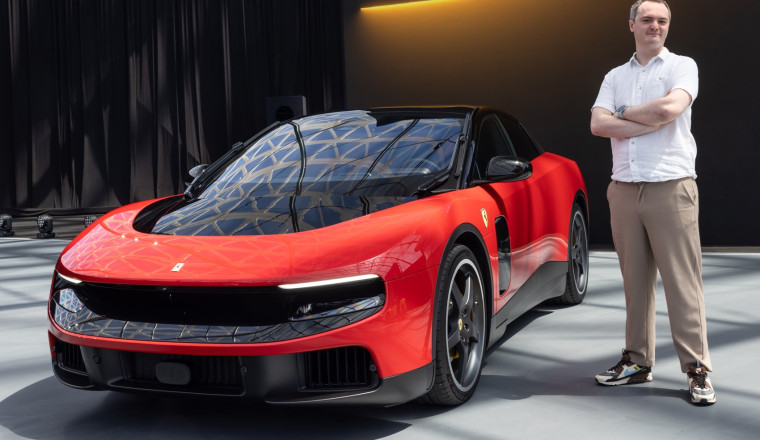
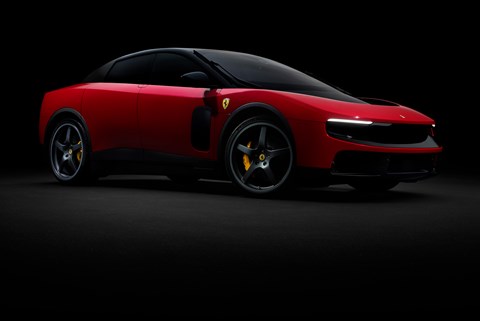
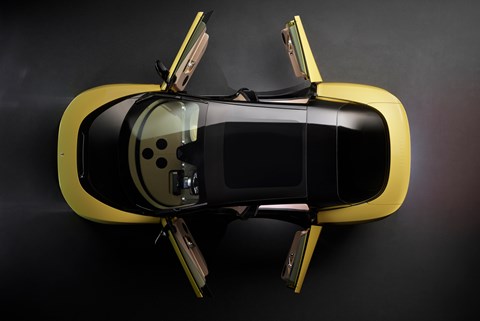
The Luce is a four-door and the longest Ferrari ever, standing at 5026mm – that’s around 50mm longer than a Purosangue. It’s also slightly slimmer than Ferrari’s V12-powered SUV… and lower to the ground, too. Like the Purosangue, the back doors are rear-hinged but, unlike the V12-powered SUV, the Luce is a proper five-seater. That’s a first for Ferrari, who claims the reason it’s never done so before is because its cars’ transmission tunnels got in the way – conveniently ignoring decades of cars from other brands that have five seats and transmission tunnels.
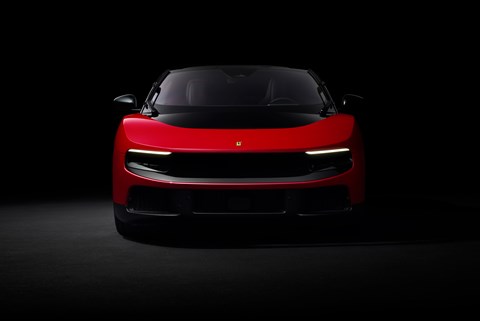
Anyway… the Luce looks a bit cab-forward to our eye, with a front end that incorporates shallow DRLs similar to the Purosangue, albeit with almost completely hidden main beams. The nose is dominated by a front spoiler that almost acts like an S-duct designed to make as much airflow goes over the car as possible.
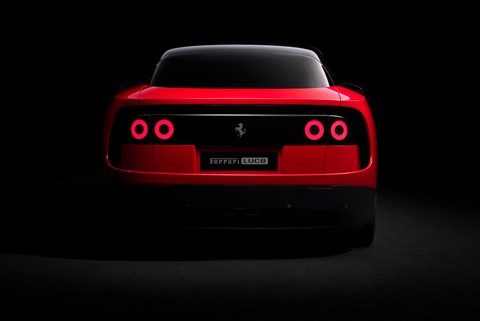
The sides are clean, with a flowing beltline sweeping over the wheelarches, and the boxy rear features two pairs of circular rear lights that are a bit of a nod to more classic Ferrari models. It does look a little like one car has been built on top of another, mind, and a lot of black detailing is used in the overall look; something we suspect is there to hide some of the bulk.
Ferrari says the Luce launches with 23-inch front/24-inch rear wheels, with a sporty five-spoke wheel being offered as well as a more aerodynamic version that claims to add an extra five per cent to the car’s range.
Other customisation options will include stripes down the sides of the doors, as well as the option to colour the black C-pillar panel that stretches over the roof, but Newson is keen to keep a tight set of personalisation options and ‘not make it a free for all.’
What’s it like inside?
Quite possibly the most impressive part of the entire Luce’s package. We’ve seen a lot of the Luce’s interior elements in isolation after Ferrari unveiled bits of it ahead of the Luce’s reveal but, naturally, we’re now seeing it all in one piece and in situ.
LoveFrom’s team have, for lack of a better phrase, gone a little retro here. Newson, for example, freely admits he’s a classic car collector and a Ferrari obsessive – and has been keen to ensure some physicality remains in the interior design. ‘Just because the vehicle is electric doesn’t mean you need to get carried away with the electronics,’ he says.
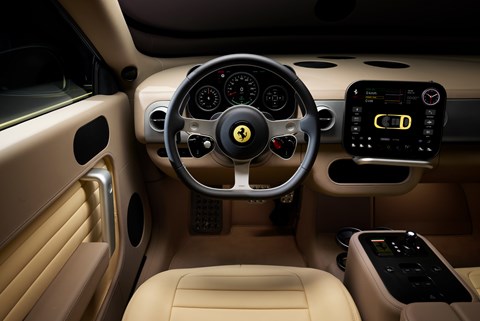
Design elements include a beautifully thin-rimmed steering wheel that includes structural elements like a milled aluminium steering column and properly thick metal paddles, while the instrument cluster includes a physical needle for the speedometer. Certain information displays like the G-sensor readout look more like what you’d see aboard an aircraft cockpit than a car.
There are not one but two Manettino dials on the steering wheel. The one on the right is the usual Ferrari stuff: a bumpy road mode for the suspension and drive modes that range from traction-focused Ice mode all the way up to powerslide-enabling ESC off. The Luce also debuts a new Dry mode for more day-to-day driving. The other dial is labelled the e-Manettino and is designed to control power delivery. Range mode halves output to – predictably – preserve range. Tour mode adds a little more shove and enables the Luce’s top speed, while Performance unlocks almost all of the available power.
The central infotainment screen itself can be pivoted to face the driver or passenger and comes with toggles for crucial controls like climate, seating and fan speed. The finely crafted handle underneath can also act as a rest for your hand. And, when you start the car, you press the key into the centre console where it glows upon activation.
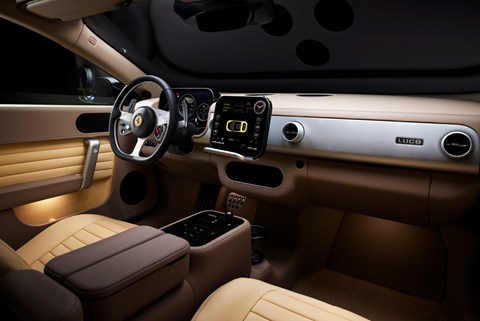
On top of that, you activate launch control by pulling down a toggle on the ceiling. It’s another bit of theatre and a nod to aviation, and one of many impressively well-crafted details inside. Doing so turns all of the dials orange.
‘It was clear to us that capacitive buttons, multi touch [displays]… it’s completely inappropriate for car interiors… it’s more or less dangerous,’ says LoveFrom industrial designer, Jeremy Bataillou. ‘We really wanted to design tactile physical controls, but we got to merge them with digital interfaces.’ That’s why you see details like slick, Apple-like animations showing temperature or fan speed changes when you flick a toggle, or can changes the analogue-handed clock in the top corner to a compass or stopwatch.
More than anything, though, it’s the tactility of it all. Everything feels of impressively high quality, with a much-improved user-friendliness not seen on Ferraris this decade. Buttons and paddles have a proper click or thunk, for example, with Newson saying that ‘I can count only one carrying part identified on the interior; everything else is completely ground up.’ That even extends to things like that milled aluminium seat rails, or the fantastically neat air vents. Perhaps our only criticism here is the finger-pull drive shifter; it feels a little too dainty and simplistic for our liking.
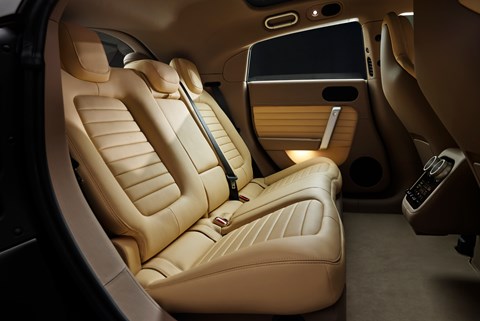
Rear space is good for adults, with the rear seat area coming with its own small display and air vents, as well as an armrest with cupholders in it. The fifth seat in the centre naturally isn’t full size, but will still hold an adult for a short while. The boot, meanwhile, is shallow but long, with 597 litres of luggage volume.
It had better be fast…
Well, let’s start with the performance basics first. The Luce debuts with four electric motors – one dedicated to each wheel. The motors for each axle are housed in one single e-axle per, er… axle, with each motor having its own gearbox and driveshaft.
The battery powering it is a mammoth 122kWh in size, giving a quoted 329 miles of electric driving range. It uses pouch cells supplied by South Korean battery company SK On, with 14 cells per module and 12 modules per Luce pack. The electric Ferrari uses 800-volt electronics, enabling 350kW DC charging speeds.
Power output depends on mode. Range mode shuts off the front two motors and limits power to 429bhp; Tour mode activates the front motors, ups power to 617bhp and unlocks the Luce’s 193mph top speed; Performance mode ups that to 972bhp. Activating launch control gets you the full whack: 1035bhp. At maximum attack, a Luce can sprint to 62mph in 2.5 seconds.
There needs to be more to it than power…
Because this is Ferrari, yes there is. Some of the tech on board is evolutionary to what we’ve seen on prior Ferrari supercars and GTs. The chassis is largely aluminium (and a lot of it has been recycled for use here) but, even so, the Luce weighs in at 2260kg. Gianmaria Fulgenzi, chief of product development, notes that the weight figure is ‘a little bit more than a Purosangue,’ but claims the Luce drives and handles like a car that’s a few hundred kilos lighter.
The Luce benefits from active suspension, for example, but this is a third-generation version of the one that launched on the Purosangue, then evolved for the F80 supercar and has been upgraded again here. Independent rear-wheel steering features, too, which uses software to calculate how much steering each wheel requires.
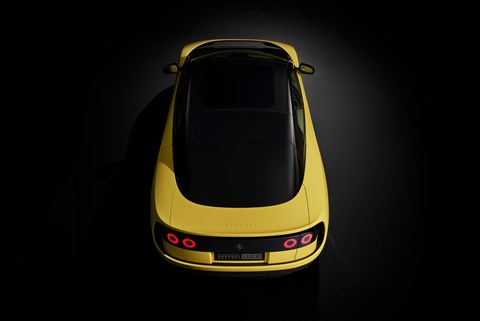
As well as the more structural aerodynamic elements like that front spoiler and integrated rear wing, there are air dams that open up depending on drive mode. And, to reduce noise and vibrations, the rear subframe is mounted with elastic contact points.
And then there’s the noise. The Luce remains silent in Range and Tour modes, with Ferrari’s chief test driver Raffaele de Simone saying that ‘silence is an added value’ for the customer buying a Luce. But flick the electric Ferrari into Performance and it emits a noise that is entirely derived by the electric powertrain. ‘The sound is authentic, the sound is real,’ says de Simone. ‘The texture of the powertrain is what you feel when you’re driving. We don’t want a fake, nostalgic sound,’ he adds, in stark contrast to the attitude over at Mercedes-AMG with its new V8-sounding electric GT four-door.
The sound also neatly plays into another feature of the Luce: torque shift engagement (TSE). This is where those meaty paddles come into play, with TSE being designed to add a little bit of extra driver engagement. As well as an ‘auto’ mode that defaults to full power and a middling amount of regen, TSE adds five ‘steps’ that both increase in power and decrease in regeneration respectively. So, step one has a limited amount of power but a high level of regen, while step five unlocks all the power but decelerates ‘similar to a Purosangue in eighth gear,’ according to de Simone. TSE is not strictly a simulated gearbox like Hyundai’s N-Shift. There’s no redline that cuts off power completely; you can still accelerate to top speed in the first step; it’ll just take longer.
It’s effectively there to make you feel more involved in the driving experience; Ferrari is keen for its first EV not to just be a point-and-squirt acceleration weapon. ‘It’s just fun to experience shifting like on an internal combustion engine Ferrari,’ smiles de Simone. ‘We’ve just redesigned the experience for the new world.’
Come on then – how much is a Ferrari Luce?
Effectively around €500,000, with UK pricing to hover around £440,000 – and that’ll naturally be before any options or customisation choices.
For reference, an electric Porsche Cayenne Turbo has an identical acceleration time and a slightly better claimed range; though this fact will almost certainly not matter to the kind of clientele expected for the Luce.
The first deliveries are expected to arrive in early 2027.