


You might think you look cool leaning back with one hand on the wheel, but your chiropractor has bad news. That "Gangster" position is destroying your spine, and it's not the only one. Meet the four worst driving postures wrecking British backs, and the one position that actually works.
Josh Newsom sees the damage every day. As a chiropractor at Ancoats Chiropractic Clinic in Manchester, he treats commuters with neck pain, office workers with lower back problems, and delivery drivers whose spines have given up entirely. The common factor? How they sit in their cars.
According to research shared with Daily Mail, Newsom identified four driving positions that consistently cause spinal problems. He's given them names based on the postures they resemble, and if you recognize yourself in any of them, your back is probably paying the price right now.
The Gangster is exactly what it sounds like. Over-reclined seat, body leaning to one side, looking effortlessly cool while your lumbar vertebrae scream for mercy. "This places uneven pressure through your spine and pelvis," Newsom explained. "One side of the body ends up working harder than the other, which increases strain on the lower back and hips during longer journeys." The asymmetry is the killer. Your spine evolved to distribute weight evenly across both sides. Lean hard to one side for an hour-long commute and one hip carries load it wasn't designed for while the other side relaxes. Over weeks and months, this imbalance creates chronic pain that won't resolve without correcting the position.
The Rollercoaster involves white-knuckle driving with raised shoulders and death grip on the wheel. Newsom notes this creates "constant tension through the neck, shoulders and arms" that leads to muscle fatigue and stiffness, particularly in slow-moving traffic where the body never relaxes. The tension compounds because muscles never get relief. In stop-start traffic, you're maintaining that grip for extended periods with no opportunity for the shoulders to drop or the neck to release. Eventually those muscles stay partially contracted even when you're not driving, creating persistent stiffness that feels like a tension headache radiating down from the base of your skull.
The Racer sits too far back with straight arms and legs, mimicking racing drivers who need that position for different reasons. For everyday driving, Newsom says this "locks the joints close to their limit" and "reduces the body's natural shock absorption," increasing strain on shoulders, hips, and lower back during stop-start driving. Joints work best in their middle range of motion where they can absorb impact and distribute forces. Lock them at extension and every bump, brake, and acceleration transmits force directly to the spine without any cushioning from bent knees or elbows.
The Hamster is perhaps the most common mistake. Sitting too close to the wheel with a hunched upper back places "sustained pressure on the neck and upper spine, making it a major contributor to everyday commuter stiffness," according to Newsom. This position forces the neck into constant forward flexion, the same posture that causes "tech neck" from staring at phones. The weight of your head, roughly 10 to 12 pounds, multiplies the stress on cervical vertebrae when held forward rather than balanced directly over the spine. Hold that position for 40 minutes twice daily and the muscles supporting your neck fatigue, leading to chronic pain and potential disc problems.
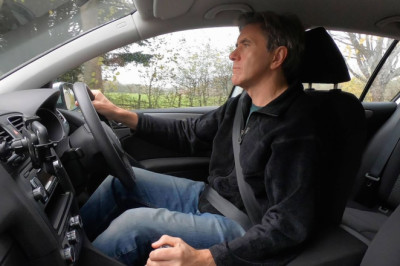
Ancoats Chiropractic Clinic partnered with car finance company Carmoola to develop what they're calling The Pro position. It's not revolutionary. It's just biomechanically correct. Sit upright with hips slightly higher than knees, elbows gently bent, head resting against the headrest. "Let the seat support your body, keep your posture natural, and avoid forcing positions," Newsom advised. "Small changes like that can significantly reduce strain and make everyday commutes far more comfortable in the long run."
The hips-higher-than-knees detail matters more than it sounds. When your knees sit higher than your hips, your pelvis tilts backward, flattening the natural curve in your lower back. That curve, the lumbar lordosis, exists to distribute compressive forces from sitting and standing. Flatten it for extended periods and you're loading the spine in ways it wasn't designed to handle. Raise the seat base slightly so hips sit higher and the pelvis tilts forward, restoring that natural curve and allowing the spine to do its job.
Bent elbows provide similar benefits. Straight arms to the wheel lock the shoulder joints and prevent them from absorbing vibration and impact. Bend the elbows to roughly 120 degrees and the arms can act as shock absorbers, reducing forces transmitted to the spine. The position also allows for better steering control and quicker reactions, though Newsom focused on the health benefits rather than driving dynamics.
The headrest recommendation addresses whiplash risk and chronic neck strain. Most drivers position headrests too low, sitting several inches below the back of the skull. In a rear-end collision, that gap allows the head to snap backward before the headrest catches it, increasing injury severity. For everyday driving, a properly positioned headrest encourages neutral head position rather than the forward tilt that creates neck strain. The headrest should sit level with the top of your head, close enough that you can touch it with the back of your skull while maintaining normal posture.
The advice sounds simple because it is simple. The problem is that most drivers never learned proper seating position and develop habits based on what feels comfortable in the moment rather than what protects their spine over thousands of hours. The Gangster position feels relaxed because you're slouched. The Hamster position feels engaged because you're close to the controls. The Rollercoaster position feels alert because tension creates a sense of readiness. None of these feelings translate to spinal health.
Newsom's final piece of advice cut through everything else. "If drivers remember one thing, it's this: relax." Tension creates muscle fatigue, restricts blood flow, and turns a comfortable seat into an endurance test. Racing drivers maintain relaxed shoulders and loose grips despite operating at the limit because tension slows reactions and causes errors. The same principle applies to commuting. Relax the grip, drop the shoulders, let the seat do its job, and your back will thank you at the end of the journey.
British drivers spend an average of 235 hours per year behind the wheel according to various transport surveys. That's nearly six full working weeks sitting in a car seat. Get the position wrong and you're subjecting your spine to six weeks of sustained abuse annually. Multiply that across decades and the cumulative damage adds up to chronic pain, reduced mobility, and potentially expensive medical treatment.
The four bad positions all fail for the same reason. They prioritize style, habit, or momentary comfort over biomechanical function. The Pro position works because it aligns the spine naturally, distributes weight evenly, and allows joints to operate in their optimal range. That's not exciting or cool, but your back doesn't care about looking good. It cares about not hurting.
So check your position next time you get in the car. If you're reclined back leaning to one side looking effortlessly cool, you're the Gangster and your spine hates you. If you're hunched over the wheel like you're peering through fog, you're the Hamster and your neck is paying for it. If you're gripping the wheel like it's trying to escape while your shoulders touch your ears, you're the Rollercoaster and those muscles will never relax. And if you're stretched out like Lewis Hamilton heading into Copse Corner except you're actually heading to Tesco, you're the Racer and your joints are locked at their limits.
Sit up. Hips higher than knees. Elbows bent. Head against the headrest. Relax your grip and your shoulders. It's not complicated. Your back will feel better immediately, and in twenty years when your friends are complaining about chronic pain from decades of bad driving posture, you'll still be comfortable. That's the trade-off. Look cool now and hurt later, or sit properly and avoid the chiropractor's office entirely.