
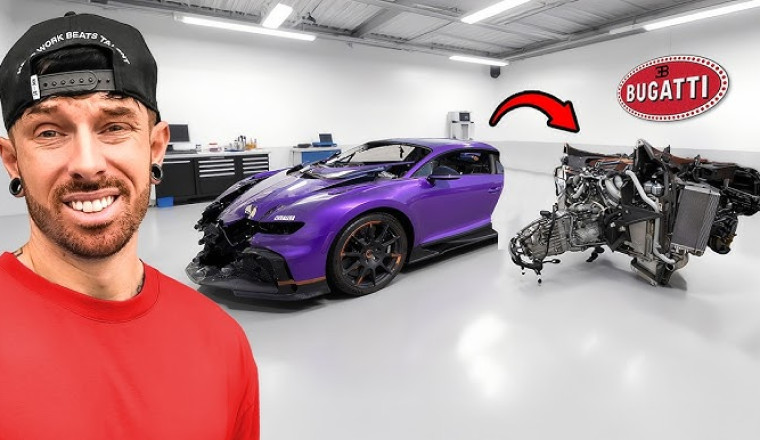

Bugatti locked the VIN. They refused to sell parts. CEO Mate Rimac personally stated the repairs exceeded what independent shops could safely accomplish and that splitting the chassis required specialized equipment available at only two facilities worldwide. The message was clear: this Chiron Pur Sport stays broken, or it goes back to Molsheim.
Mat Armstrong responded by rolling a garbage can into frame and calling his father.
The saga started when fellow YouTuber Alex Gonzalez crashed his $6 million Chiron Pur Sport during a stunt and got paid out by insurance. Then he bought it back at Copart auction for $1.6 million, paying roughly $1.9 million after fees. According to Luxury Launches, Gonzalez enlisted Armstrong to rebuild the hypercar rather than send it to Bugatti for their quoted $1.7 million repair. When that figure came in, Gonzalez did what any sensible person would do and asked a YouTuber with 3.2 million subscribers who rebuilds crashed supercars in his garage to fix it instead.
Bugatti's initial response was swift. A technician flew from France to Miami, inspected the car, and declared it a total loss. The company then blacklisted the VIN, meaning no authorized dealer could sell replacement parts. The front end absorbed massive damage, deployed airbags, cracked carbon fiber, destroyed headlights, twisted frame. But the real problem emerged when Armstrong's team pulled the car apart and discovered what looked like hairline fractures in the transmission mounts were actually enormous tears on both sides. The entire engine needed to come out, which meant splitting the chassis.
That's when Rimac got involved. According to multiple reports including Supercar Blondie, the Bugatti CEO contacted Gonzalez directly and offered to fix the car for $600,000 to $700,000 if he shipped it to France. Gonzalez refused, wanting the work done in Miami. Rimac then issued public statements explaining that the damaged gearbox and potentially compromised carbon fiber monocoque required factory expertise and that splitting the chassis was something only two shops in the world could properly accomplish using proprietary Bugatti equipment.
MotorBuzz previously covered Armstrong's visit to a Bugatti dealership where he learned the company's position on crashed vehicles. Bugatti maintains strict policies about structural repairs, particularly concerning the carbon fiber monocoque chassis that forms the Chiron's core. If the monocoque is compromised, they won't certify repairs. The reasoning makes sense for a car capable of speeds where structural weakness could prove catastrophic. Only 60 Pur Sport models were ever built, and independent specialists simply don't have experience working on these vehicles because they never get the chance.
Armstrong wasn't deterred. In the video posted to his channel, he brought in his father and together they devised a solution using equipment already sitting in the shop. They positioned the car on a standard two-post lift, then grabbed the wheeled base from a workshop garbage can along with additional scrap materials lying around. According to Hot Cars, this makeshift rig proved effective, allowing them to separate the front and rear sections despite Bugatti's warnings about needing state-of-the-art facilities with proprietary equipment.
The footage shows exactly what they did. The car sits on the lift. Armstrong and his dad position the garbage can trolley base underneath strategic points, add some additional supports cobbled together from workshop scraps, and carefully begin separating the chassis. It works. The Chiron splits cleanly, giving them access to inspect the monocoque and reach the damaged transmission that sparked this entire controversy.
Rimac's claim that only two shops worldwide possess the capability to split a Chiron chassis wasn't technically wrong. Those two shops certainly have purpose-built equipment designed specifically for this task. What Rimac didn't account for was a British YouTuber and his father figuring out that the same physics Bugatti's engineers used to design their specialized tooling could be replicated with basic workshop equipment and ingenuity. The garbage can trolley provides mobility. The lift provides vertical support. The scrap materials provide additional stability. Physics doesn't care whether the equipment cost $500,000 or came from the rubbish bin.
The repair saga continues. Armstrong still faces the challenge of actually fixing the transmission damage, sourcing or fabricating replacement parts Bugatti won't sell him, and reassembling a hypercar worth more than most houses. Gonzalez has reportedly threatened to 3D print replacement components if Bugatti continues refusing cooperation, which prompted Rimac to lift some restrictions and engage with the project rather than risk unauthorized parts entering a Chiron.
The entire situation highlights the growing tension between manufacturers' desire to control their products and customers' legal right to repair what they own. Gonzalez bought the car. He paid $1.9 million for a salvage-titled hypercar. He owns it. Bugatti's position is that he doesn't have the right to fix it outside their approved network, or at minimum shouldn't be allowed to buy the parts needed to do so. That's a philosophical stance about brand protection and liability rather than a legal position, but it's one Bugatti appears willing to enforce aggressively.
Armstrong's response was to grab a spanner and a bin trolley and get to work anyway. He documented the process, posted it to YouTube where millions watched, and proved that claims about specialized equipment requirements were overstated. Whether the final repair succeeds remains to be seen. Whether Bugatti eventually cooperates or continues fighting the project isn't yet clear. What is clear is that when the CEO of a multibillion-dollar hypercar manufacturer says something is impossible for independent shops, and a YouTuber with access to basic workshop tools proves otherwise on camera, the manufacturer's credibility takes a hit.
Mate Rimac watches Armstrong's videos now. He even comments on them. The Bugatti CEO has issued multiple public statements about the rebuild, explaining why the company won't support it and emphasizing safety concerns about unauthorized repairs on vehicles engineered to exceed 250 mph. Those concerns are legitimate. A Chiron at maximum velocity experiences forces that would destroy conventional cars. Any structural weakness could kill the driver and potentially others.
But those safety arguments become harder to defend when the impossible repair you claimed required two specialized facilities worldwide gets accomplished in a Miami garage using refuse bin components and a father-son team following the same engineering principles Bugatti's own technicians use. Either splitting the chassis truly requires proprietary equipment and specialized training, in which case Armstrong's success suggests otherwise, or Bugatti was overstating the difficulty to discourage independent repairs and protect their repair monopoly.
Armstrong's latest video shows the Chiron split open, the transmission accessible, and his father standing next to a garbage can trolley that just helped disassemble a $6 million hypercar. Bugatti said only two shops in the world could do this. Mat Armstrong with a spanner and bin trolley just made it three. The repair isn't finished. The car isn't back on the road. But the claim that it couldn't be done outside Molsheim or one other approved facility has been definitively disproven by a YouTuber who turned trash into the tool that cracked open a Bugatti.