

Alpine, in its 21st-century incarnation at least, is still a young brand, but it’s quickly growing up.
The first step in the masterplan was to make us all take notice with a sports car: the brilliant A110. Then it came up with something more attainable: the Renault 5-based A290 hot hatchback. Now it needs a car for all the family to enjoy: the new Alpine A390.
Because it’s 2025, that means it’s electric, and because the batteries need to go in the floor, it’s crossover-shaped. But stick with us, because this isn’t one of those slightly limp Esprit Alpine versions of a Renault: it’s a completely stand-alone Alpine model with a special trick up its sleeve – or rather, three of them.
This is a slightly difficult story for Alpine to tell, because the brand is all about cars being light, and as an electric crossover, the A390… isn’t that. So supposedly, the A390 is all about creating the A110’s feeling of lightness through torque vectoring and careful tuning of the traction control and stability control (ESC) systems.
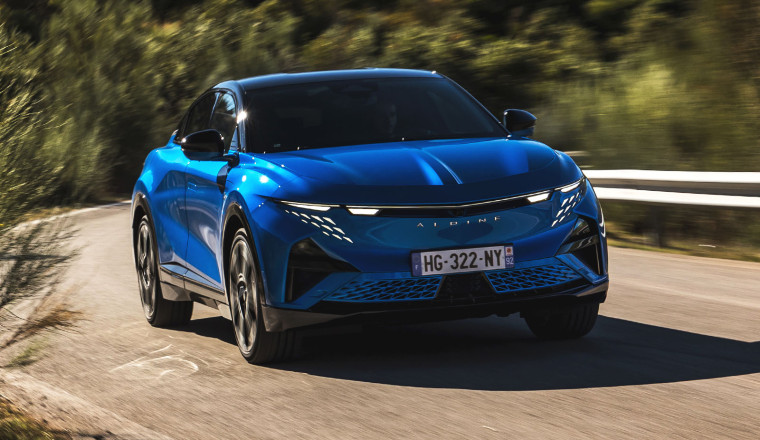
Deep down, the A390 is related to the Renault Scenic, but it isn’t just a Scenic with a sloping roof: it’s clearly trying to emulate the A110 with its curvy bonnet, central spine and visor-shaped rear windscreen. I’m not convinced it has worked, but you will be the judge of that.
Like the Tesla Model S Plaid and Maserati Granturismo Folgore, the A390 has three motors – one at the front, two at the back.
The A390 comes in two forms: GT and GTS. In both cases, there’s an asynchronous motor at the front and two back-to-back permanent magnet synchronous motors at the rear.
In the GT, they all produce 132bhp each, but the one at the front makes more torque, at 176lb ft (the rears make 156lb ft each). The GTS has three 154bhp motors making 221lb ft at the front and 193lb ft each at the back.
That lets it do proper torque vectoring: rather than just brake an inside wheel to encourage the car to turn in, it can overspeed the outside rear. This is electric performance cars coming of age and trying stuff that has no analogue in combustion-engined cars.
Polestar tries to achieve much the same effect with a clutch pack on the rear axle but, according to Alpine, that solution is slower to respond. What’s more, two smaller rear motors back-to-back are lower than one big one, thus allowing a lower boot floor.
The battery is different from the Scenic, too. This one is a bit bigger and is made in France (down to the cells), and is developed to continuously be able to deliver full power, down to a low state of charge. Unlike the Hyundai Ioniq 5N, it remains just a 400V architecture, though. Then again, the maximum charge rate of 190kW isn’t a million miles from the Hyundai’s.
Speaking of the Hyundai Ioniq 5N, that’s clearly the A390’s chief rival, since they’re only 10cm apart in length (the Hyundai is slightly bigger) and if French pricing is anything to go by, will command a very similar amount of money.
The suspension of the A390 is unusual for a performance car. First off, there are those dual rear motors. Unlike most performance cars with a rear-biased torque distribution, the A390 doesn’t have wider tyres at the back: the fronts and rears are the same size. The engineers say that the wider rear track gives the car all the traction and stability it needs, and having four identical tyres makes sourcing replacements easier. The GT runs on 20in wheels with Michelin Pilot Sport EV tyres; the GTS has 21in wheels with Pilot Sport 4Ss.
Alpine keeps it simple in other areas too: there’s no four-wheel steering and the suspension is passive for the most natural feel (although I imagine that cost plays a part here as well).
The A390’s interior bears a lot of similarities with that of the Scenic. That might be a disappointment for what is supposed to be a bespoke car, but then the fabulous Hyundai Ioniq 5 N is fundamentally an Ioniq 5.
Alpine has also successfully lifted the A390’s cabin with posher materials and a different steering wheel. The Scenic is already pretty good inside, and with Alpine’s signature soft blue leather, this environment feels suitably upmarket. The screens are the same as in the Scenic too, which is to say intuitive, quick and full-featured.
The hard-backed bucket seats are unique to the A390. They’re comfortable enough but lack a bit of support.
More of a problem is just how dark and confined the A390’s interior feels. The beltline is high and the glasshouse low, and that feeling is even worse in the back, where the privacy glass lets in very little light and the front seats block what’s coming from the front. Knee room isn’t stellar but boot space is usefully up on the Ioniq 5 N’s.
With 395bhp in the GT and 463bhp in the GTS, the A390 is down on power compared with the Ioniq 5 N, but the quoted 0-62mph times of 4.8sec and 3.9sec for the two versions are still more than quick enough, so we don’t see this as a downside.
So far, we’ve spent most time in the GTS and found it quick, no doubt, but not explosively fast. That seems like a good place for Alpine and a sporty electric crossover in general to be in.
As in the A290, the accelerator is nicely progressive and there’s a rotary dial on the steering wheel to adjust the level of regenerative braking.
What isn’t shared with the hot hatch is its pleasing brake-by-wire system. Because the A390 uses a different platform, it would have been too costly and involved to integrate here. As a result, the brake pedal feels a bit soft at the top of its travel, although the brakes have enough bite when you have to lean on them.
Alpine has its own take on EV noises. There are no simulated gears, but the synthetic noise is supposedly inspired by the A110. Like a lot of EVs, it sounds a lot like a tube train. It’s too loud and I turned it off quite quickly.
Does the A390’s chassis scream A110? Not immediately, although there is undeniably something redolent of the little sports car's manner in the crossover's particular blend of tautness and pliancy. The shared DNA is subtle, but it is there in the take-up of roll and the way the body is firmly cushioned through troughs and the like.
We first drove the A390 as a prototype on Michelin’s wet handling circuit to explore its various drive modes, and we've now driven the finished product on the road as well.
Those modes are designed to create distinct experiences but are a world away from the configuration-fest of the Ioniq 5 N. Many will prefer Alpine's more straightforward approach. There are Normal, Sport and Track modes, plus an Individual mode that lets you mix and match a few parameters, but you can’t mess around with the power split or the suspension. The engineers say they would rather give you a handful of good set-ups than infinite bad ones.
Normal mode is, it must be said, very normal. Herein the A390 finds good grip in both the wet and the dry (especially on the Pilot Sport 4S tyre), and when that runs out, it naturally defaults to mild understeer, with the ESC checking any slides before they have a chance to develop.
The passive suspension controls the body well in terms of roll but does permit a fair amount of pitch on the brakes. You can see why Alpine has configured the A390 like this: easy weight-transfer and pronounced body movements are a hallmark of the A110 experience. However, in a taller crossover the effect can be a little unnatural when you're barrelling into bends. The payback comes when you're back on the accelerator with commitment. A bit of squat helps communicate what the chassis is doing and feels satisfyingly dramatic.
Sport mode doesn’t change the torque distribution but relaxes the ESC and makes the steering slightly heavier. The difference isn’t huge, and the electronics will still fight back you if you try to misbehave. From steady-state cornering, under power the chassis will, as stated, naturally push. However, with some well-timed but gentle weight transfer on the way into a bend, you can pick up the accelerator and exit in a super-neutral power-wheel slide, within the constraints of the chassis electronics. This is the kind of Alpine-typical polish we had expected to find, and it's there to be enjoyed if you get things just right.
Track mode is where things get markedly more interesting, with the A390 starting to feel rear-driven. It will rotate on the power, and it’s at its most playful if you pitch it in on the brakes and then get hard on the accelerator. Once again, weight transfer is crucial to get the A390 properly steering on the accelerator – more so than it is the Ioniq 5 N.
Trying to provoke the car and seeing what it will let you get away with is certainly good fun, but it never feels completely natural, because even with the ESC disabled (which you can do in any drive mode, using a single physical button), you always have the four-wheel drive system second-guessing you and pulling you out of a slide before you want it. The steering is also sped rather quickly. This is again an attempt to draw a line to the A110, but here it isn't fully intuitive.
In general, the steering probably feels Renault rather than Alpine, with a glassy sub-limit feel and slightly nervous responses off-centre. The A290's steering comes alive when you really lean on it, but the A390’s limits are much higher and it’s a much bigger car, meaning opportunities to do so are rarer.
So the A390 has some verve and class about it from a handling perspective, but overall it can be difficult to exploit the triple-motor set-up on the road. At the same time, within the limits of grip the balance is overtly neutral, rather than feeling conspicuously driven forward from the hips, and there isn't much of that delicate throttle-adjustability, used to trim your line, which the A110 is all about.
For all that, the A390 rides reasonably well despite its big wheels and passive dampers. It can on rougher surfaces feel slightly busy and wooden, but it's well within acceptable bounds for a sporting model.
UK prices haven’t been announced yet, but in France the GT will be a good deal cheaper than the Ioniq 5 N (€67,500 or £59,000) and the more powerful GTS will cost exactly the same (€78,000 or £68,000). That also means it undercuts the Polestar 3 and equivalent Porsche Macan Electric by quite a bit.
On paper, it should also be more efficient and go further on a charge. The GT is rated for 3.3mpkWh, the GTS for 3.0mpkWh. That gives them 345 and 313 miles of range. We would need more testing for a representative real-world figure.
Rapid charging speeds are only okay, at 150kW for the GT and 190kW for the GTS.
We like the philosophy of the A390. It doesn’t try to be the fastest or have the most tech yet it has a dynamic party piece in the form of its torque-vectoring rear end. Despite sharing more than a few parts with the Scenic, the interior also feels suitably expensive.
With its passive suspension setup, on the road this is a car with a straightforward alertness and cohesiveness that's rare among crossovers, and that doesn't spill over into feelings of hyper-sensitivity and uncomfortable robustness underwheel. It's well-judged in this respect – useable but with an ingrained sportiness.
If there is a caveat, it's that we'd like the torque-vectoring dynamics to come to the fore more easily – for the A390 to be more discernibly throttle-adjustable, as the Hyundai Ioniq 5 N is. The potential is clearly there, and in fairness, longer exposure in the UK may well reveal hidden depths to the A390.
As a road tester, Illya drives everything from superminis to supercars, and writes reviews and comparison tests, while also managing the magazine’s Drives section. Much of his time is spent wrangling the data logger and wielding the tape measure to gather the data for Autocar’s in-depth instrumented road tests.
He loves cars that are fun and usable on the road – whether piston-powered or electric – or just cars that are very fit for purpose. When not in test cars, he drives an R53-generation Mini Cooper S or a 1990 BMW 325i Touring.
Richard is Autocar's deputy road test editor. He previously worked at Evo magazine. His role involves travelling far and wide to be among the first to drive new cars. That or heading up to Nuneaton, to fix telemetry gear to test cars at MIRA proving ground and see how faithfully they meet their makers' claims.
He's also a feature-writer for the magazine, a columnist, and can be often found on Autocar's YouTube channel.
Highlights at Autocar include a class win while driving a Bowler Defender in the British Cross Country Championship, riding shotgun with a flat-out Walter Röhrl, and setting the magazine's fastest road-test lap-time to date at the wheel of a Ferrari 296 GTB. Nursing a stricken Jeep up 2950ft to the top of a deserted Grossglockner Pass is also in the mix.