
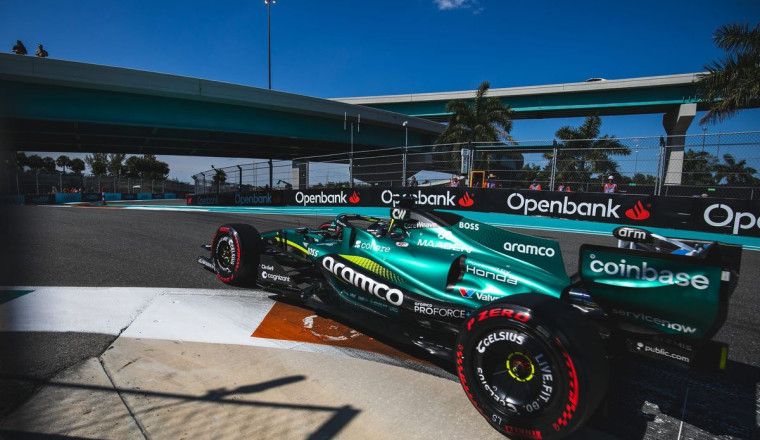

Aston Martin and Honda have now addressed their biggest Formula 1 2026 problem but as the issues run so deep, there is immediately another one to address urgently.
Having first mitigated the vibrations that were causing destructive reliability problems on Honda's engine, a combination of countermeasures across the chassis and power unit finally improved the significant driver discomfort that has also plagued Aston Martin since its AMR26 first hit the track.
This was the result of a major collaborative effort that included taking advantage of the cancellation of the Bahrain and Saudi Arabian Grands Prix to leave a car at Honda's Sakura factory after March's Japan race so engineers could finally get to the root of the vibration problems.
When asked in Miami if these had been reduced, or eliminated entirely, Fernando Alonso said: "Gone. I would say gone."
And in reliability terms the results speak for themselves: from three of a possible eight classified finishes with its two cars across three grands prix and a sprint at the start of the season, to four in one weekend in Miami.
Australian GP: Alonso DNF, Stroll unclassified
China sprint: Alonso 17th, Stroll 18th
Chinese GP: Alonso DNF, Stroll DNF
Japanese GP: Alonso 18th, Stroll DNF
–
Miami sprint: Alonso 15th, Stroll 17th
Miami GP: Alonso 15th, Stroll 17th
Though Aston Martin's chief trackside officer Mike Krack cautioned that "we are still talking about modest results", this is a relative win for the strategy of focusing almost entirely on reliability until now.
With that box ticked, a different problem has moved to the front of the queue. Throughout qualifying in Miami, Alonso was hampered by erratic gearbox behaviour that he described as making the car almost undriveable.
"The biggest problem for me was the gearbox," he said. "It was impossible to drive. I lost sync in every braking point, I had no acceleration out of the corners, and the downshifts were all over the place, very random.
“Sometimes I had push, sometimes I had rear locking. That was a bad surprise."
There was more of the same on Sunday. And with Canada next on the calendar, Alonso's made it clear this is something Aston Martin - which has developed its own gearbox for the first time since 2008 - must improve.
"It was more the gearbox the whole weekend than the engine," he said.
"It was very weird on the downshifts and the upshifts. So not very well in control.
"That's the fix number one for Canada. With all these heavy brakings in Canada we need to improve the gearbox behaviour at the moment."
Some driveability improvements and chassis weight reductions were also in effect for Miami but improving the dire performance has not been the priority.
Given Aston Martin's cars were slowest of all at the previous race in Japan, and lacked high-speed downforce in particular, it was a surprise to see F1's 'worst' car was the only one without a single declared upgrade in Miami.
This relates specifically to what is visible - that's the requirement from the FIA - but it means there were no prominent aerodynamic or mechanical developments, though a lighter car is obviously an improvement in theory.
Performance will gradually move further up the queue. As Lance Stroll said: "We have no downforce. We have no power. So those are the things we need to work on."
But there are supposedly no conventional performance upgrades coming "until after summer", according to Alonso.
He has been circumspect about Aston Martin not bothering with short-term upgrade packages because the car is so far off the midfield that only major improvements will actually make a meaningful difference.
"There is not really any point to bring two tenths, three tenths, four tenths into the race track because you cannot capitalise [on] that in terms of results because there is one second to the next car in front of you," he said.
"We don't need to come to Canada and wonder what to expect. Austria, the same.
“Until we have a second-and-a-half- or two-second improvement it's better not to press the button into production because we waste money."
Alonso said he is at "peace because I understand the situation". While Aston Martin works on bigger R&D projects at its factory, and Honda readies longer-term engine performance upgrades once those are approved by the FIA, the gains in the short-term will be modest.
Honda will seek to make some small gains with its energy management settings and driveability. Aston Martin may be able to chip away at its weight deficit, and see if it can get the gearbox working more smoothly.
As the team finally enters a phase where it can hopefully aim for a lot of laps and more learning, the AMR26 could get a little faster just by being optimised, too.
"We have a lot to extract from this package the way it is at the moment," said Krack.
"It's important that we keep everybody motivated to work on that, and then wait for the big steps to come."