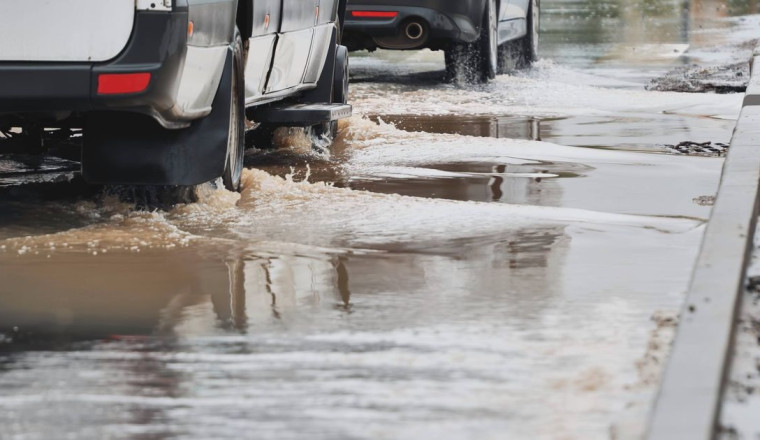

As heavy rain is predicted today across southern England and Wales, motorists are being cautioned that splashing pedestrians by driving through puddles could result in a substantial fine. An expert has also highlighted the potential dangers lurking beneath puddles and how they could inflict serious damage to your vehicle.
Matt Crole-Rees, car insurance specialist at Confused.com, warned: "Driving through puddles might seem harmless, but it can have serious consequences. If a driver is caught splashing a pedestrian, it can be treated as careless or inconsiderate driving. This can result in a £100 fixed penalty and three points on your licence, or in more serious cases, a court fine of up to £5,000.
"Besides the legal implications, puddles can create unpredictable driving conditions. Drivers have no way of knowing what's underneath the water, which could include potholes or damaged road surfaces.
Standing water also increases the risk of aquaplaning, where tyres lose grip and the driver can momentarily lose control of the vehicle. "To reduce the risk of fines and stay safe, drivers should slow down in wet conditions and stay alert to pedestrians walking close to the road. It's not always safe to steer around puddles, especially on narrow or two-way roads, so easing off the accelerator and passing through slowly can help reduce the chance of splashing pedestrians and avoid putting others at risk."
Highway Code rules 226 to 237 cover driving in extreme weather. This includes wet weather, icy and snowy weather, windy weather, fog and hot weather.
Rule 226
You MUST use headlights when visibility is seriously reduced, generally when you cannot see for more than 100 metres (328 feet). You may also use front or rear fog lights but you MUST switch them off when visibility improves (see Rule 236).
Rule 227
Wet weather. In wet weather, stopping distances will be at least double those required for stopping on dry roads (see ‘Typical stopping distances’). This is because your tyres have less grip on the road. In wet weather:
Rule 228
In winter check the local weather forecast for warnings of icy or snowy weather. DO NOT drive in these conditions unless your journey is essential. If it is, take great care and allow more time for your journey. Take an emergency kit of de-icer and ice scraper, torch, warm clothing and boots, first aid kit, jump leads and a shovel, together with a warm drink and emergency food in case you get stuck or your vehicle breaks down.
Rule 229
Before you set off:
Rule 230
When driving in icy or snowy weather:
View 3 Images
Driving conditions are oikely to be difficult for many today(Image: Getty Images)
Rule 231
Drive extremely carefully when the roads are icy. Avoid sudden actions as these could cause loss of control. You should:
Rule 232
High-sided vehicles are most affected by windy weather, but strong gusts can also blow a car, cyclist, motorcyclist or horse rider off course. This can happen on open stretches of road exposed to strong crosswinds, or when passing bridges or gaps in hedges.
Rule 233
In very windy weather your vehicle may be affected by turbulence created by large vehicles. Motorcyclists are particularly affected, so keep well back from them when they are overtaking a high-sided vehicle.
Rule 234
Before entering fog check your mirrors then slow down.
If ‘Fog’ is shown on a sign but the road is clear, be prepared for a bank of fog or drifting patchy fog ahead. Even if it seems to be clearing, you can suddenly find yourself in thick fog.
Rule 235
When driving in fog you should:
Rule 236
You MUST NOT use front or rear fog lights unless visibility is seriously reduced (see Rule 226) as they dazzle other road users and can obscure your brake lights. You MUST switch them off when visibility improves.
Rule 237
In hot weather, keep your vehicle well-ventilated to avoid drowsiness. Be aware that the road surface may become soft or if it rains after a dry spell it may become slippery. These conditions could affect your steering and braking. If you are dazzled by bright sunlight, slow down and if necessary, stop.