

► All-new AMG GT four-door EV revealed
► AMG.EA platform, axial flux motors
► Plus, active aero and V8 soundtrack
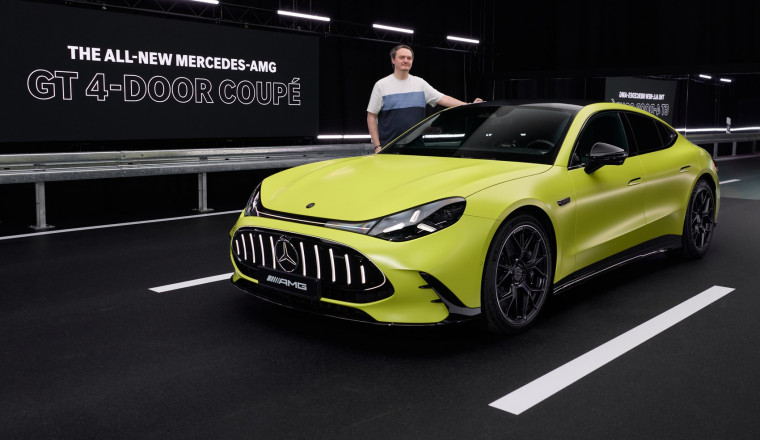
AMG is going all out with its new era of EVs, starting right here: this is the all-new AMG GT four-door.
The new-generation electric grand tourer launches with a novel electric motor design, an entirely new platform that will underpin several extremely high-powered EVs in the years to come.
‘I’m 120 per cent convinced that it will really change the game,’ says AMG boss Michael Scheibe. ‘It’s a truly revolutionary car. Not only in terms of its design, but the technology. It’s a real technological monster.’ Hyperbole? Possibly. But the AMG GT’s long list of new tech builds a strong case for itself.
And worry not; the launch of this new and… aesthetically challenging electric AMG does not mean the world is ending just yet. More AMGs with combustion engines, including V8s, are on the way.
‘Aesthetically challenging’ is putting it mildly…
Yes. The consensus in the CAR office is that this is most certainly not a looker. Some of the design is to be expected, given we’ve had some hints and teasers up to the car’s unveil. The GT XX prototype that previewed the technology that lies beneath the new AMG GT four-door also pointed us in the general direction of how it would be designed. But some of this is still a lot to swallow.
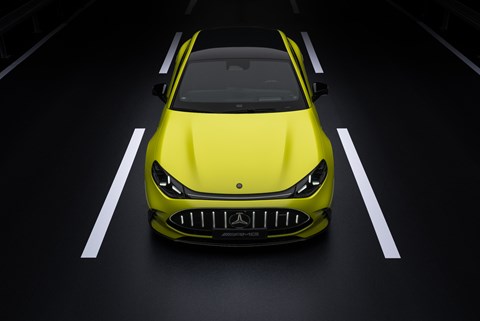
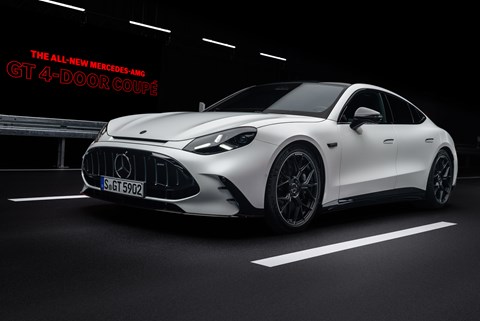
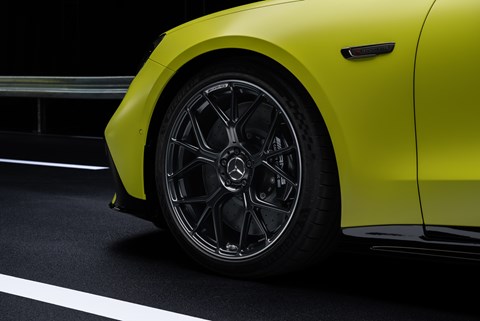
Its look has evolved from the GT XX development mule with the production car’s face being slightly less dopey-eyed catfish than the XX model but more angry basking shark, albeit with a ‘grille’ that’s blanked-off (the GT XX’s was real and functionally useful) and optionally backlit vertical strakes that look like venting. Its stance is certainly more aggressive and a little less cab-rear than the XX, with some properly intricate wheel designs and a remarkably low ride height despite the battery pack being under the floor. It’s 5094mm long, 1959mm wide and 1411mm tall, making it longer and a smidge taller than a Taycan but a similar footprint to a Lotus Emeya.
What’s perhaps most challenging to look at is that rear end. It almost looks like the visor from a pair of ski googles, with a large dark-colour panel blunting the car’s backside. A pair of three circular taillights each with their own three-pointed star inside are a badly translated carry-over from the XX here, but the production-spec GT benefits from active aerodynamics that shapeshift the car’s silhouette just like the XX did.
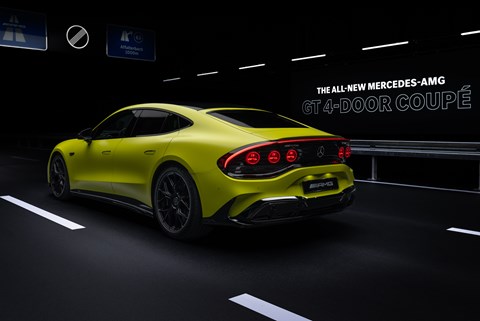
As well as some active air dams inset into the front bumper and an active rear spoiler that lifts and changes angle depending on speed, complex air channels run underneath the car enables a motorsport-spec venturi effect. ‘Where it gets really interesting, though, is that we’ve added an active rear diffuser – we think that’s a world first,’ says GT project manager, Oliver Ganzmann. He adds that this is an aerodynamic trick that’s been brought over from both the Vision EQ XX – the low-drag, super-slippery and efficient prototype that has repeatedly clocked more than one thousand kilometres on a single battery charge – as well as the GT XX. When fully receded, the diffuser is designed for maximum aerodynamic efficiency but, when fully extended, its aim shifts to focus on high-speed stability. It deploys automatically at 74mph (so it’s a good marker for if you’re speeding in the UK…) or can be manually deployed in the car.
Speaking of the interior…
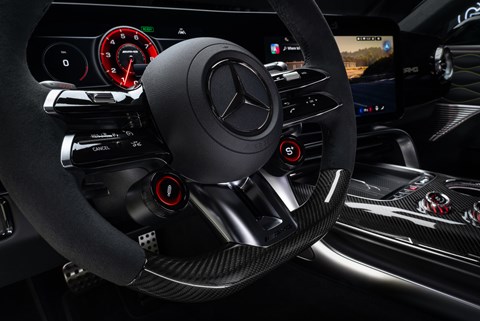
A lot of this will be largely unsurprising in here. It’s a proper performance car interior with plenty of microfibre upholstery, a chunky steering wheel beset with AMG’s usual suite of customisable switches, thickly bolstered performance seats and a shallow glasshouse that almost gives the impression it’s a two-door.
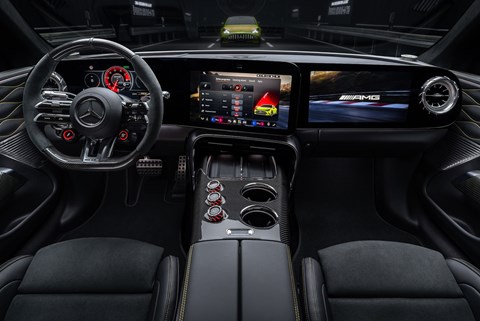
The GT four-door includes three big displays inset into its dashboard panel running an AMG-reskinned version of MBUX, which comes complete with a bunch of performance car graphics and design details.
Perhaps the only unique thing about the GT four-door’s interior is the trio of switches on the centre console that are designed to alter the car’s dynamics to suit the situation. The software running it is named AMG Race Engineer, which enables direct access to every facet of the car’s handling attributes and gives you control of details like power delivery, braking, recuperation and body control.
And… more power than an AMG One?
1153bhp to be precise, so long as you choose the more powerful AMG GT63 version.
That’s enabled by a trio of axial flux electric motors designed and manufactured by Mercedes subsidiary Yasa, with one on the front and two on the rear. That enormous power figure allows this four-door GT to accelerate to 62mph in 2.1 seconds and a 0-124mph speed over with in 6.4 seconds. There is also a GT55 variant (pictured in white) that has to deal with a piffling 805bhp but, even then, this model can still sprint to 62mph in 2.5 seconds.
Dr. Claus Schulte-Cörne, head of e-drive at AMG, says: ‘axial flux motors have about 70 per cent less length and overall volume, but our power and torque density is two, maybe three times higher [than a conventional radial motor used by almost all other EVs on the road].’ AMG engineers claim better reliability, but their much smaller size means they’re also easier to repair – and better for heat dissipation. ‘In a regular motor, the rotor is deep inside a large housing,’ says Schulte-Cörne, ‘so you cannot get any heat transfer. With these axial motors, we have a much bigger surface area for much better heat transfer.’
Naturally, the battery pack has to be pretty hardy too. The new AMG.EA platform launches with a battery configuration that uses slim cylindrical cells that engineers say are best for cooling, enabling much better endurance in the long run.
The two power variants of the GT benefit from the same capacity battery pack at 106kWh. It’s all connected via an 800-volt electrical architecture for extreme charging speeds, with AMG’s engineers claiming a peak DC speed of 600kW. A 10 to 80 per cent charge would be done in 11 minutes at that max rate, with Mercedes working with Alpitronic to roll out chargers capable of such rates via its own growing network around the world.
To handle all the power and torque, GT four-doors come standard with rear-wheel steering, AMG-spec semi-active roll stabilisation and carbon ceramic front brakes.
And it sounds like a V8?!
That’s perhaps the most interesting bit – a bit of technology called AMGForce. It’s a party piece for the GT four-door that acts a lot like Hyundai’s N Shift technology. Paddles on the steering wheel adjust the level of regeneration by default but, when in S+ mode, AMGForce activates and turns your silent EV into a grand tourer that seemingly has a classic AMG V8 under the bonnet and simulated ‘gears’ to match.
‘It’s all about the emotion now, and sound in particular is so important for Mercedes-AMG customers, so we hired the best sound talents with many coming from the music industry,’ says Scheibe, to the point that he says AMG developed its own ‘ministry of sound’ to accurately develop sounds with cross-department teams.
The result is convincing; pressing the throttle elicits a deep, bellowing bark from speakers built into the car that’s audible both inside and out. But there’s more to it than that; there are pops and bangs when you lift off like the tastiest of performance exhausts and intricate vibrations in the seat provide an entirely persuasive tactility to the tech that even Hyundai can’t offer. The paddles work like a dual-clutch transmission, enabling you to ‘shift’ gears with a corresponding torque dip from the e-motors; the only difference between this and Hyundai’s technology is there is no synthetic redline that cuts power here.
When and how much?
AMG says you’ll be able to order a new GT four-door very soon, with production starting in the summer of 2026.