

► Project Nightingale previews e-droptop for 2028
► First of new Coachbuild Collection team
► More EVs coming – but V12s will live on beyond 2030
If, like us, you were expecting the next electric Rolls-Royce after the successful Spectre coupe to be a production version of the SUV that’s been photographed as a camouflaged prototype – well, here’s a nice surprise.
For now it’s called Project Nightingale, and it may well be called Nightingale when the 100 customers receive their hand-built cars in 2028. Why 100? Because it’s not a full series-production model. Rather, it’s the first Coachbuild Collection product.
Coachbuild is the sub-division of the Bespoke customisation department that will build one-off cars in collaboration with ultra-wealthy Rolls fans. Coachbuild Collection isn’t quite as hardcore as that, although it’s still only for repeat customers, by invitation only.
It’s aimed at those who want something rare, but who don’t have the time or the inclination to work closely over the course of several years with Rolls designers and engineers. Customers get to choose the colours of the body, the upholstery and the roof. Some of the 100 customers – spread across Asia, the US and Europe – have been involved from the sketch phase at the start of the project two years ago, but more as observers than participants.
As ever with these special projects, Rolls isn’t talking prices – but it will be more than £1 million.
Talk us around the body…
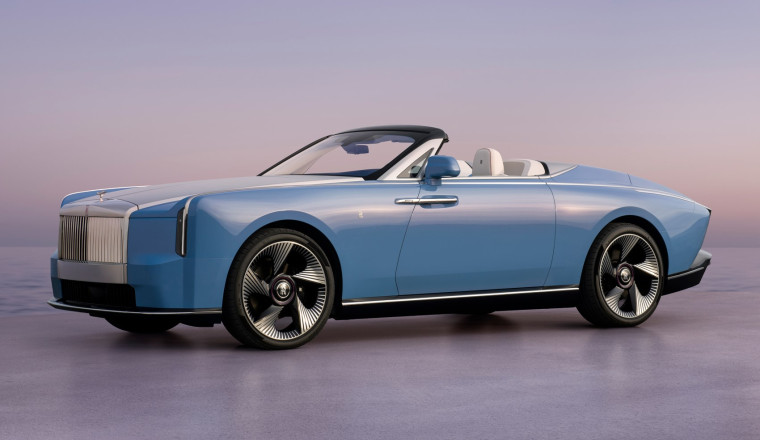
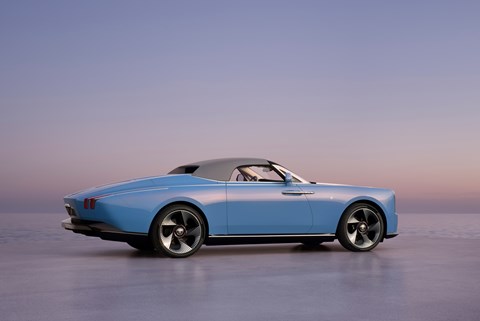
It’s a two-door, two-seat convertible, with an upright nose, clean sides and a drooping tail. The proportions were inspired by the 1928 EX Torpedo models: ‘it’s almost all bonnet and tail with a very small cabin,’ in the words of Coachbuild design lead Jacobo Ojea Dominguez. The Streamline Moderne school of architecture and design of the 1930s was also a big influence, with its emphasis on aerodynamics, curves, long horizontal lines, and nods to boats and trains.
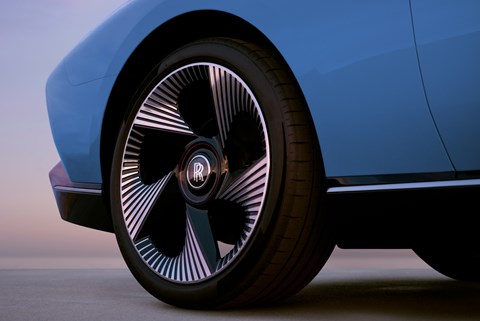
Project Nightingale has the biggest rims ever fitted to a Rolls, at 24 inches in diameter. All four wheels are different, as they are directional (so the lefts and rights mirror one another) and the rears are wider than the fronts.
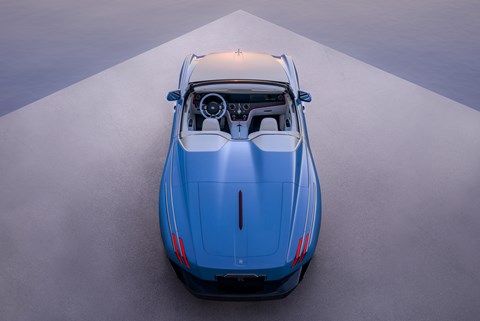
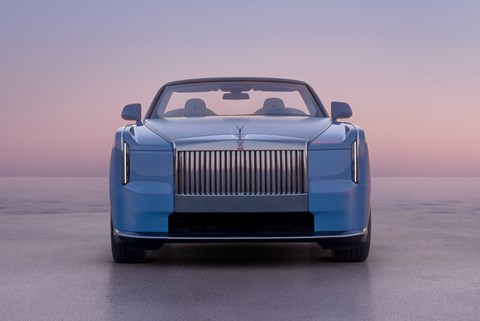
The familiar Rolls ‘Parthenon’ grille is wider than usual, at almost a metre, made possible by the ultra-slim vertical lights: just 55mm wide, they incorporate DRLs, headlights and indicators. At the rear, the lights are similarly slender, but twinned, and they turn 90º from the top of the boot to the back. There’s also a central brake light, long and slender, forming part of the centreline that starts with the Spirit of Ecstasy and runs through the cabin.
The lower edges of the nose and tail have carbonfibre aerodynamic mouldings, achieving positive downforce at speed and making the sloping tail possible, with no need for wings or spoilers. The black theme is continued along the bottom of the sides, helping give the illusion that the car is smaller than it is; it’s actually as long as the standard-wheelbase Phantom.
A decorative hull line runs from nose to tail, joined by a second line towards the rear to evoke the wake of a boat. The overall look has strong echoes of the Arcadia Droptail from a couple of years ago, but that was powered by a V12, and differs in many details.
Dominguez says: ‘We started with the feeling. This car is about wind in your hair – about openness. The experience of driving is a destination in itself.’
…and now the cabin
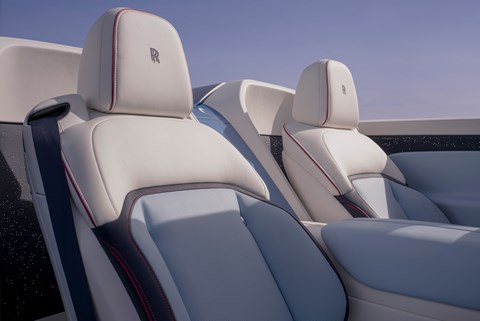
At first glance it looks conventional for a Rolls: roomy, plush and blessed with plenty of physical switches and dials. But look closer and there are new elements, including some shapes that echo saddles and horseshoes (which may seem random, but they reflect the lifestyles of the ultra-wealthy client base).
The central armrest slides back to reveal the multifunction controller, and then slides back further to reveal a ‘secret’ compartment. There’s a new finish on some of the controls – part polished, part sandblasted.
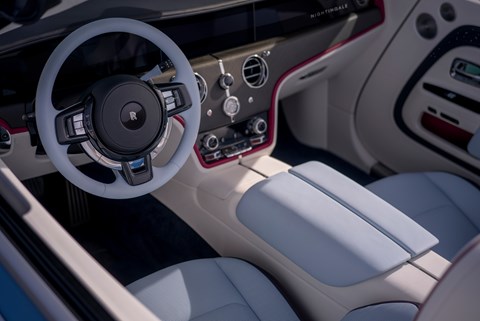
In the absence of a fixed roof, which Rolls would normally decorate with hundreds of tiny LEDs making intricate patterns, the Nightingale instead has 10,500 lights forming a pattern inspired by the soundwaves of the nightingale’s song. And the dash rises at each end, evoking a nightingale in flight.
There’s room for a bespoke bag behind each seat. The boot has a grand piano-style sideways opening, and should have room for two sets of golf clubs. But there’s no frunk – despite the vast size of the bonnet and the absence of an engine, it’s full up with electric componentry and heating/ventilation hardware.
The roof is still a work in progress, but when it’s finished it will be a part-cashmere folding softop that disappears into a compartment between the cabin and boot. When it’s up, it brings out the 1920s vibes, with very shallow side windows.
What’s under the skin?
That’s even more of a work in progress. All they’re saying so far is that it uses the aluminium spaceframe common to the current Rolls line-up, and an electric powertrain. Don’t expect it to be very different from the Spectre’s, but it will have the benefit of a few years of progress in cell chemistry.
Although the design is largely complete, the dynamic elements needs finalising. A programme of road testing begins in August, and crash testing for homologation purposes. More time in the wind tunnel is also needed, although so far the car’s shape has proved to be impressively sleek. Data from all that will lead to tweaks of the powertrain and chassis, and more testing will be conducted in 2027.
And the name?
Co-founder Henry Royce had an estate on the French Riviera called Le Rossignol, French for ‘the nightingale’.
So, what’s next from Rolls?
As ever, they’re not saying much. The previously announced plan to go all-electric by 2030 has been dropped, but there will still be a gradual roll-out of new EVs over the next few years, with an SUV expected to be next. The revised plan means that the familiar V12 will continue to be available for the foreseeable future for those customers who prefer an engine.
There will more Coachbuild Collections – a new one every four years or so. They won’t necessarily be 100-strong, but feedback from customers and dealers worldwide suggests that might be about the right balance of exclusivity and availability.
Phil Harnett, head of future product, says: ‘With 100 units you can do things that you can’t with a series production car’ – things like hand-made lights.