Three weeks of filming. Three cars each. A compliant mayor who wanted Hollywood money flowing into San Francisco. Real streets, closed for a few hours at a time while drivers hit 110 miles per hour between the hills. And at the end of it all, 10 minutes and 53 seconds of footage that remains, 57 years later, the most imitated car chase in cinema history.
Bullitt came out in 1968. Steve McQueen wanted the best car chase ever filmed and told his camera crew money was no object. He spent weeks rehearsing with stunt driver Bill Hickman at the old Cotati Speedway before a single shot was taken in the city. The production sourced two Highland Green 1968 Ford Mustang GT fastbacks and three 1968 Dodge Charger R/Ts. Stunt coordinator Carey Loftin, stuntman Bud Ekins and Hickman did most of the actual driving. McQueen did approximately 10 percent, but made certain audiences knew he was there: he deliberately kept his head near the open window throughout the chase scenes so that people watching in cinemas could see his face. Director Peter Yates called for speeds of around 80 miles per hour. The cars hit 110.
The reverse burnout, that moment where the Mustang swings sideways having apparently missed a turn, was not in the script. McQueen had genuinely missed the turn. Yates kept it because it was real.
That is the thing about Bullitt. There are no special effects. There is no score over the chase. There is just engine noise, tyre squeal and gear shifts. The San Francisco hills become a character, launching both cars airborne on their crests. The hubcaps that fly off during the chase are real hubcaps that genuinely came off. When the Charger loses a wheel, that happened on the day.
The car that McQueen drove was later purchased by a Warner Bros employee, ended up in New Jersey, and eventually sold at auction in 2020 for $3.74 million.
The films that followed in its wake
Bullitt set a template that every serious car chase film since has at least tried to honour.
The French Connection in 1971 put William Friedkin under the elevated railway in Brooklyn with Gene Hackman pursuing a train through live traffic with no road closures and a minimal crew. Friedkin has spoken about how they simply drove fast through real streets with a car rigged for camera work. People on the street genuinely swerved to get out of the way. Some of the near misses were not planned.
Ronin in 1998 brought it back in the modern era. Director John Frankenheimer, who had cut his teeth on Grand Prix in 1966, choreographed high speed reverse pursuit through the streets of Paris in a way that left audiences genuinely unsure which of the impacts were intended. The answer, in several cases, was: most of them. Real cars, real speeds, real streets.
Baby Driver in 2017 opened with a chase sequence around downtown Atlanta that director Edgar Wright had storyboarded to the second and then drilled with his drivers until the car became an instrument responding to the music. No CGI. Practical locations. The Subaru WRX that opens the film was driven by a real driver at real speed.
The thing these sequences share is physical consequence. When a car hits a wall, you see the wall. When a wheel leaves a car, you see it rolling. When a stuntman pulls a handbrake, the back end follows the laws of physics rather than the demands of a compositor. The audience's body knows the difference even when the conscious mind cannot articulate it.
Like this? Get the app: iOS | Android
Where the F1 movie sits in this conversation
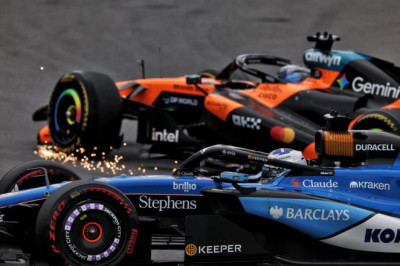
The F1 film, released in June 2025 with Brad Pitt as Sonny Hayes and directed by Joseph Kosinski, took a different approach and a genuinely interesting one. The production shot at actual Formula One weekends in 2023 and 2024, using real circuits during real race sessions, with a purpose built filming car. Cinematographer Claudio Miranda, who shot Top Gun: Maverick, brought the same philosophy of mounting cameras on real vehicles at real speed rather than relying on studio work.
The results were genuinely impressive in parts. Audience reviews consistently praised the racing sequences. Sight and Sound, in a broadly critical review, acknowledged the film strives hard to emulate Formula One's thrills and often succeeds. The film earned $57 million on its opening weekend in the US and went on to become the highest grossing Brad Pitt film ever made, eventually surpassing $540 million at the box office.
But there is a split verdict running through the reaction to it, and it maps almost exactly onto the real versus CGI question.
Hard core Formula One fans found the race sequences spectacular and the racing logic indefensible. Pit stop timings were described as fictional. Strategy made no sense. One IMDB reviewer estimated roughly 30 percent of the racing footage was computer generated. Others pushed back and said those critics missed the point: if you want accuracy, watch a race broadcast. Sight and Sound's review described the film as "bruisingly tech-reliant" and noted that the dialogue scenes were filmed almost entirely in sterile, highly polished spaces: showrooms, simulators, hotel suites. The physical world, with its texture and consequence, was conspicuously absent outside of the racing itself.
The comparison to Bullitt is not entirely fair: Formula One cars at 200 miles per hour on live circuits cannot be filmed the same way McQueen filmed a Mustang through San Francisco in 1968. Some CGI is simply unavoidable at that level of speed and proximity. But the degree to which audiences trusted the F1 film's racing, compared to the instinctive, bodily certainty they feel watching Bullitt or The French Connection, reflects something real about how physical filmmaking communicates to the human nervous system.
Kosinski himself made the point most convincingly in Top Gun: Maverick, which used real F-18s with real pilots and real actual gravitational load and became one of the most commercially successful films of the 2020s. The cockpit footage in that film works because audiences could see the actors being physically thrown around by actual aerobatic manoeuvres. The F1 film had a harder task and did it with more CGI.
Why practical still wins
The answer is not that computer generated imagery is bad. It is that the body knows physics. When a camera is mounted on a car doing 90 miles per hour around a real corner, the lens distorts slightly under genuine gravitational load. The sound crew picks up real tyre howl. The background blur carries genuine velocity information. The human brain has spent millions of years calibrating its responses to physical motion and it reads those signals at a level below conscious thought.
CGI can replicate the appearance of a car chase. It cannot replicate the physics of one. The best car chases in cinema history understood this, and they were made by people willing to close real roads, modify real cars, rehearse real drivers for weeks, and then just go.
McQueen's Mustang launched off those San Francisco hills because San Francisco has hills and the car was actually there. That is still, after more than half a century, the thing audiences cannot quite get from anything else.
Sources: