
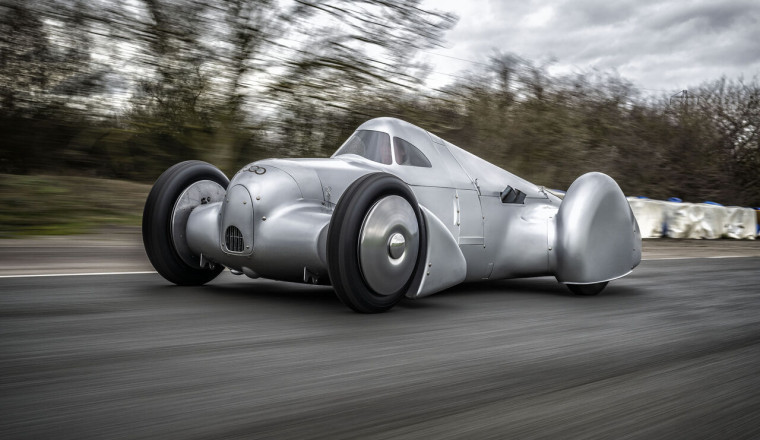

Something doesn't smell right in Ingolstadt. While automotive enthusiasts across social media celebrate Audi's supposed resurrection of the legendary 1935 Auto Union Lucca, a closer examination of the historical record reveals a troubling reality: this "record breaking" racing car appears to never have existed.
The story sounds compelling enough. Audi Tradition, the company's respected heritage department, has allegedly recreated a one off Auto Union racing machine that dominated pre war competition. The narrative ticks every box for automotive nostalgia: German engineering excellence, a lost prototype, meticulous restoration work bringing history back to life.
Yet comprehensive searches through Auto Union's documented racing history from the 1930s reveal no mention of any model called the "Lucca." The company's racing cars from that era followed a clear naming convention, designated as Type A, Type B, and Type C models. These were the machines designed by Ferdinand Porsche that actually did set speed records, including the Type C's documented land speed achievement of 406.32 km/h in 1937 on the Frankfurt-Darmstadt autobahn.
Auto Union itself was formed in 1932 through the merger of four German manufacturers: Audi, DKW, Horch, and Wanderer. Their silver arrows dominated Grand Prix racing alongside Mercedes-Benz throughout the decade. The company's actual racing legacy is extensively documented, photographed, and preserved in automotive museums worldwide.
Audi Tradition, established to maintain the brand's legitimate historical vehicles, has indeed restored several genuine Auto Union racing cars over the years. Their work on authentic Type A and Type C models has been celebrated by historians and collectors. The department operates with scholarly rigor, working from original blueprints and consulting period documentation.
Like this? Get the app: iOS | Android
Which makes the Lucca story even more puzzling. If Audi Tradition had genuinely discovered and restored a previously unknown Auto Union prototype, the automotive world would be buzzing with legitimate coverage from established motoring publications. Classic car auction houses would be estimating values in the tens of millions. Racing historians would be rewriting books.
Instead, the story appears to exist primarily in social media posts and unverified online claims. No major automotive publications have covered this supposed restoration. No official press releases exist from Audi AG or Audi Tradition announcing the project. The company's official heritage communications focus on their documented historical vehicles, not mysterious discoveries.
The pattern resembles other automotive urban legends that periodically surface online. Claims about "lost" Ferrari prototypes, "secret" Porsche racing cars, or "rediscovered" manufacturer archives regularly circulate among enthusiasts eager to believe in hidden automotive treasures. Most prove to be misidentified vehicles, wishful thinking, or deliberate misinformation.
For GaukMotorBuzz readers, this serves as a reminder that automotive history, like any other field, requires careful verification. The appeal of discovering forgotten racing legends can override critical thinking, especially when stories align with our preferences about particular brands or eras.
Audi's actual heritage deserves celebration without fictional embellishment. Their genuine Auto Union racing cars represent legitimate engineering achievements that influenced automotive development for decades. The real Type C that set speed records in 1937 remains one of the most significant racing machines ever built.
As for the mysterious Lucca, its greatest achievement may be demonstrating how quickly automotive mythology can spread in the digital age, even when the underlying facts refuse to cooperate with the narrative.
Research conducted through Auto Union historical documentation and Audi AG official communications. No credible sources located confirming existence of "Auto Union Lucca" model or recent restoration project.