
Porsche fans are probably aware that the 993 generation (1994 to 1998) was the last of the air-cooled 911s. What may come as a surprise is that vintage Porsche 911s are not exclusively air-cooled. In fact, they use a mixture of air and oil cooling to keep the 911's flat-6 motor from overheating. This is very different from a liquid-cooled engine, which relies on radiators, coolant jackets, and pumps to keep things in working order.
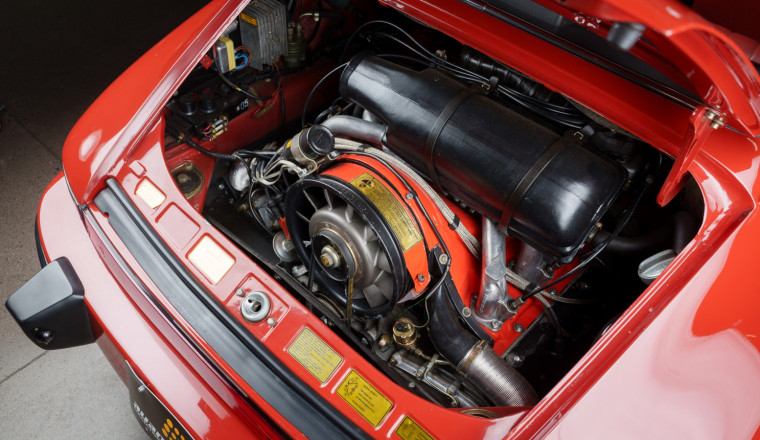
If you've ever peeked into a classic 911's derriere, you'll notice a huge cooling fan sitting atop the engine. The flat-6's cylinder barrels and heads are very motorcycle-like in that they use fins to increase the surface area for better heat dissipation. The fan is responsible for shoving lots of cool air into the 911's engine compartment, where it passes over the flat-6 and its many auxiliary components, then exits through the bottom of the car.
That, however, is the air-cooled side of the equation. Within the engine compartment usually sits an engine-mounted oil cooler that, much like a passive heat exchanger, transfers lubricating oil from the engine and circulates it back through dedicated hot and cold flow paths. But not all air-cooled 911s have an engine-mounted oil cooler from the factory. Porsche dropped it for the 964 (1989 to 1994) and 993-generation 911s. These do still have oil coolers. It's just that Porsche decided to use front-mounted oil coolers with fans instead, as seen in the late G-series cars (1987 to 1989).
Auxiliary oil coolers (the front, fender-mounted kind) were first seen in the 1969 Porsche 911S. But the vast majority of 1965-1973 cars did not have a front oil cooler. That's primarily because they were initially offered as an optional extra. Porsche, however, did make them standard equipment on later model years, starting with the 1978 SC. Unlike the first-gen coolers, cars from 1973 to 1983 had an upgraded version dubbed the loop cooler, with 1984 U.S.-spec Carreras featuring an even better 28-tube brass-type design. 1987-1989 911s transitioned from passive to active cooling, pairing a radiator-style aluminum oil cooler with a powerful electric fan.
The reason seems pretty obvious. The main cooling fan is rpm-dependent, since it runs off the crankshaft through a V-belt-pulley arrangement — justifying the addition of oil cooling.
Context:
Air-cooled Porsches actually use both air and oil cooling systems to manage engine temperatures effectively.
Context:
This hybrid approach was crucial as 911s gained more power over generations, requiring enhanced cooling solutions.
Context:
The 911's cooling fan runs directly off the crankshaft via belt, making oil cooling essential at low RPMs.