

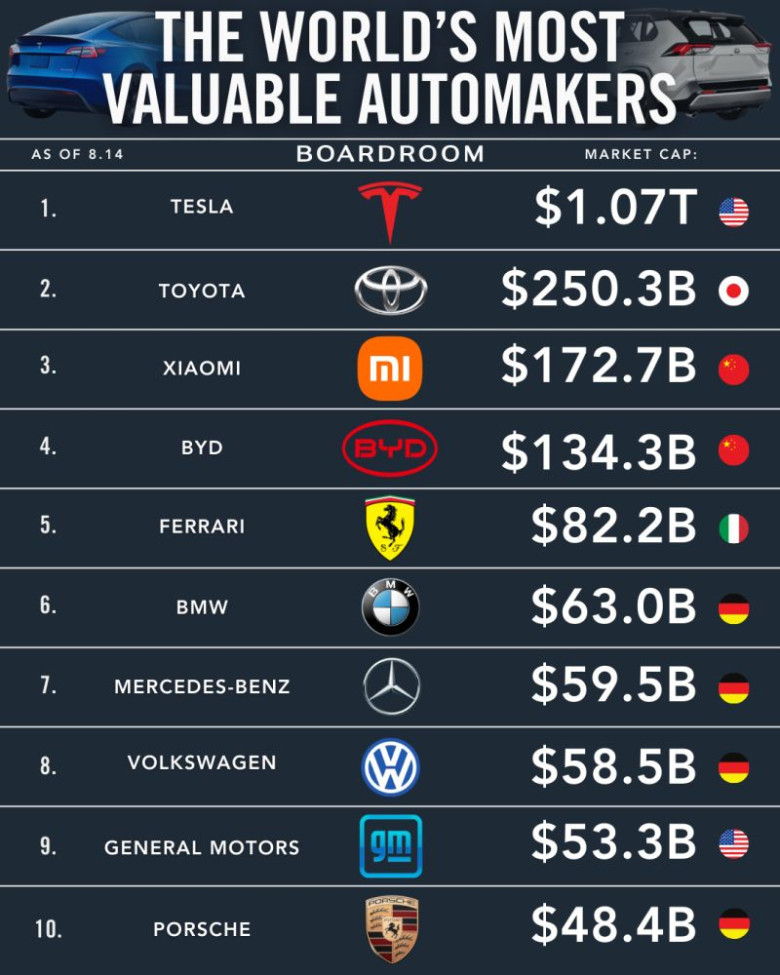
While Toyota holds strong as the second-largest automaker by market share, Asian companies, including China's BYD and tech giant Xiaomi, now closely follow, signaling Asia’s rise as a dominant force in the global automotive landscape.
Global Auto Industry Rankings — Tesla, Toyota, and the Asian Surge
According to the latest global sales data for 2025, Toyota commands the largest market share of around 10.8%, thanks to its broad lineup of reliable vehicles and significant presence in both combustion and hybrid models. Volkswagen, Ford, Hyundai, and Honda round out major players with solid worldwide footprints.
However, beyond Toyota and these Western stalwarts, the rapidly expanding Asian automotive sector demands attention. China’s BYD has surged to a top 10 global position, growing sales by over 13% this year and becoming a central player in Europe and America for electric vehicles. Xiaomi, leveraging its technological expertise, has made aggressive moves in EV production and smart car development, underscoring Asia’s innovation leadership in automotive technology.
This reshuffle highlights an important shift: while Tesla remains the global leader with its pioneering electric technology and market influence, Asia's strength through companies like BYD and Xiaomi is profoundly challenging traditional powerhouses.
Tesla’s Innovations Extend Beyond Vehicles
Tesla's leadership isn't limited to vehicle sales. The company is aggressively pushing new frontiers in autonomous and robotaxi technology. In New York, Tesla is quietly advancing its Robotaxi plans by recruiting test drivers for "automated driving systems" testing in Queens. Notably, this activity is happening even though Tesla has not formally applied for city approvals to test autonomous vehicles there.
Moreover, Tesla recently won a permit to operate a ride-hailing business in Texas, positioning itself to revolutionize urban mobility by combining its electric fleet with advanced self-driving software. This initiative showcases Tesla’s ambition to reshape transportation — from selling cars to operating autonomous ride services — cementing its role as not only an automaker but a mobility technology powerhouse.
What This Means Moving Forward
Tesla's global dominance is backed by continuous innovation, a loyal consumer base, and aggressive adoption of cutting-edge technology. Still, it faces intensifying competition from established automakers and nimble Asian newcomers who are quick to innovate and scale.
Meanwhile, Tesla’s moves into robotaxis and autonomous ride-hailing signal a bold future: a shift from vehicle manufacturer to full mobility service provider. As regulatory hurdles, public safety concerns, and infrastructure challenges remain, Tesla’s progress in autonomous testing will be pivotal to watch — especially in major markets like New York and Texas.
Ultimately, Tesla’s blend of leadership in EV technology, market influence, and ambitions in autonomous driving keeps it ahead of the pack globally. At the same time, Toyota’s steady hold and China’s rapid rise through BYD and Xiaomi reflect a fierce automotive future where innovation, regional strengths, and strategic vision will decide the winners.