
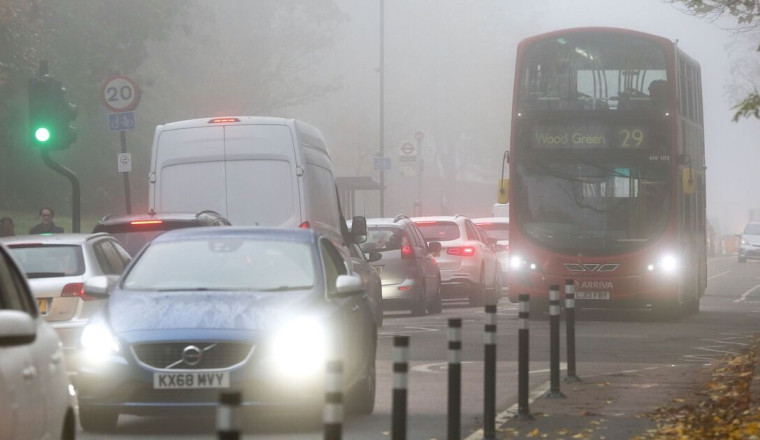

The RAC is warning drivers they could be landed with a fine of up to £1,000 for making a common driving mistake this winter. Guidance from the Driver and Vehicle Standards Agency (DVSA) states that fog lights should only be switched on when visibility drops below 100 metres when driving on British roads, but according to new research, as many as 60% of drivers use their fog lights at the wrong times.
Findings from a survey conducted by eBay have found that more than one in 10 drivers switch on their fog lights when visibility is less than 300 metres, which means motorists risk being fined up to £1,000 and given three penalty points on their licence. The Highway Code states that drivers must use headlights when visibility on the road is seriously reduced, and this is generally when you cannot see for more than 100 metres (328 feet).
In this situation, you may also use your front or rear fog lights, but these must be switched off once visibility improves.
The Highway Code Rule 236 says: “You MUST NOT use front or rear fog lights unless visibility is seriously reduced as they dazzle other road users and can obscure your brake lights. You MUST switch them off when visibility improves.”
eBay research also uncovered another worrying trend in regard to the use of headlights, with 48% of drivers saying they activate full-beam headlights when it is dark outside, regardless of oncoming traffic and other road users, while many don’t have their fog lights regularly maintained.
eBay analysed data from the DVSA on MOT pass rates and found 4.3 million MOT failures relating to front and/or rear lights between June 2024 and June 2025, with around 31,000 of those being due to front or rear fog lights.
The findings follow recent research from the RAC into dazzling headlight glare which found that many drivers are nervous about being on the roads at night due to bright headlights.
Of the 1,701 respondents who took part in the survey, one-in-four drivers (25%) who find headlights too bright are driving less as a result and a further 22% say they wish they had the option to drive less at night, but don’t have another form of transport.
The RAC has been campaigning with The College of Optometrists, IAM RoadSmart and Baroness Hayter for the causes of headlight glare to be investigated, which has led to the Government commissioning independent research, conducted by TRL, which is due to be published soon.
RAC senior policy officer Rod Dennis said: “Unfortunately, for a lot of drivers the annual onset of darker evenings coincides with another unwelcome arrival – that of overly-bright headlights that they believe make driving more difficult due to dazzle and discomfort.
“While most of us have no choice other than to adapt to driving at night more often as the clocks go back, the fact headlight glare is the leading cause of nervousness underlines it’s a problem that needs tackling.
“At the same time, it’s important to remember that brighter headlights can give drivers a better view of the road ahead – so there’s a balance to be struck.
“We look forward to the publication of the Government’s report and hope that it helps explain why so many drivers report struggling to cope with dazzling headlights – whether that’s due to changes in technology, the fact more of us than ever are driving vehicles that sit higher on the road, or for some other reason. We also hope it comes with recommendations that lead to road users feeling safer behind the wheel at night.”