
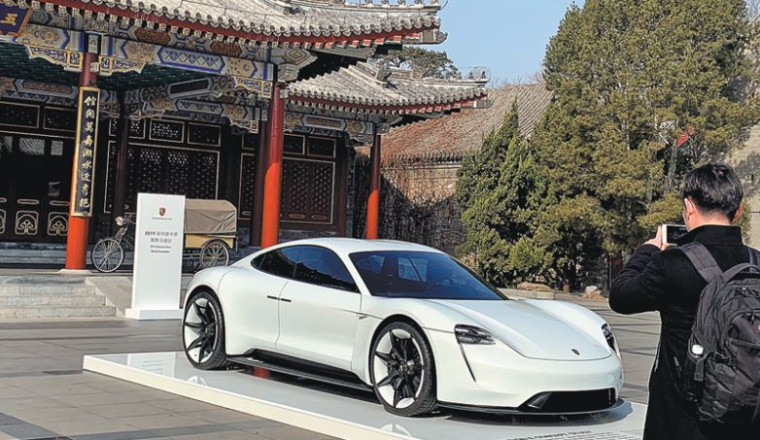

Porsche plans to shutter its proprietary charging network for electric vehicles in China, with the company operating about 200 chargers in the country that will gradually be decommissioned from March 2026. The stated reason? "Changes in market conditions evolve and user charging habits continue to change". Translation: nobody's using them because nobody's buying Porsches anymore.
The numbers are catastrophic. Sales peaked at 95,671 units in 2021 when China was Porsche's largest single market globally. They've been shrinking ever since, with only about 40,000 units projected in 2025. That's a 58 percent collapse in four years. China sales fell 26 percent in the first nine months of 2025 alone to 32,195 units. Porsche is experiencing the kind of sales decline usually reserved for brands actively trying to exit markets.
The Chinese Competition Nobody Saw Coming
Xiaomi's SU7 electric sedan, with its Porsche-inspired design and significantly lower price, caused a sensation. In February, Xiaomi launched an ultra powerful 1,548 horsepower version called the SU7 Ultra starting at about $72,600. The result: 10,000 pre-orders in two hours, slightly more than Porsche's total sales in China for the quarter. By comparison, the cheapest 911 costs $201,170 and offers 394 horsepower.
Read that again. A Chinese smartphone company that entered the automotive sector one year ago got 10,000 orders in two hours for a car that makes 1,548 horsepower and costs $72,600. Porsche's entire quarterly China sales were 10,000 units. Xiaomi sold 137,000 SU7s last year, more than double Porsche's total full year China sales of just under 57,000. A one year old brand is outselling an icon by more than two to one.
Chinese carmakers have started offering more luxurious and technologically advanced cars at lower prices. Porsche also lost the performance crown to Chinese rivals, with BYD and Xiaomi breaking records on the Nürburgring race track. When a Chinese phone manufacturer builds a car that's faster than your Taycan Turbo GT, costs half as much, and breaks your track records, the premium you charge for the Stuttgart badge stops making sense.
The Technology Gap Nobody Wants to Discuss
You still can't buy a Porsche with a Level 3, or fully hands off Level 2 driver assist system, though the latter is coming this year. Meanwhile, the Lidar equipped SU7 comes with a 56 inch head up display and Xiaomi's smartphone and AI know how means drivers get into the car and can transfer their phone interface to the SU7's media screen with the press of a single button.
Chinese buyers don't care about heritage or racing pedigree anymore. They care about technology that works today. German, American and even Japanese and Korean brands have all underestimated the importance of software defined vehicles. Porsche spent decades perfecting hydraulic steering feel and naturally aspirated flat six engines. Chinese brands spent five years building software ecosystems that make Porsche's infotainment look like a relic from 2010.
Domestic contenders like the Xiaomi SU7 Ultra deliver standout performance with 1,548 horsepower at approximately €50,000. In contrast, Porsche's electric Taycan has failed to regain traction even after a substantial price reduction of over €10,000, achieving only one eighth of its 2023 sales. Porsche cut Taycan prices by over €10,000 and still couldn't sell them. That's not a pricing problem. That's a product nobody wants problem.
The Financial Carnage
Group operating profit plunged to 40 million euros in the first nine months of 2025, down from 4.04 billion euros a year earlier. Operating return on sales collapsed to 0.2 percent from 14.1 percent. From €4 billion profit to €40 million in one year. That's not a bad quarter. That's existential crisis territory.
Earlier this year, Porsche announced plans to reduce its sales network in China, aiming to scale back to about 100 locations by 2027. In December 2024, multiple local media outlets reported that Porsche China was planning to reduce its workforce by about 30 percent. Closing dealerships, firing a third of staff, shutting down charging infrastructure. These aren't optimizations. These are controlled retreat maneuvers.
The Contradictions Are Stunning
Only last month, Porsche opened its first major development facility outside Europe in Shanghai, a 10,000 square meter facility operational since early November designed to accelerate local innovation under the company's In China, for China strategy. So Porsche is simultaneously closing 200 charging stations while opening its first overseas R&D center? The Shanghai R&D hub's first major achievement is a next generation, China exclusive infotainment system, set to launch across several Porsche model lines starting mid 2026.
Infrastructure that serves customers today gets cut. Infrastructure that might help in 2027 gets built. Porsche is betting on a future where it can fix its software and tech gaps before Chinese competitors extend their lead even further. That's optimistic considering Ford boss Jim Farley has already said he loves driving his SU7 so much he doesn't want to give it back. When the CEO of Ford is driving a Xiaomi and raving about it, your window for catching up is closing rapidly.
The Luxury Market Nobody Expected
Maextro, a Chinese brand, received 18,000 orders for the S800 within just 175 days of launch. The company is currently selling more than 2,000 units a month with plans to reach 4,000 per month. At 215.7 inches long, this is a proper full size luxury sedan, priced between $100,600 to $144,900. For reference, the BMW 7 Series starts at $130,000, the Porsche Panamera at $156,200, and the Mercedes S Class at $208,800.
A Chinese brand nobody outside China has heard of is outselling established luxury sedans with a car that costs less and features a 40 inch rear projector that turns the back seat into a private cinema. The Maextro S800 features a triple screen dashboard, automatic doors, crystal effect buttons, and a starlit ceiling reminiscent of Rolls Royce. Chinese buyers aren't compromising on luxury. They're getting more luxury for less money, and the badge doesn't matter anymore.
What This Means for Everyone Else
Tu Le, founder of consulting firm Sino Auto Insights, says "Porsche is finished in China". Andrew Fellows, global head of automotive and mobility at technology consultancy Star, said foreign automakers "won't get that market share back". These aren't hot takes. These are industry analysts stating the obvious.
The charging station shutdown is symbolic. Self built charging stations are heavy assets and can become financial burdens when their utilization rate is insufficient, so the industry is shifting to joint construction with third parties to dilute costs. But NIO builds battery swap stations that are wildly capital intensive and likely unprofitable. Tesla built the Supercharger network specifically so owners would never worry about charging. They do it anyway because premium ownership experience justifies premium pricing.
When Porsche exits this battlefield, it's conceding that its ownership experience no longer needs to compete with Chinese brands on this dimension. China now has over 1.2 million public fast chargers through networks like TELD and State Grid. Porsche's 200 stations represent a rounding error in that ecosystem. The rationale makes sense. The optics are terrible. You're telling Chinese buyers that you're pulling back while Chinese brands are expanding.
Porsche is mulling gradual withdrawal from the country, Germany's Focus magazine reported in November. Official statements claim otherwise, but actions speak louder. Close charging stations. Fire 30 percent of staff. Reduce dealerships to 100. These are exit preparations disguised as strategic realignment.
The brand that nobody thought could be squeezed out of China is being squeezed out of China. Xiaomi, a company that made phones and rice cookers, entered the automotive market 12 months ago and is already outselling Porsche two to one. The Chinese luxury market Porsche dominated for two decades no longer wants what Stuttgart is selling. And judging by the sales trajectory and infrastructure shutdowns, Stuttgart has finally noticed.