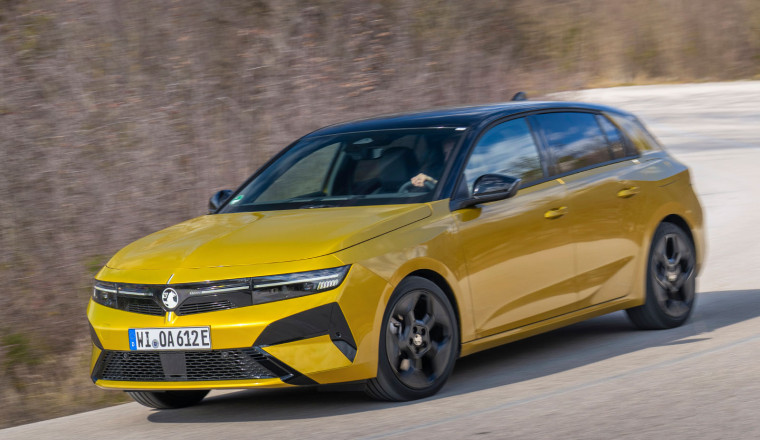

It seems Vauxhall’s bosses have gone to the Burger King school of management, because with the facelifted Astra, you can have it your way.
Regardless of whether you opt for a hybrid, plug-in hybrid or EV, hatchback or Sports Tourer estate, it’s the same price, starting at £29,995. (Cheaper petrols are coming later this year, though.)
The hybrid matches Stellantis’s ubiquitous 1.2-litre turbo petrol triple with an electric motor (mounted inside its six-speed dual-clutch automatic gearbox) and a 0.9kWh battery. That nets 128bhp, 170lb ft of torque and 56.5mpg.
It’s worth noting that this engine doesn’t use the now-infamous ‘wet belt’ design found in previous Astras, having moved to a timing chain. That should hopefully abate concerns over long-term reliability.
The PHEV gets a 1.6-litre turbo petrol four, a seven-speed dual-clutch gearbox, a punchier electric motor and a 17.2kWh battery (up from 12.4kWh previously) for 192bhp, 266lb ft and an electric range of 52 miles.
Emissions are rated at 50g/km in the hatch and 51g/km in the estate, landing benefit-in-kind tax rates of 10% and 17% respectively (from the new financial year). Take this figure with a huge pinch of salt, but its fuel economy is officially rated at up to 128.4mpg.
Here I will focus on the PHEV: not only is it great value, considering the Volkswagen Golf eHybrid costs £6490 more, but it’s also the best all-rounder in the Astra range.
Unlike in the regular hybrid, its motor is pokey enough to glide through town and faster A-roads on electrons alone. Give the throttle a squeeze and the engine fires into life after a second or so, transforming it into a surprisingly fizzy car: its 266lb ft makes it feel significantly more urgent than the hybrid or the EV.
But the most notable benefit of going for the PHEV over the hybrid is its refinement. Although a tad droney, its four-pot engine is much easier on the ear than the shouty triple, whose bark soon grates. And, because the PHEV’s battery is nearly 20 times larger than the hybrid’s, it calls on the assistance of its engine much less frequently. You could drive it entirely as an EV if you really wanted to, whereas the hybrid requires you to tip-toe on the throttle to disengage the engine and plod around on the motor.
Around 40 miles of real-world range in the PHEV (albeit on a 20deg day in sunny Croatia) should prove plenty for many urban commutes, and you get the flexibility of petrol power when you run it empty.
To that end, Vauxhall claims the PHEV is almost as efficient as the hybrid when the battery is flat, doing 52.3mpg – which makes the 56.5mpg hybrid feel a little pointless.
As well as better performance and the economy, the PHEV has more pleasant steering. The hybrid’s helm has little weight and yields minimal feedback. Switch to the PHEV and you immediately notice the extra effort required around the straightahead, plus a hint more texture.
This contributes to an overall sense of solidity that the hybrid lacks. It gave me a confidence in tackling twistier roads that I didn’t feel in other versions – and the Astra is game for pressing on too.
It possesses good body control through tighter bends and, provided you’re not being silly, there’s plenty of grip. The front wheels can scrabble a little if you floor it from a standstill, but this isn’t the kind of car that encourages such behaviour.
Indeed, the Astra isn’t so much fun as it is satisfying to push; it’s a good ‘flow’ car, handling intuitively and fostering a sense of trust when you’re preoccupied by hazard perception on unfamiliar routes.
The pedals – well spaced in the left-hookers we had to test and satisfyingly meaty in feel – help to foster that sense of belief in the car.
The only major trade-offs if you go for the PHEV are a noticeable amount more fidget over brittle road surfaces (although it's still within acceptable levels) and reduced boot space (112 litres down in the hatch, 131 litres down in the estate).
The Astra’s interior is good too: the digital panels’ graphics are easy to understand, the infotainment software is responsive to inputs and sensibly laid out and you get proper switches for the climate controls.
The steering wheel gets a pair of paddles that allow you to take control of gearchanges. However, the ‘box is overeager to override your inputs and change up earlier than you might like or prevent early downchanges intended to allow engine braking. I was also disappointed that the paddles can’t be used to adjust the strength of the regenerative braking if you put the PHEV into electric-only mode; this feels like an oversight.
Still, for usability, the Astra is ahead of anything from the Volkswagen Group. That makes it all the more a shame that it’s a bit drab to sit in.
What about the EV?
Given its lack of a combustion engine, the EV feels like a completely different car to the two hybrids. It’s powered by a front-mounted 154bhp motor and a 58.3kWh (55.4kWh usable) battery, giving a range of 281 miles in the hatch or 276 miles in the estate. And it can charge at up to 100kW, giving a 20-80% refill time of about half an hour.
You only get the full 154bhp if you stick the Astra Electric in its Sport driving mode, so it feels rather lackadaisical most of the time. Still, it's quick enough to cruise with the flow of traffic – even in Croatia, where the beaming sun seems to have set everyone’s hair on fire.
The pedals are well judged for making smooth progress at lower speeds and the ability to adjust the strength of the regenerative braking using the wheel’s paddles is welcome. There’s also a ‘B’ mode that cancels out retardation from the motor and allows you to free-wheel on the motorway.
Through bends, your confidence is undermined by the same wooly steering feel as in the hybrid, although it’s significantly better at ploughing over bumps than the PHEV.
Refinement is an improvement on the other variants, too, given there isn't an engine booming away under the bonnet.
If I were to nitpick, there’s a little bit of road noise and, without the engine to muffle it, you notice it echoing around the rear compartment of the estate a bit more. But it’s still more than hushed enough to have a conversation with passengers sitting in the back without having to raise your voices.
You get a bigger boot in an EV in a PHEV, but it’s still not as quite as capacious as that in a hybrid, being rated at 352 litres in the hatch and 516 litres in the estate.
In essence, the Astra Electric is a fine car. It’s good value for money. But if you can stomach paying a little more, there are better alternatives. Although it’s £33,000 and doesn’t offer as much range (270 miles), the entry-level Kia EV3 is nicer to sit in and can charge faster. Target Price data from What Car? suggests that it’s being discounted to around the same money too.
Vauxhall Astra facelift: verdict
By making marginal improvements and realigning its pricing structure, Vauxhall has improved the Astra’s odds against the Golf.
It feels like a return for form for the brand, playing to its historic strength of offering decent cars at sensible prices.
Whether that will be enough to return the Astra to past success remains to be seen, but I wouldn't bet against it. Particularly so now that its biggest competitor, the Ford Focus, is out of the picture.
That said, I’d feel shortchanged if I’d bought anything other than the PHEV. The Astra Electric doesn't feel as practical nor as plush as rivals built on EV-specific platforms, while the hybrid is the one to avoid, being a much less rounded product.
More broadly, some may criticise PHEVs as compromised: nowhere near as rangey as a full EV nor as efficient as a hybrid when the battery is depleted – and typically the most expensive of the bunch. But when one is priced on equal terms as the alternatives, as it is in the Astra, it becomes a compelling option. It's better at being an everyday petrol car than the hybrid, thanks to its smoother and zingier engine, and still gives you the option of running it like an EV on shorter commutes.
Join our WhatsApp community and be the first to read about the latest news and reviews wowing the car world. Our community is the best, easiest and most direct place to tap into the minds of Autocar, and if you join you’ll also be treated to unique WhatsApp content. You can leave at any time after joining - check our full privacy policy here.
Context:
Vauxhall's new Astra PHEV offers Golf-beating value at £30k with impressive 52-mile electric range.
Context:
This pricing strategy could reshape the premium hatchback market by removing powertrain cost barriers.
Context:
The switch from wet belt to timing chain design addresses previous Astra reliability concerns.