
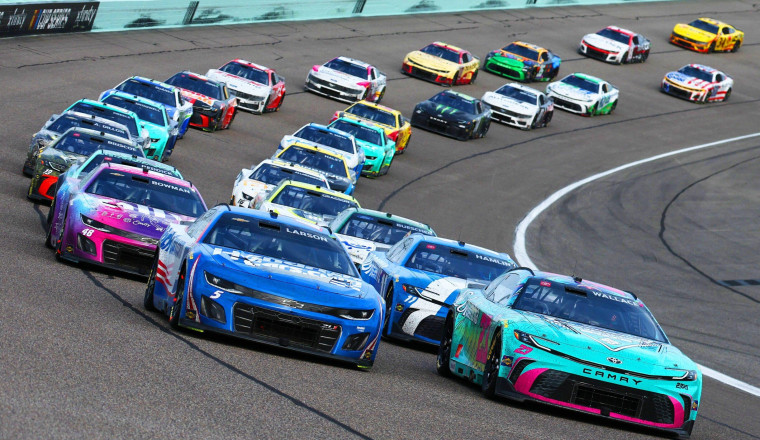

NASCAR is currently running the championship weekend at Phoenix Raceway. Ahead of the weekend, NASCAR commissioner Steve Phelps and NASCAR President Steve O’Donnell addressed the media…
Watch the full state of the sport video below.
“I think this sport has a lot of momentum at this particular point in a lot of different areas,” Phelps said. “One, we just heard the Freeway Insurance announcement (Friday morning) being our fourth Premier Partner.
“A big shout-out to (CEO) Cesar (Soriano) and his entire team. We’re thrilled he’s back with Daniel (Suarez as a sponsor). We’re thrilled they’re going to expand the relationship to include a race entitlement as well as being our fourth Premier Partner, joining Coke, Busch Light and Xfinity.
“It goes way past that. If you think about where sponsorship lives today versus where we were three, four, five years ago, if you ask our race teams, probably the best number of sponsors on cars that they’ve had in probably 15 years as we head into the 2026 season.”
“The race tracks are doing great from a sponsorship standpoint,” he added. “I think after a couple years of kind of at the league level, the NASCAR level, I think we’re a little bit behind. We’re closing that gap quickly with a number of new sponsors that have come on board. There are a number that will be making announcements in the near future.”
“Again, if you think about the importance of sponsorship to NASCAR broadly, the revenue is important—don’t get me wrong—but it’s what the sponsors do to showcase our sport to their customer base or their B2B base, bringing them to the race track and experiencing this sport. It’s important.”
“If you think of the number of appearances that have happened, the sheer number of hours that the drivers have logged promoting this sport—6,000 hours, up 40% year-over-year. That is huge for us, right? They’re building our brands. They are the face of NASCAR.
“The more opportunities we give to them, the more opportunities they step up and take, the better it is for the growth of this sport.”
“In each of the past two years, I’ve sat here and told you the same thing: healthy race teams are critical to our sport,” Phelps said in part. “We’ve been true to our word. From the outset, we’ve been clear, this is not an anti-trust case.
“The 2025 charter agreement is an improvement on the 2016 framework with enhancements that reflect real progress for teams and the sport, including over $3 billion in guaranteed payments to the teams, enterprise value that is roughly $1.5 billion now to the race teams, guaranteed starting positions each week that allow teams to sell sponsorship on the best billboards in sports, the Next Gen car, and charters guaranteed for 14 years until at least 2039, plus an obligation to negotiate in good faith beyond that.”
“I also want to be clear: the France family started NASCAR in 1948 using their own resources, grit and ingenuity,” he said. “They have taken countless personal and financial risks, investing billions of dollars and untold hours into growing this sport to create opportunity for teams to race in front of fans for nearly eight decades.
“We are proud of what we built for fans together with the race teams, especially since the charters were introduced. As you saw in the race team declarations, the charter system is a critical part of the sport, something we created with and for the teams. We’ll continue to defend and preserve it. Make no mistake, the lawsuit puts this at risk.”
“One of the concerns is future drivers coming up through the system, having multiple wins, and not necessarily winning a championship,” O’Donnell said.
“I think that’s a challenge for a sport where I think the light really goes on is having that driver be deemed a potential superstar…”
“I think that’s something that as you look at the future of the sport, making sure that a driver who has delivered all season long has the ability to be named a champion, and not have something maybe come down to one race. That’s really been the focal point, is we want to reward winning. We’re going to continue to do that. Whatever model we come up with, winning is very important.”
“When the season started, because of the distribution changes to be less broadcast heavy and more cable heavy and streaming, we knew we were going to have a reset,” he said. “We had projected that reset and told everyone in our industry that reset would be between 14 percent and 15 percent in Cup.
“We also told them we probably have a double-digit increase in Xfinity. Then Trucks would be where Trucks are, because the distribution stayed the same primarily on FS1 and some FOX.
“Right now, as we sit, our ratings in Cup are down 14 percent, exactly what we predicted… I think that Xfinity exceeded a lot of experts’ opinions about what their audience would be. We surmised that the audience makeup of Amazon would be younger, and it was, by about six years.
“I would say the cable portion of the NBC package has been a little softer than we had expected. Bounce back on the NBC races, I think we’ll have a decent rating here on Sunday (for the NASCAR Cup Series Championship Race).
“Again, the expectation moving forward, now that we have had the reset, is that we are going to grow. We’re going to grow because we have the best racing in the world, our stars are going to be more out there, we’re creating better content, all the things that make fandom.”
“It’s definitely a trend that we need to be very watchful on,” O’Donnell acknowledged when asked about the ascendance of such organizations as Hendrick Motorsports, Joe Gibbs Racing and Team Penske. “I think when you look at the car, our team has done a really great job around the car, what you can do. Most of the spend now is going through simulation, engineering, all these things. The bigger teams have more resources. You look at the future with AI, all these things.
“Our focus as a competition group really needs to lean into that aspect of it. What do the have-not’s not have, and what can we do and what rules can we put in place as technology becomes more and more of a factor? Can we lessen that?
“Probably difficult to do. Technology costs a ton of money. But what can we share with some of the smaller teams as we look at future rules to make sure they’re able to go out there and not only compete but compete for wins?”
Categories
Tags