
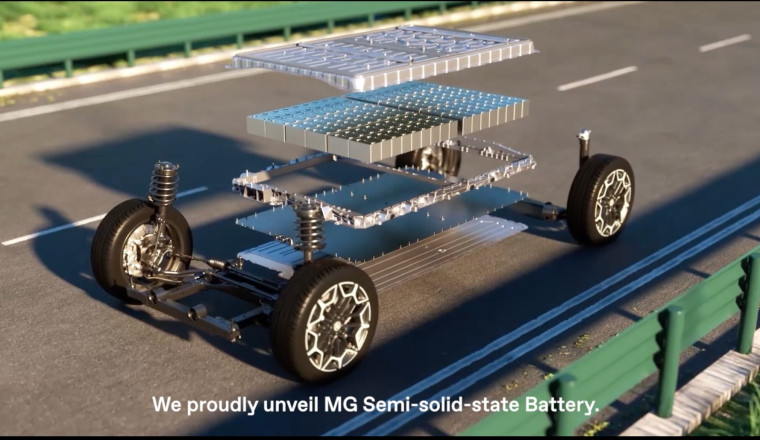

► MG is the first to finally bring solid-state battery tech to mainstream EVs
► On sale to UK buyers in the MG4 EV Urban by the end of 2026
► Improved safety and charging, but only incremental benefits
MG is right to be proud of the fact that it is the first manufacturer to bring semi-solid-state batteries to mainstream EVs in Europe and the UK. The Chinese maker, which is owned by SAIC, has announced that it will bring a semi-solid-state battery to the recently launched MG4 EV Urban range before the end of 2026, with two further models to gain the new SolidCore battery after that.
This new battery is expected to be sold alongside the existing LFP batteries that already give the MG4 EV Urban a range of up to 258 miles.
Like this? Get more CAR delivered to your browser! Click here to add CAR Magazine as a preferred source on Google.
What’s a semi-solid-state battery, then?
Good question. We’ve been talking about solid state batteries for a long time, and at various points most major manufacturers have said that they’ll have solid state batteries ‘in the next year or two’.
It’s been mooted as the next big game changer because solid-state battery tech replaces the liquid electrolyte (which is the most volatile part of the battery cell) with a solid electrolyte. Hence, solid-state battery. This is said to offer improved safety, energy density, charging speeds and even battery longevity. All of which sounds pretty good to us.
The problem is that we’ve been hearing that solid state batteries are only a year or two away for about a decade, now, and in the meantime the existing lithium-ion NMC and lithium-iron LFP battery chemistries have improved drastically.
Even so, it’s big news that MG has finally brought solid-state tech to a mainstream EV – and a very affordable one at that.
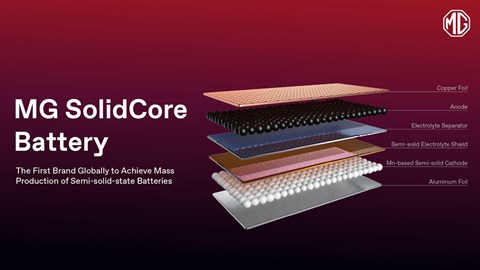
MG’s ‘SolidCore’ semi-solid-state battery uses a new Lithium-Manganese-Oxide (LMO) chemistry, complete with a semi-solid electrolyte cathode that that acts almost as a shield on top of the cell packs. This new battery is only around 5% liquid electrolyte, compared with conventional NMC and LFP batteries, which are typically composed of around 20% liquid electrolyte. A fully solid-state battery would, obviously, contain no liquid electrolyte at all.
The chemistry in the SolidCore LMO battery works to deliver some 15% faster charging than comparable LFP batteries in very low temperatures, improved performance and a safer battery pack. MG didn’t quite have the guts to hammer a nail through the battery live on stage, as BYD is famous for with its LFP-based BYD Blade battery, but it did show us a video of the pack having a bolt driven through it, and it didn’t look like it was about to catch fire. Which is reassuring.
How much range will it deliver, then?
Unfortunately, MG isn’t giving any specifics on that. Dr. Li Zheng, MG Global Chief Battery Scientist, wouldn’t be drawn on the specific range or charging details, but he did tell CAR that “we can increase the energy density [of the SolidCore battery] but this first battery will have very similar energy density to the existing LFP battery tech. It offers better performance and charging speeds – especially in very cold weather, right down to minus 30degC.”
What is probably more interesting for those who’ve been waiting a very long time for solid-state batteries to transform the EV world is that MG is already planning evolutions of this tech, and has stated that in the second- and third generations of this battery it could be capable of up to 621 miles (1000km) of range.
MG wouldn’t elaborate on how big the SolidCore LMO battery would need to be for this kind of range, so it’s impossible to judge efficiency. But MG is already talking about the next steps that it’s planning with this battery chemistry, and Dr. Zheng told CAR that “we will aim to get out a new product with a higher energy density next year” so we’re hopeful that we won’t be waiting too long.
How much more will it cost?
Again, MG is being close-lipped on this, but Dr. Zheng told CAR that the new semi-solid-state battery actually costs a similar amount to produce to the company’s LFP batteries (which are already popular in the MG4 and MG4 EV Urban).
This news, and the fact that the battery is arriving first in the budget-oriented MG4 EV Urban means that the new semi-solid-state battery tech is likely to be quite affordable when it does go on sale later this year.
Is this new-fangled battery any greener?
According to Dr. Zheng, yes – the new SolidCore battery is “greener and easier to recycle than existing tech like LFP, because it has less liquid electrolyte.”
This is because the liquid electrolyte is the volatile part of the battery that can combust if it’s exposed to oxygen, so having less of it is a very good thing for making the battery easier and safer to recycle.
Manganese – the significant metal component in the new LMO SolidCore cells – is already a substantial component in the NMC (Nickel Manganese Cobalt) lithium-ion chemistry that’s used in the majority of EVs sold in Europe and can be fully recycled while also retaining 100% of its conductive qualities when re-used in a new battery.
There are still challenges with recycling any EV battery, but the core composition of this new semi-solid-state battery should prove easier – or, at least, no more difficult – to recycle than the common lithium-iron LFP and lithium-ion NMC batteries.
What are the actual benefits to the customer, then?
We asked that question, too, because having heard all about the chemistry of this new semi-solid-state battery, the fact that it will have a similar energy density and cost to LFP does beg the question of – why not just stick with LFP? “The real benefit to the customer is the additional safety,” said Dr. Zheng. “and the better charging speeds in cold weather.”
Plus, there’s already talk of the next evolution of the semi-solid-state battery, which MG already has in a near production-ready form in China and promises to offer longer range.
In the meantime, it has to be said that the benefits to the customer of this first semi-solid-state battery are fairly marginal. There’s that improved safety and charging, but that’s not a huge incentive given that existing LFP and NMC batteries have already proven to be very safe, and MG’s estimates of 15% better charging speed than its LFP batteries suggests that existing NMC battery tech may significantly outperform the SolidCore battery for charging performance.
If MG can bring the SolidCore semi-solid-state battery into the MG4 EV Urban at a comparable price to the LFP batteries then there’s no doubt that it’s an improvement – that cold-weather charging and safety stuff that we’ve been talking about – in battery tech. Yet the benefits to the consumer are marginal, at best, until MG can deliver that improved energy density that has already been alluded to.
We’ll have to wait and see what figures the SolidCore battery can deliver in the MG4 EV Urban, but on these early details we’re rather more excited about the next generation, which sounds like it might bring much more tangible benefits to EV drivers.
It is, at least, a familiar feeling to know that the really big leaps forward in solid-state battery tech are… well… a year or two away.
Context:
MG becomes first manufacturer to bring semi-solid-state batteries to mainstream European EVs by 2026.
Context:
This breakthrough could finally deliver the safety and charging improvements promised by solid-state technology.
Context:
The SolidCore battery contains only 5% liquid electrolyte compared to 20% in conventional batteries.