
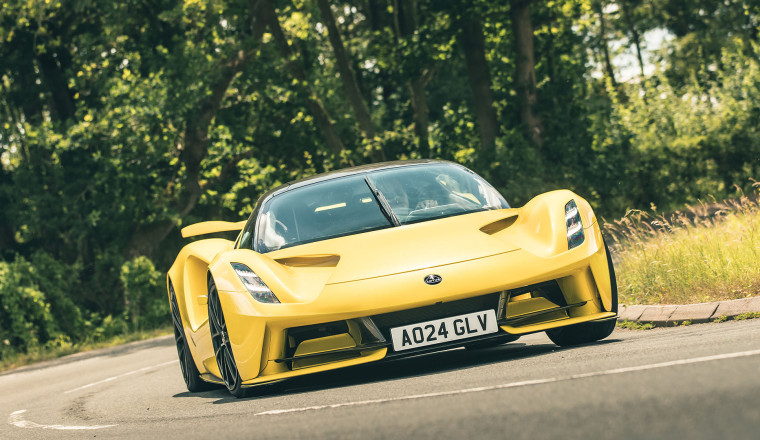

The Lotus Evija, a fully electric hypercar and one of the most powerful production vehicles on the planet, has just carved its name into the history books — and it did so with a thunderous, tire-melting sprint. During Autocar’s definitive road test, the Evija didn’t just show up — it showed out, smashing multiple acceleration records and proving that electrification and raw performance can go hand-in-hand. Now that customer deliveries are underway, Autocar put the Evija through its paces in what’s widely considered the gold standard of performance benchmarking. The results? Nothing short of jaw-dropping.
The Evija is officially the fastest car to ever complete Autocar’s rigorous road test — a program that dates back to 1928. It clocked the fastest-ever 0–200 mph time, and obliterated all standing records for both the quarter-mile and standing kilometer runs. In mid-range acceleration, where true hypercar power becomes undeniable, the Evija pulled even further ahead. From 100–150 mph, it was a full three seconds quicker than any other car tested. From 150–200 mph? It widened the gap to a staggering five seconds. To put that in perspective: the Evija’s 150–180 mph sprint takes just 2.7 seconds — roughly the same time a high-performance sedan needs to get from 60–90 mph.
Autocar has only ever tested two other road-legal cars that could hit 200 mph from a standstill during their benchmarks. The Evija not only joins that elite club — it crushes expectations. It rockets past the 200 mph mark in under a kilometer and hits its top-speed limiter of 217.4 mph before many top-tier supercars even reach 180.
Autocar’s Road Test Editor, Matt Saunders, summed it up perfectly: “Hypercar makers some time back shifted their focus away from top speed as a distinguishing feature. Some have opted for outright circuit pace, but Lotus chose something powerful electric motors could be truly exceptional at: the 0–200 mph, standing-kilometre drag-strip blast. In 2011, the Bugatti Veyron cut the standard for that – as verified by this magazine in 1994 with the McLaren F1 – by 21%. In 2025, proportionally speaking, the Evija’s leap is twice that size.”