
View all Mercedes-Benz Reviews
► EQS prototype with steer-by-wire
► Just electrical cables between the driver and the wheels
► Yoke steering wheel the controversial element
Anything Tesla can do, Mercedes can do better (or so the Germans are hoping). Because the facelifted EQS will, for the first time, be available with steer-by-wire and a yoke steering wheel.
What this means is that there’s a very funny-shaped steering ‘wheel’ in front of the driver and then two electrical cables running from the yoke down to the steering rack. The second cable is for redundancy, in case one fails.
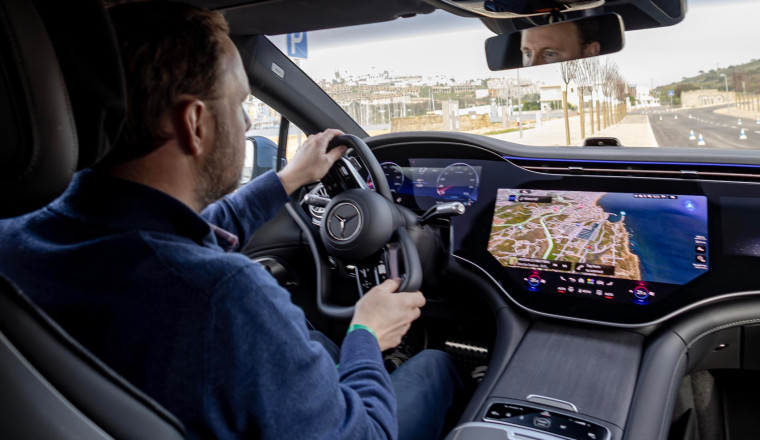
We got to try it out on a very limited test run and it felt… oddly normal to start off with.
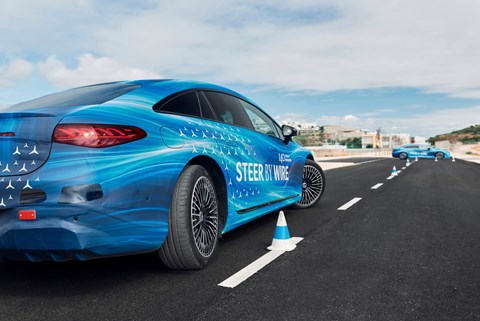
Setting off in between various traffic cones, the car reacts just as you’d expect it to and you quickly forget that there’s no physical connection between yourself and the front tyres. The steering even returns to dead centre if you let go, just like a normal electromechanical set-up.
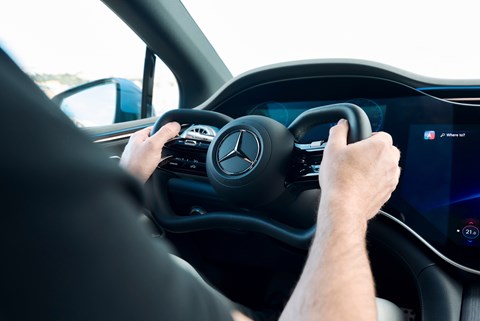
It’s worth emphasising this point. With no physical connection between tyres and driver, the Mercedes engineers had to actively build in the return to centre – an illustration of how much this new technology changes things.
There’s never any need to take your hands off the wheel – with a yoke, you don’t want to be doing ‘hand-over-hand’ because there’s not as much rim to grab hold of – and it’s easy to thread the EQS through a series of turns. The agility is helped by the rear-wheel steer, which can pivot the tyres by 10 degrees, and the fact that with a variable ratio, Mercedes can limit the lock-to-lock to 170 degrees (a little less than the arms-crossing-over point).
Mercedes claims the ratio change is linear but in practice, it didn’t quite work like that. It was fine up to about 160 degrees, but as I went past that and my hands approached the fully crossed over point, the car tightened its line dramatically and I had to wind the lock off to stop us hitting a cone. This is where it feels unnatural and like it needs more calibration. The systems can work – I drove a Tesla Cybertruck and never got this impression – but the Mercedes one isn’t there yet.
The view ahead is excellent, mind. By removing the top half of the steering wheel, it frees up a huge amount of real estate inside the cabin and makes it feel strangely airy next to a standard EQS.
You don’t have to have this system as the EQS will continue to be available with the regular electro-mechanical steering.
So why do it? It’s a technology thing – Mercedes wants to be seen to be leading in this sort of field – and it’s also a practical thing. If Mercedes can make this work, it frees up all the physical constraints you get in a normal system – you no longer have to worry about steering column routes and how it gets around engines and into racks. It also makes the conversion to right-hand drive much simpler.
Apparently, the engineers have even tested it on ice and going sideways. Now that I need to see.
Context:
Mercedes' steer-by-wire yoke feels normal at first but needs calibration work at extreme steering angles.
Context:
This tech could revolutionize car design by eliminating physical steering constraints and simplifying RHD conversions.
Context:
Tesla's Cybertruck already uses similar yoke steering technology without the dramatic tightening issues.