

► CAR meets Massimo Frascella
► The man leading Audi’s design renaissance
► What’s inside his little black book?
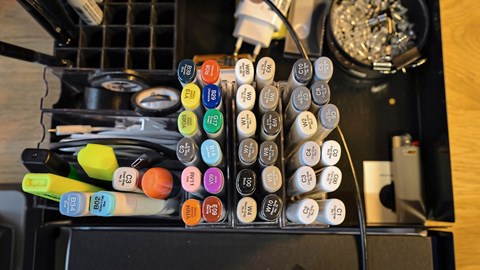
There it is, right in front of me, the inconspicuous black book that contains key elements of Audi’s renaissance. Next to it, a small set of stubby markers and a handful of Bic ballpoint pens. Could we perhaps catch a quick glimpse? No? Alright then.
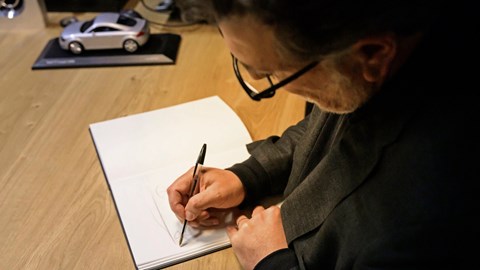
Over an hour later, when the ice has been broken and the conversation has reached its working temperature, Massimo Frascella relaxes enough to let me watch as he squiggles a car that wears the new grille that caused such a stir when it appeared on Audi’s Concept C… although nothing like the stir caused by the wild scissor-wing Jaguar Type 00 show car a few months earlier. Or, perhaps more recently, even Ferrari’s Luce.
Like this? Get more CAR delivered to your browser! Click here to add CAR Magazine as a preferred source on Google.
Both were penned by one and the same person. Before joining Audi, Frascella was at JLR, where he was second-in-command to Gerry McGovern. He arrived at Ingolstadt in June 2024 to replace the outspoken and outgoing Marc Lichte.
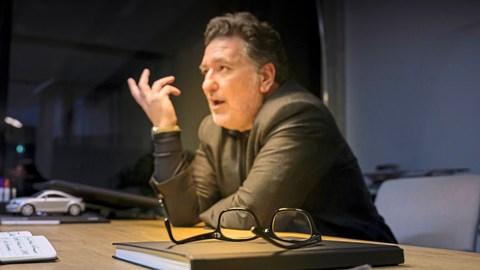
The new appointment was not a committee decision but very much a personal promotion pushed through by Audi chief executive Gernot Döllner, at the time relatively new to the job himself.
What did Döllner hope Frascella could bring to Audi? The strong stance and distinct personality of JLR cars such as the Velar, Defender and Range Rover, and maybe also the polarising new high-end electric Jaguar and its upcoming derivatives.
Obviously impressed by the cocktail of progressive elegance, sophisticated execution and distinctive style, the CEO gave Frascella carte blanche with the full support of the board. With these assurances in his pocket, the 54-year-old Italian didn’t feel the need to bring along the usual back-up entourage – the trusted deputy or a couple of long-running sidekicks – as so many senior designers would upon starting a new job. A shrewd communicator and a perfectly nice guy, Frascella was almost instantly accepted by the Audi design team, who welcomed their new leader with anticipation, curiosity and respect.
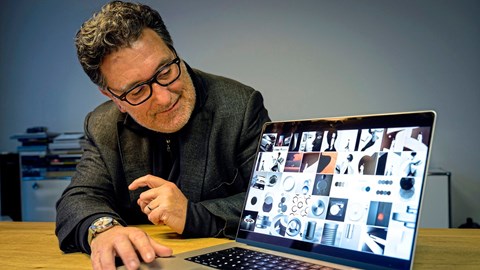
Now, more than 18 months later, the designers and modellers have fully allied themselves with the friendly man everyone calls ‘Masse’. They quickly embraced his no-nonsense working style, and they certainly appreciate the less regimented processes, the precise feedback, his open-door approach to work and the holistic approach to design. Instead of compiling a classic brand bible detailing every facet of the future Audi look, Frascella put together a slim booklet titled The Radical Next, summing up his aesthetic vision in sketches, photographs, typefaces, slogans and graphics.
Featured primarily in black and white are past Audi game changers like the original Quattro and TT, the A2 and R8, along with concepts such as the Avus, Rosemeyer and RSQ. The message on the closing page says it all: ‘Last century, Audi changed car design. This century, we intend to change it again.’
Frascella tells me: ‘Car design is a journey. It starts with a vision and it ends with a promise. To keep that promise, the product must go through many moultings. On the one side, there are certain basic limitations and requirements like budget, timing, feasibility, size, content, platform, you name them.
‘On the other side, we have established soft targets like crafted clarity, radical identity, emotional presence, the visualisation of Vorsprung durch Technik. The familiar means used to achieve these goals include proportions, plan views, cross sections, wheels and tyres, overhangs, surfaces. The Audi Design Manifesto calls for a flexible yet quite specific toolbox which allows us to create shapes that are clear, technical, intelligent and emotional.
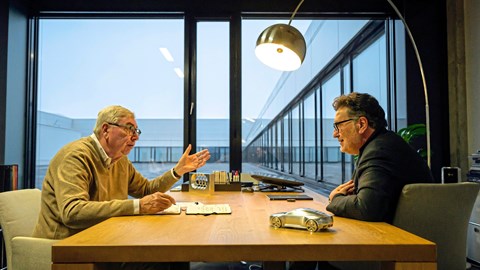
‘Is this too theoretical? Then let me word it differently. In my view, Audis should exude extreme solidity and absolute simplicity. The secret sauce is the perfect coexistence of radii and tensions, incredibly controlled but never organic, a strong sense of solid metal supported by very precise geometric shutlines.’
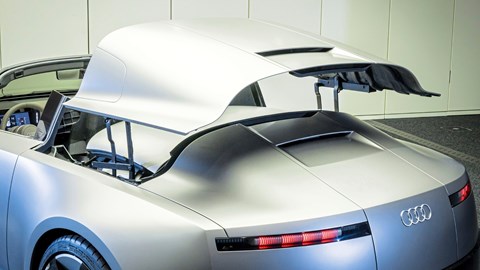
The production version of the Concept C, the Nuvolari, is Frascella’s first Audi, although sources say he made a few last-minute changes to this year’s harvest (RS5, Q4 facelift, A6 Allroad, Q7, Q9 and A2), cars that were essentially completed before his arrival. The Concept C marks a new beginning, and is indeed a different animal altogether – all substance, zero gallery play. As well as making a statement in itself, the striking two-seater also uses many elements that will reappear on future production models.
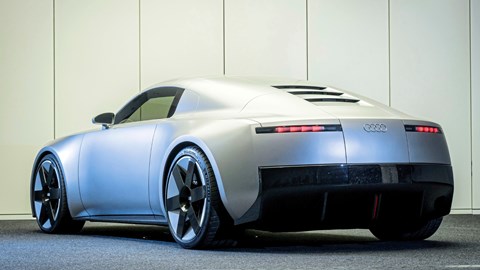
Among them are the super-precise wheelarches, the cabin-to-body transition, the scaled-back glass area, the sharp full-length creases defining the flowing, broad-shouldered plan view, and the bumper sections which are neatly integrated parts of the whole rather than blunt add-ons.
The minimalistic interior, too, is indicative of the shape of things to come. Instead of a pillar-to-pillar touchscreen, the only digital elements to be found inside the belated successor to the TT are the conventional instrument panel and a relatively small roll-up centre monitor. There’s no sign of a rotary controller – long an Audi fixture – or head-up and passenger displays. There’s also no Q6-style secondary control panel in the driver’s door.
From now on, all key functions, including the transmission stalk, can be accessed without taking your hands off the wheel. Doubtless more kit and bigger screens will be available, but if the Concept C is anything to go by then the vogue for acres of black plastic, fake metal accents and abundant digital distractions has now passed. Instead, haptic knobs and buttons will return, even though this time the primary switchgear is crafted from aluminium or machined from carbon fibre, boasting high-quality touches like knurled surfaces, precise grating and unambiguous feedback.
For many generations, the horizontal air intake and the four rings defined Audi front ends. Until 1976, the grille was flanked by one or two headlamps, often round, then rectangular headlights took over. In the two decades that followed, Audi design was tidy and timeless, solid and simple, Bauhaus-strict in concept and evolutionary in execution. The daring low-drag 100 C3 broke the rhythm for one generation, but its replacement depended again on the four rings for reliable identification.
Walter de Silva, appointed chief designer at Audi in 2002, combined the two air intakes above and below the front bumper into one large single-frame grille.
‘That eye-catching new theme marked a turning point,’ reckons Frascella. ‘Like the upright centre motif of the Concept C, it connected to the ovoid upright frame of the classic Type C/D racer. All three front-end treatments are instantly recognisable and unmistakable paradigms of simplicity, geometry and clarity.’
In November 2024, after five months in the job, Frascella invited top management to the Audi light tunnel, where he presented the proposed New Look on four different vehicles. While the chief designer is mum about details, the Audi grapevine suggests the four cars were the Concept C, the next A4, a fresh take on the ageing A8 and the future Q8.
This particular quartet was reportedly chosen to demonstrate the flexibility of the vertical frame, which works almost equally well on all vehicle types. The upright centre section can be a little wider on a saloon and substantially taller on a full-size SUV, and always remains the core styling element. The four rings can be integrated in the grille or placed above it, like on the R8 and the Rosemeyer concept.
For our drive to Munich for dinner, Frascella has borrowed a 444bhp 2002 C5 RS6 saloon from Audi Tradition – the first high-performance single-frame model, and the epitome of brand-shaping essentials like superb fit and finish, pace-setting ergonomics and absolute understatement.
But Frascella admits with a chuckle: ‘I’m not your archetypal car guy. Although I’m quite attracted to certain classics like the Lancia Delta Integrale, I don’t actually own a collector’s car, and I’m not one of the world’s greatest drivers, either – just ask the guys in the factory workshop, who’ve probably stopped counting the chipped wheels and chafed tyres on my RS7. At JLR I drove Land Rovers and Range Rovers, where kerb rash wasn’t an issue, but here the rolling stock tends to be extra wide, extra low and extra vulnerable, which partly explains why my next company car is an RS Q8.
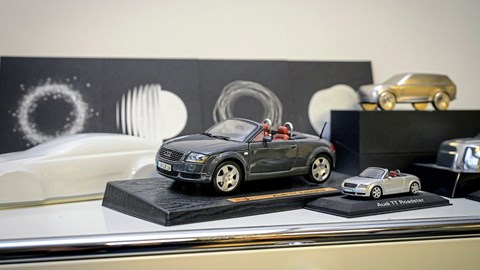
‘If I ever had the money and the time, my dream garage would probably be all-Italian: Lancia Aurelia B20 GT, Lamborghini Miura, Lancia Stratos, it’s that simple.’ He pauses to think, eyes rolling up to better visualise the memory he seeks. ‘No, wait a minute. Can I also add the Bugatti Type 32 “Tank”, one of the first aerodynamic racing cars, very dramatic and way ahead of its time? And a silver MkI TT, before they put on that rear spoiler. Not because I work for Audi now, but because it is a real masterpiece, period.’
When a design is this cool, coherent and complete, does a manufacturer still need to follow the usual timescale for model lifecycles, with all the cost of facelifts this involves? ‘Some shapes are made for eternity. They trigger the good vibes. An Audi isn’t something you need. It’s something you desire. Good design fuses art and engineering to a highly functional and very emotional whole.’
Frascella’s eager to elaborate: ‘It is our duty to think against the current, ask questions knowing we won’t get an answer. In this business, taking interesting, even risky sidesteps is essential. I’ll do anything to avoid the boring and predictable.’
Anything? Just because he’s a different character from Lichte, and didn’t mature as a designer in the VW Group, don’t assume he’s going to tear everything up. In his brief introductory speech to his fellow designers, Frascella did not question the Audi world order.
‘We need to act in concert to make this transformation work, and collaboration is an incredibly fulfilling way of obtaining results. The team embraced change from day one, their commitment is phenomenal, and although debates and discussions are often heated and intense, joining forces is the only way to get things done. Since the management is supportive of our work, I don’t have to fight hard for creative freedom.’
There must be all sorts of shapes, sizes and silhouettes in his sketchbooks, but rather than focusing on the next Q model, for instance, or a possible future halo car, he is more concerned about what design does for Audi and its users. Balancing imagination and innovation, orchestrating the cultural change, and masterminding the brand philosophy is what makes Frascella tick. The big picture.
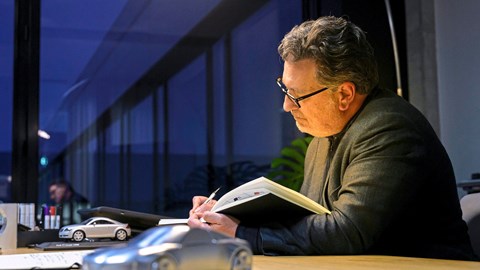
At the same time, he is a switched-on operator, pen in one hand and tape in the other, momentarily sidetracked by an organisational issue, the next minute totally immersed in a debate about the perfect radius, then talking with a clay modeller a couple of heartbeats later. At the VW Group’s regular internal design shows, where it’s usual for a brand to play its cards close to its chest, Frascella takes the opposite approach, sharing ideas: ‘I don’t believe that competition improves creativity. Pulling together has that effect.’
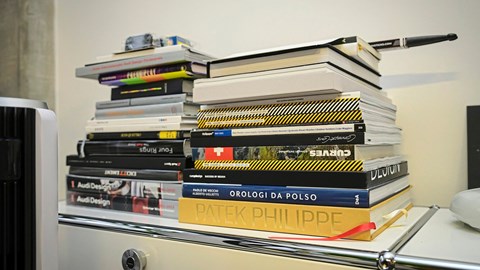
The marque’s new chief creative officer is a champion of structural soundness, a stickler for precision and an advocate of technicality. He loves geometric shapes, hair-thin cutlines and stunning proportions. Frascella’s credo – although inspired by the past – goes way beyond retro. Omnipresent abstract mood boards reflect Ingolstadt’s new minimalism, highlighting architecture, fashion and precision engineering.
This thinking has influenced the 2026 Formula 1 livery, which combines classic Silver Arrows hues with signature Audi Sport red and contrasting black, and of course the four rings.
How about a truly outstanding supercar to milk that win-on- Sunday, sell-on-Monday possibility? ‘Happy to do anything,’ quips Frascella, ‘but it’s not on me to decide.’
Although we’re not allowed to talk future product, it’s clear that the Concept C is only the starting point of a journey which must eventually again include standout brand-shapers on a par with the A6 Allroad, the original A5 and the five-door A7 coupe. While the Nuvolari is a nice-to-have element, the must-have list is topped by a fresh set of crossovers and SUVs which will include the full-size body-on-frame sibling of the US-built Scout Traveler, and of course the next-generation Q3/4/5/6/7/8/9.
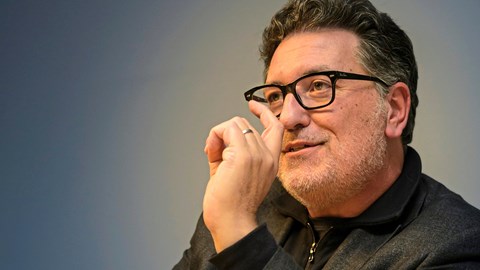
When will the new all-electric SSP platform take over as the dominant architecture from the combustion MQB/MLB/PPC models? Frascella shrugs his shoulders. ‘It doesn’t matter. The multifunctional vertical frame works for both factions. It can be the main air intake or merely act as an ADAS centre of intelligence. Irrespective of powertrain and vehicle type, the new upright grille is the determining element of our future architectures.’
He holds up the black sketchbook and taps on that private top-secret bible which is so near and yet so far. ‘You just wait and see.’