

By DAVID CHURCHILL, CHIEF POLITICAL CORRESPONDENT
A grandmother killed in a crash could still be alive today if safety technology on the smart motorway she broke down on hadn't been 'dangerously defective', a court heard.
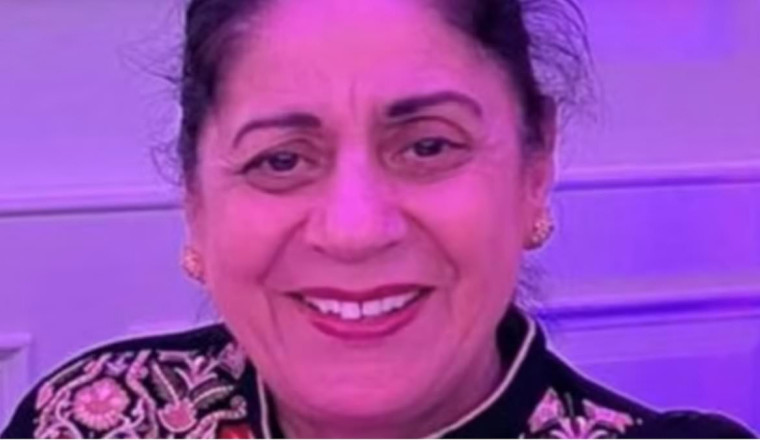
Pulvinder Dhillon, 68, was a passenger in her daughter's Nissan Micra when it stopped in a live lane of traffic on a section of the M4 with no hard shoulder.
After being stranded for six minutes, it was hit from behind by a van in a 'high velocity' and 'calamitous' crash which 'incinerated' the Nissan after turning it into a fireball.
Mrs Dhillon's daughter, Rajpal Dene, was dramatically pulled to safety by other motorists. But the pensioner died at the scene.
Reading Crown Court today heard the safety technology had been 'defective for five days' and that National Highways, which maintains the roads, was apparently 'unaware'.
It meant drivers were not warned on 14 gantries and lollipop signs of the broken down Nissan ahead.
Smart motorways have no hard shoulder because they have been turned into an extra lane of traffic, with safety technology designed to mitigate this.
Pulvinder Dhillon, 68, was a passenger in her daughter's Nissan Micra when it stopped in a live lane of traffic on a section of the M4 with no hard shoulder in March 2022. She died at the scene after it was struck by a van
Barry O'Sullivan (pictured at Reading Crown Court) denies causing death by careless driving
The court heard that Barry O'Sullivan, 45, struck the pair's stranded Nissan from behind in the outside lane with his Ford Transit.
He denies the crash, in March 2022, was his fault, pleading not guilty to causing death by careless driving.
Defending, Ian Bridge told the court that 'Mr O'Sullivan's case is that he didn't cause this' and that the 'over-riding cause' was the failure of the safety technology.
He added: 'If it wasn't him, it would have been somebody else.
'People who use motorways rely on the safeguards motorways have in place.'
He added: 'It had been defective for five days.
'Mr O'Sullivan and all other road-users were completely oblivious that their protection system was defective. It appears that National Highways were also unaware.'
He said this meant the stretch of M4, near Reading between Junctions 11 and 12, was 'dangerously defective' and that this was the 'dominant and overwhelming cause' of the crash.
Ian Hope, prosecuting, said it was true 'to some extent' that the crash may never have happened if the technology had been working.
He told the jury it was 'highly unlikely' O'Sullivan would have been driving at at least 70mph if the safety systems were working.
The failure meant the 'smart motorway system wasn't working and therefore it wasn't showing messages about any obstructions in the road ahead or to alter your speed.'
The systems could have closed the outside lane with the stranded Nissan in it by displaying a red X on overhead gantries, he said.
But he added that drivers 'can't just drive how they like' and 'ignore the rules of the road.'
He played CCTV footage to the jury showing several other drivers managing to swerve past the stationary Nissan before O'Sullivan hit it, adding: 'The actions of other drivers, and resulting calculations, show that this was an avoidable collision, and that the fatal incident appears to have resulted from a period of inaction on behalf of the Ford van's driver, Mr O'Sullivan, most likely due to inattention on his part.
'In other words, Mr O'Sullivan's driving on the approach to this incident was careless. He simply did not have sufficient regard to what was happening around him.'
Crash investigators determined that O'Sullivan started steering left to try and avoid the Nissan less than half a second before impact, which Mr Hope said was proof that O'Sullivan was 'not focusing' on the road.
He had been travelling between 70mph and 82mph.
The court heard the tragedy struck during morning rush hour at about 8.30am near Reading between junctions 11 and 12.
For an 'unknown reason', the Nissan's engine failed, lost power and broke down in the M4's outside lane.
Ms Dene tried switching the engine off and on again after activating her hazard lights but the car could not be re-started.
Mr Hope added: 'Whatever was occupying Mr O'Sullivan's mind in the seven or eight seconds leading up to this collision and for the 260 metres of sight line he had to the stranded Nissan, we submit that the evidence proves that he was not focusing upon the road.'
The trial continues.
Sorry we are not currently accepting comments on this article.