
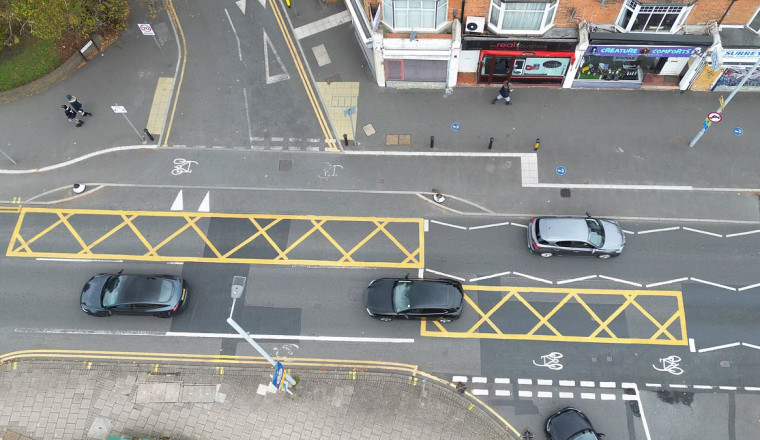

Yellow box junctions are one of the few bits of road furniture that drivers broadly accept on principle. The deal is simple: don’t block the crossroads. Keep the side road moving, keep buses from getting trapped, stop the whole network from locking up. Anyone who’s crawled through a busy town centre at 5:30pm knows why they exist.
So when a single cluster of boxes and cameras coughs up £450,000 in fines in just eight months, the mood shifts from “fair enough” to “hang on a minute”. Not because motorists suddenly want the right to park a Qashqai across a junction, but because that kind of revenue almost always points to one of two things: a genuinely chaotic location that needs engineering, or an enforcement setup that’s tuned to harvest mistakes rather than prevent them.
The council line is predictable: the junctions are “legally compliant”. That phrase does a lot of heavy lifting in local government. Compliant with what, exactly? The box markings can be the right shape, the camera can be approved, the signage can tick the required boxes, and the whole thing can still be a booby trap for ordinary drivers doing ordinary traffic-speed decisions.
The Highway Code summary is widely understood: don’t enter the box unless your exit is clear. The part that catches people out is how brutally literal the enforcement is. If you cross the first yellow line and then stop because the car ahead doesn’t clear, that’s a contravention. It doesn’t matter if you were moving when you entered, it doesn’t matter if traffic stopped suddenly, and it doesn’t matter if you only came to a halt with your back wheels a foot inside the paint. If you stopped because your exit wasn’t clear, the camera has your number.
There’s one big exception: turning right. You’re allowed to enter the box and wait in it if you’re held up by oncoming traffic or other right-turners. That’s not generosity; it’s how junctions function. But outside that exception, box junction enforcement is essentially a test of whether you can correctly predict the behaviour of the queue in front, with a penalty attached if you guess wrong.
That’s why the money figure matters. £450,000 is not “a few hot-headed drivers”. Depending on the penalty level and how many people pay at the discounted rate, you’re talking roughly 7,000-ish PCNs at £65 or 3,500 at £130. In eight months. From what is, in theory, a simple “don’t block the junction” instruction.
If thousands of drivers are “making the same mistake”, you’re looking at systemic design failure or an enforcement strategy that’s banking on the inevitability of human judgement under pressure.
Councils will insist they don’t run box cameras for profit, and legally they’re meant to frame it around traffic management. Fine. But from a driver’s perspective, the incentive structure looks rotten.
A well-designed box junction should become boring. It should prevent blocking, reduce conflict, and then sit there quietly doing its job. A box junction that generates a steady five-figure monthly income has, by definition, found a constant supply of failure. If the council really cared about outcomes over revenue, the obvious response to a huge spike in contraventions would be to ask: why are so many people stopping here, and what can we change?
Because if the junction is genuinely that vulnerable to being blocked, a camera is a bandage. The cure is traffic light phasing, lane allocation, yellow box sizing, clearer approach markings, or changes to the downstream bottleneck that’s causing the tailback in the first place.
There’s also a difference between a box junction that’s legal and a box junction that’s fair.
A box can be technically correct yet placed where the road layout almost guarantees an honest misread: a crest just before the junction, a bend that hides the standing queue, a bus stop immediately beyond the box where vehicles dwell, or a merge that collapses flow seconds after you commit. The enforcement camera doesn’t care whether you could realistically see the exit space when you entered. It cares that you stopped.
Then there’s box sizing. Over-generous boxes that extend beyond the actual conflict area turn “keep the junction clear” into “don’t breathe near this paint during peak hours”. That’s when drivers stop treating it as a safety device and start treating it as a trap to tiptoe around, often with worse driving as the side effect: harsher braking, hesitation, and people leaving silly gaps because they’re terrified of being caught with a tyre on the lines.
If you get a yellow box PCN, you can ask for the video and check the basics: did you stop because your exit was blocked, or did you stop for oncoming traffic while turning right? Were you actually stationary, and for how long? Some people do win appeals on technicalities or edge cases, but anyone expecting “I only stopped for a moment” to be a universal get-out is in for disappointment. Adjudicators can be sympathetic, but the rule is blunt.
The bigger point is this: a system that relies on thousands of people rolling the dice with an appeal process after the fact is a bad system. If the junction needs that much enforcement, it needs redesign.
If the council wants to cool the “cash cow” narrative, there are practical moves that don’t require anyone to pretend boxes are optional.
Publish the numbers properly. Not just revenue, but PCNs issued per day, discount uptake, repeat locations, and the times contraventions spike.
Show the engineering logic. Why this box, why this size, why this camera, and what problem it was meant to solve.
Review the layout when contraventions explode. A junction that suddenly starts printing fines often has a downstream change causing queues to form where they didn’t before.
Fix the bottleneck, don’t monetise it. If the exit lane is regularly blocked by loading, parking, bus dwell time, or lane drops, enforcement is just billing drivers for a council-shaped problem.
Be honest about behaviour. If thousands are caught, the right question is whether the design matches real traffic patterns, not whether the paint matches a diagram in a manual.
Yellow box junctions are supposed to keep cities moving. When they start behaving like a subscription service, drivers stop seeing them as traffic management and start seeing them as a revenue machine with a bright yellow logo. And once that perception sets in, “legally compliant” won’t buy back much trust.