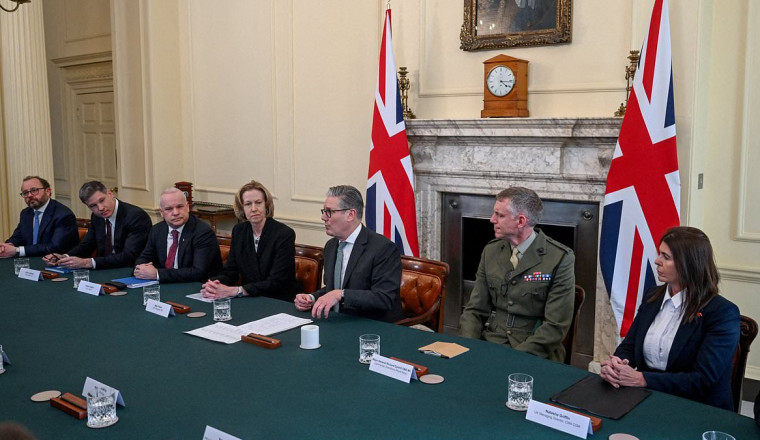

Keir Starmer tonight admitted the Government can't deal with the fallout from the Iran war 'on its own' as he held emergency talks with industry chiefs in Downing Street.
The Prime Minister hosted a roundtable meeting in No10 with top bosses from the insurance, oil, gas and shipping sectors as the Middle East crisis entered a fifth week.
'This is going to have to be a joint effort,' Sir Keir told them as they began discussions about the devastating economic impact of Donald Trump's conflict.
'The Government can't do it on its own. You can't do it on your own. We're going to have to work together on this.'
It came as the RAC warned van drivers are 'bleeding cash' just to stay on the road as the price of fuel continues to rocket.
Warnings are becoming more stark about the scale of the hit to the UK - and how long it might last - with soaring pump prices just the tip of the iceberg.
An ex-Bank of England chief cautioned that Iran's closure of the crucial Strait of Hormuz means a 'long-term reduction in supply' and ministers must look at rationing consumption.
At the same time a leading shipping expert pointed out that the world was far more interlinked than at the time of the notorious 1970s energy shock.

Keir Starmer admitted the Government can't deal with the fallout from the Iran war 'on its own' as he held emergency talks with industry chiefs in Downing Street

The Prime Minister hosted a roundtable meeting in No10 with top bosses from the insurance, oil, gas and shipping sectors as the Middle East crisis entered a fifth week

A sign telling motorists there is no unleaded petrol available at some of the fuel pumps is displayed at a Tesco supermarket in Southend
They suggested shortages of fertiliser could send food prices spiralling and could cause political turmoil in poorer countries.
The Government has admitted it is drawing up contingency plans as the Iran war stretches on, despite appealing for Brits to continue their lives as normal.
As the Middle East crisis dragged on:
- Mr Trump said he is considering a military operation to seize Kharg Island, a crucial part of Iran's oil export infrastructure;
- Brent Crude oil prices ramped up again as the US President said: 'Maybe we take Kharg Island, maybe we don't';
- A further 3,500 US troops have arrived in the Middle East;
- US media reported the Pentagon is preparing for weeks of ground operations in Iran;
- Pakistan said it's preparing to host peace talks between the US and Iran;
- Chancellor Rachel Reeves joined emergency talks with G7 counterparts.
Sir Keir met Shell, BP and Norwegian energy company Equinor in Downing Street telling them the UK is working on a 'viable plan' for the Strait of Hormuz.
He added that people in the UK will have concerns about energy bills, petrol and food prices 'uppermost in their minds'.
'We're just entering the fifth week of the conflict in Iran, and I wanted to bring all of you together with government to talk through some of the implications,' the PM said.
'The political position we've taken, I think, is straightforward, which is, we're not going to get drawn into the conflict proper.
'We will defend British interests and British lives in the region, particularly in the Gulf allied states, and obviously our allies there, and we are working on a viable plan for the Strait of Hormuz, which I want to come back to.
'So it's not our war, but it is our duty to protect British citizens.
'Particularly their concern will be not just the escalation of the war, but this sense that it's going to hit them and their families and their households.
'And I think probably uppermost in their minds at the moment is energy bills, petrol and also food prices.'
The talks in Downing Street also involved bosses from shipping giant Maersk, maritime insurance specialist Lloyd's of London, and banks HSBC and Goldman Sachs.
They were updated on the military situation in the region from Major General Richard Cantrill, the UK's maritime operations commander.
Mr Trump has threatened the destruction of Iran's energy infrastructure and possibly its water desalination plants unless the Strait of Hormuz is 'open for business'.
The RAC said the average cost of a litre of diesel at UK forecourts had hit 181.2p, up 27 per cent from 142.4p on February 28, the day the US-Israeli strikes began.
Average petrol prices have reached 152.0p per litre, an increase of 14 per cent from 132.8p over the same period.
Steve Gooding, director of the RAC Foundation, said: 'Diesel is the lifeblood of millions of small businesses, but today white van man is bleeding cash just to stay on the road.
'Whether you drive or not, soaring diesel prices will take money out of your pocket, either at the pump or in the bills you pay for everything from calling out the plumber to getting a home delivery.
'If oil prices remain at this level the impact on the forecourt could be felt for weeks, if not months.
'That's bad news for everyone, not just drivers of the UK's 4.6 million diesel vans, the majority of which will be used for work purposes.'
The enormous cost of servicing the UK's debt mountain means the Government has limited firepower to respond to the Iran turmoil.

Motorists fill up at the the Braywick service station on Windsor Road in Maidenhead today

CCTV footage shows smoke rising from Israel's Haifa refinery after a reported Iranian attack on March 19
Brent Crude prices ramped up again overnight as Donald Trump hinted he could send in ground troops to seize Kharg Island, a crucial part of Iran's oil export infrastructure.
Fears have been raised that shortages of diesel could start to appear in the coming weeks, as the disruption feeds through into supply chains.
That is expected to be worse affected than petrol which is largely sourced from the US and Norway.
Australia has announced that duty on fuel sold at pumps is being halved for three months. It comes after Ireland, Spain and Poland took similar measures.
But the UK Government has so far batted away calls for similar action, and refused to cancel a rise in duty scheduled to take effect in September.
Alongside the PM's 'round table' in Downing Street, the Chancellor held discussions with G7 counterparts on Monday.
Rachel Reeves reiterated the need for 'a swift solution' in the Middle East at a virtual meeting of finance and energy ministers and central bank governors.
The Chancellor, Bank of England governor Andrew Bailey and Energy Secretary Ed Miliband were all present in the meeting.
After the call, Ms Reeves wrote on X: 'At today's G7 talks with Bank of England (governor) Andrew Bailey and Ed Miliband, I reiterated the need for a swift resolution in the Middle East.
'This is not our war and we won't be drawn into it, but its economic impacts are global – we must work with partners to strengthen resilience.'
The G7, which includes the UK, the US, Germany, France, Italy, Canada and Japan, along with the EU, were considering ways to respond to the economic hit from the war.
Ms Reeves had been expected to plead for countries to avoid 'protectionism' during the meeting, amid concerns that Britain's energy imports could be choked off by hoarding of oil and gas supplies.

Alongside the PM's 'round table' in Downing Street, the Chancellor held discussions with G7 counterparts on Monday
Ahead of his own meeting on Monday, Sir Keir said: 'We are bringing together the shipping sector, insurance and energy, because obviously that's a focus of concern.
'A lot of discussion about the Strait of Hormuz and what we can do to get the straits open, which is the single most effective way to bring energy prices down.
'I will have a Cobra tomorrow, another Cobra, to look at the economic impacts of the war and making sure that everything that we need to have in place, everything is monitored and audited properly.'
Asked about whether petrol rationing was being considered, as it has in other European nations, the PM insisted the advice to motorists is that there was 'no need to do anything other than what is normal'.
Former Bank of England deputy governor Howard Davies said with Covid it 'looked as if it was going to be a V-shaped recession once we'd sorted out vaccinations'.
Read More
US-Iran conflict is 'not our war' says Keir Starmer as he tears into UK's biggest ally Trump in bid to rescue Labour from local election bloodbath

'In this case it could well be that supplies from the Middle East are constrained for quite a long time,' he told the BBC.
'Therefore we may have to live with a higher oil price - perhaps not $150 but certainly higher than the $60 it was when we started - for quite a long period.
'That requires a plan to increase alternatives and also to reduce consumption. It looks as though we may well have a long-term reduction in supply.'
Sir Keir also reiterated that UK forces would not be taking part in offensive action in the Gulf. He said: 'This is not our war and we're not going to get drawn into it.'
But Tory leader Kemi Badenoch shot back: 'He doesn't need to have any more meetings, the oil and gas sector has said what it is they need.'
Petrol stations are 'well-stocked nationally and any suggestion otherwise is incorrect', according to Downing Street.
Asked whether the Government was planning for any shortages, the Prime Minister's spokesman replied: 'We'll always plan for all eventualities.'
He added: 'To be very clear, as the PM has said and as the Government have said, and indeed industry have said, fuel production and imports are continuing.
'The UK benefits from diverse and resilient supply.
'Petrol stations in the UK are well-stocked nationally and any suggestion otherwise is incorrect.'
Lars Jensen, a former director of shipping giant Maersk, said it looked 'exceedingly unlikely that there is any short-term respite to the flow of goods' through the Strait of Hormuz.
Asked what governments could do to ease the impact, Mr Jensen said: 'In reality, not very much. There will be a lot of words but there is very little action that can be taken, because at the end of the day it boils down to whether or not the Iranians want to shoot at ships in the Strait of Hormuz.
'Any talks about well can we do something on insurance, can we do something about military escorts - all of that is unlikely to lead to a massive change in the risk willingness of the commercial shipping companies.'
Mr Jensen - who now runs Vespucci Maritime - told the BBC's Today programme that the world must brace for worse because it is 'only in the beginning of those price escalations'.
'We need to keep in mind that a lot of the oil that was loaded in the Persian Gulf prior to this crisis is still right now arriving at some of the refineries around the world,' he said.
'That will soon stop. So the oil shortages that we have been seeing they are only going to get worse, even if magically the Strait of Hormuz would reopen tomorrow.'
He added: 'The problem again is the extended supply chain for oil and energy products is measured in many, many months. So as I mentioned, even if you opened (the Strait of Hormuz) tomorrow you are going to feel these higher prices at least for the next six months, if not even more.
'And that is before we take into account the facilities that have now been physically destroyed in the Persian Gulf.
'So we need to sit back from a global perspective and start to work around that we will face massive energy costs, not just while this crisis goes on but also for six to 12 months after it is over.'
Pressed whether the energy shock could be comparable to the 1970s, which sparked a global recession, Mr Jensen said: 'The comparison is easy to make.
'The problem is it is not quite correct. Because back then the amount of goods - not just oil but also fertiliser, aluminium, all sorts of other products - it was a lot less than what we are dependent on today.

Rachel Reeves will plead for countries to avoid 'protectionism', amid concerns that Britain's energy imports could be choked off by hoarding of oil and gas supplies
'So the impact we are seeing today is going to be substantially larger than back in the 70s.
'I think a lot of people are underestimating what the impact is. We talk a lot about oil, what has me a lot more concerned is fertiliser.
'You've got 20-30 per cent of the seaborne fertiliser in the world originating from the Gulf.
'This will mean rapidly escalating food prices, especially in poorer countries which typically tends to destabilise such countries.'
Nigel Green of financial advisory firm deVere Group warned that the UK is 'more exposed than most advanced economies' because up to 40 per cent of energy is imported.
'Energy costs transmit quickly through the system. Fuel, transport, food production and manufacturing all feel the impact. If oil and gas remain elevated, inflation in the UK will inevitably rise again, and it'll do so faster than many forecasts currently assume,' he said.
'Around 35–40 per cent of our energy is imported, and we remain reliant on global markets for both crude and refined products. Any disruption to key routes feeds directly into domestic prices and economic stability.'