

By RUPA HUQ MP
A decade on from Volkswagen's 'dieselgate' scandal, a pivotal trial at London's High Court is currently in process, with 1.6 million motorists taking legal action against major car makers accused of cheating emissions tests.
More than a dozen car manufacturers have been alleged to have used technology on diesel vehicles made from 2009 onwards to manipulate emissions tests.
The claim is the largest of its kind in English history, with the High Court previously told it is believed to be worth at least £6billion.
Among the major car firms embroiled in the case include giants such as Mercedes-Benz, Ford, Nissan, Renault and the Stellantis-owned brands Peugeot and Citroen, all of which are facing accusations of fitting unlawful 'defeat devices'.
These devices detected when vehicles were being tested and ensured emissions were kept within legal limits but did not do so when the cars were on the road, the claimants' lawyers say.
The manufacturers, however, say the claims are fundamentally flawed and reject any similarity with the scandal that erupted in 2015, which cost Volkswagen billions in fines and compensation.
As millions of Britons await the outcome of the case, including whether they will be entitled to renumeration, Rupa Huq, Labour MP for Ealing Central and Acton, says its time for the Government to get tough on manufacturers who victimise the motoring public...
Campaigners pictured outside the Royal Courts of Justice in central London in October as the High Court case against more than a dozen car makers accused of installing emissions 'defeat devices' in diesel cars sold in the UK began
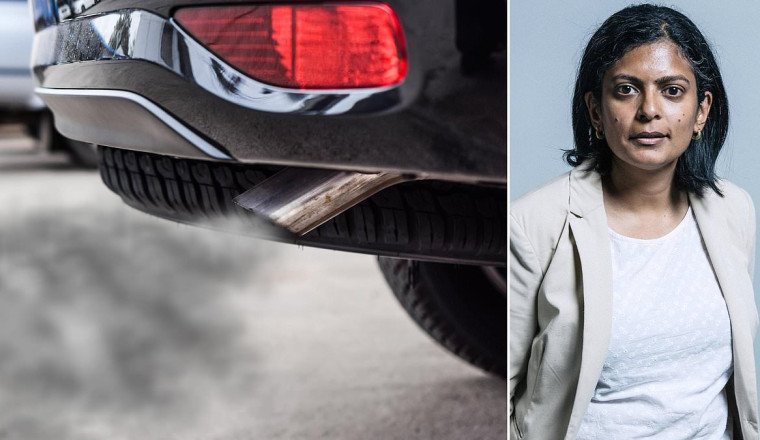
Rupa Huq, Labour MP for Ealing Central and Acton says its time for the Government to get tough on car makers who are found to have victimised the UK motoring public
Rupa Huq MP writes: While once a brand associated with Herbie the 'lovebug' beetle and reputed for German high performance motoring, a decade ago VW became synonymous with 'scandal' when the company was exposed for faking emissions tests.
Reputational and financial consequences followed.
Just as VW was rehabilitated having served its sentence, now comes the sequel: Dieselgate 2 playing in High Court deliberations as we speak.
The sequel covers hundreds of thousands of vehicles on British roads alleged to be continuing to spew out dangerous emissions far beyond the legal limits.
Multiple major auto manufacturers are accused of using so-called 'defeat devices' to cheat on emissions tests for diesel cars while simultaneously conning British consumers that these were cheaper and cleaner to run.
But testing on 2008-2020 vehicles show massive pollution when driven under real world conditions.
This flouting of our law is highly problematic.
The dieselgate scandal first emerged in September 2015. The US Environmental Protection Agency accused Volkswagen of installing software - known as 'defeat devices' - on diesel cars to lower readings of nitrogen oxide emissions
The consumers who bought these cars believing they were low-emissions vehicles have essentially been defrauded by the companies, which have misrepresented the level of emissions.
Countless members of the public, including young children, have been harmed by breathing those excess emissions.
This is true not just in London, but also in those cities in the North that suffer from high levels of pollutants.
These excess emissions may already have led to 16,000 premature deaths in the UK and 30,000 new cases of childhood asthma, according to a recent report from an international climate thinktank.
Mercedes, Ford, Nissan-Renault, and Citroën-Peugeot - are all now on trial for the suspected use of these illegal defeat devices, with possibly 23 other brands potentially similarly culpable.
Alexander Antelme KC, for Renault, said in written submissions for trial that the legal action was based on the 'false assumption that the features of the 'VW Dieselgate' applied across the entire automotive industry'.
He said: 'The Renault core sample vehicles do not contain defeat devices or prohibited defeat devices, whether by accident or, as the claimants allege, deliberately to 'cheat' the emissions regulations.
'The latter allegation is without merit and untenable.'
He continued: 'The claimants' case is riddled with errors and misunderstandings, especially about the design and operation of the vehicles' emission control systems.
'The features to which the claimants wrongly object are, in fact, appropriate and necessary elements of a well-designed diesel engine.'
Neil Moody KC, for Ford, said in written submissions that the case was 'scientifically illiterate' and 'flawed on the facts and the law'.
He said: 'Their case is not only that these vehicles were designed and marketed in breach of the emissions regulation; their case appears to be that these vehicles all contain PDDs as a result of deceit and fraud by all manufacturers.
'The inference seems to be of some sort of industry-wide conspiracy. The proposition need only be stated for it to be seen to be implausible.'
The evidence presented is compelling, featuring internal company documents discussing the pros and cons of different devices.
Data based on the claimant pool indicated that close to 90 per cent of these cars are likely to have defeat devices, and under real driving conditions, some cars exceed the legal limit by 20 or 30 times.
The true extent of the companies' wrongdoing should become even clearer as the trial proceeds, but the sheer number of claimants - 1.6 million - makes this a far larger case than the 2022 UK Volkswagen settlement, which compensated only 91,000 consumers.
But the reality is that trials are always a roll of the dice - verdicts cannot be predicted and appeals can leave those verdicts indefinite for years.
In this case, even if the court rules against the companies, discussions on compensation for affected consumers will not begin until autumn 2026.
But the government has a trump card that can ensure that the companies are held accountable under the law.
Earlier this year, the Department for Transport (DfT) launched an investigation into the possible use of defeat devices, involving many of the same brands represented in the trial.
The department has stated that 'defeat devices are illegal' and has pledged to consider action if the investigation concludes that defeat devices were used.
Unfortunately, to date there has been little indication of any progress in that investigation, conducted by the DfT's Driver and Vehicle Standards Agency.
If the Government truly cares about the people who have been affected by these illegally high emissions, this investigation must proceed with speed and consequence.
Every month that the results are delayed our government is neglecting to hold the auto manufacturers to account and crucially puts more people—including children—at risk for asthma and other health issues.
'If the government truly cares about the people who have been affected by these illegally high emissions, this investigation must proceed with speed and consequence,' Huq says
During the first Dieselgate scandal in 2016, the DfT launched an inquiry into the use of defeat devices by Volkswagen but ultimately did not prosecute.
The Transport Select Committee expressed concern about the DfT's 'ambivalence' toward VW's use of defeat devices and charged the Department with being 'too slow to assess the use of its powers…'
Having been given a second chance, the DfT should clearly prioritise the interests of the public and consumers as it pursues the current investigation.
The Government should also make clear to the auto manufacturers that it is prepared to act.
Since 2024, the Environment Act has enabled the government to introduce regulations that would require manufacturers to recall cars when there are reasonable grounds to believe they do not meet applicable environmental standards.
The government should move now to use these powers, so that any use of defeat devices can be corrected promptly and at the companies' expense.
For too long, auto manufacturers in the UK have victimised the public.
They have misled consumers about the pollution emitted by diesel auto engines and have put millions of citizens at risk simply because they live or work near roads.
These companies should step forward and make things right with those they have harmed.
The government should do everything in its power to ensure that happens. We should not wait for Dieselgate 3.