
► Lola returns
► Road car and race car shown
► Well under 1000kg…
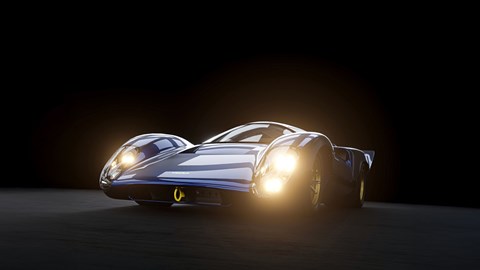
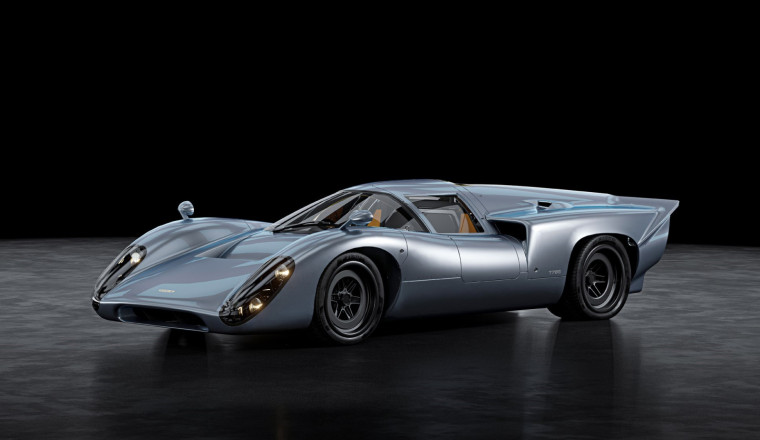
The legendary Lola T70 racing car has been revived for the road with a 500bhp Chevrolet V8 engine and bodywork made from 100% natural fibres. There’s also a lighter, faster 530bhp competition version that’s eligible for Historic racing. Both versions weigh well under 1000kg, so performance is… significant.
What’s the Lola T70, then?
One of the most successful mid-engined sports racing cars of the 1960s. It first raced – and won – in 1965, becoming the car to beat in the bonkers Can-Am series. Dozens of wins and several championships followed, but it was the final Mk.IIIB coupe version that made the T70 iconic.
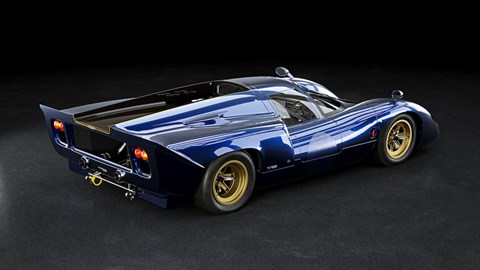
That’s because it’s widely regarded as one of the most beautiful racing cars there has ever been, also because it scored the T70’s biggest success when the Team Penske cars finished one-two in the 1969 24 Hours of Daytona. Many T70s of all varieties are still campaigned in Historic racing and, by all accounts, a well-sorted one’s a delightful, friendly, really very quick thing.
There have been many T70 Mk.IIIB replicas produced over the years, including a run of Continuation cars built by Lola itself. And it’s the Mk.IIIB that the latest version faithfully copies.
Tell me about the new version
The new Lola T70S couldn’t just be mistaken for the original, it essentially is the original, but made using modern materials and techniques. So it has an aluminium monocoque chassis and composite body, double wishbone suspension with adjustable dampers, 304mm brakes with four-piston calipers all round and gorgeous five-spoke magnesium alloy wheels. Even the powertrain mirrors the Chevrolet/Hewland combination favoured in period. Indeed, it’s so faithful that every race version will come with FIA papers for Historic racing.
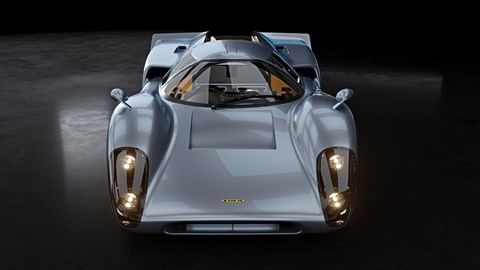
The big departure is in the type of composite used to make the body. Dubbed Lola Natural Composite System (LNCS), the fibre element is taken from agricultural waste and basalt rock, while the resin is plant-based. Lola claims LNCS is stronger than glassfibre reinforced polyester (GRP) and reduces noise, vibration and harshness. CO2 emissions from production are massively, reduced as well.
What’s performance like?
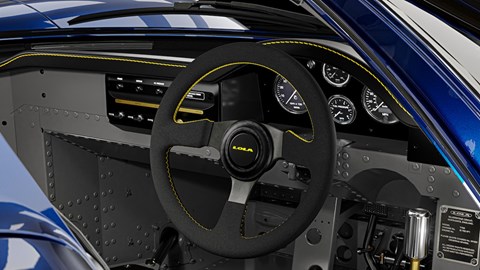
Huge. The road-going T70S GT is powered by a 6.2-litre Chevy V8 producing 500hp driving the rear wheels through a six-speed gearbox that can be switched between H-pattern and sequential shifting. With a mere 890kg to shift, it catapults from 0-62mph in just 2.9 seconds, and 0-124mph in 9.3 seconds, before reaching 200mph flat-out. Without traction control or anti-lock brakes, even power steering.
The racing T70S is even faster. To comply with FIA regs it has a period-correct 5.0-litre Chevy V8 producing 530bhp, connected to an equally period five-speed Hewland LG 600 gearbox. Without the GT’s aircon, it weighs 860kg. That translates to 0-62mph in 2.5 seconds – the same as a current Porsche 911 Turbo S – 0-124mph in 8.9 seconds and 203mph.
Grand Prix and Le Mans winner Johnny Herbert is taking care of chassis development – having recently campaigned the famous green Mk.IIIB owned for many years by privateer racer David Piper – so it should be as good to drive as the original.
Anything else I should know?
It’s tiny. Lola quotes a length of 4225mm and it should match the original Mk.IIIB’s width of around 1800mm and height of just over 1000mm. The GT version has a few concessions to everyday usability including chunkier switches and storage for the headsets that will be necessary if you want to be heard over the thundering engine.
Okay, I’m sold. How much does it cost?
Lola hasn’t given a specific figure but expect to pay a similar amount to a good example of an original Mk.IIIB. Values are hard to pin down as only 16 were built, but expect a T70S to cost around £750,000.