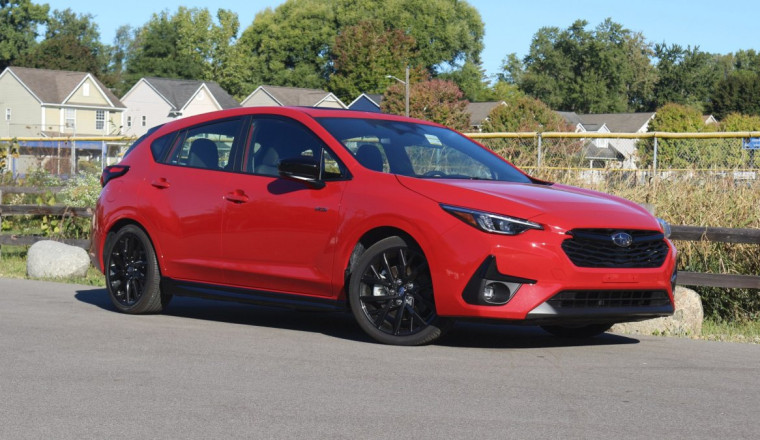

The Impreza proposition is a simple one: take a fairly basic economy hatchback, give it standard all-wheel drive, and, well, that’s basically it. But if you’re feeling frisky, you can step up to the 2026 Subaru Impreza RS, and inject some pep into your commute courtesy of its 180 horsepower.
Once upon a time, we had more choices. Subaru used to offer an Impreza sedan, but the closest thing you’ll find in showrooms these days is the WRX, which is exclusively available as a four-door. Instead, the Impreza’s most direct relative is now the Crosstrek, which takes the same commuter-car formula and applies the crossover treatment (a mild lift) to put on a show of greater capability, further enhanced by the ultra-granola Wilderness model.
But here in Impreza-dom, Subaru keeps it between the lines, literally and figuratively. There’s no gimmick here—no niche or excess niceties. It’s just a simple, honest car. Is that enough these days, though? I recently spent a week with one to find out.
Not much is new for the RS this year. Subaru slightly massaged the 2.5-liter boxer engine to improve refinement. Those revisions came at the expense of 2 hp, lowering the 2026 figure to a flat 180 hp, but kept the same 178 lb-ft of torque as 2025. Since it’s the sportier of the two Impreza models on offer, the RS gets larger wheels with an RS-specific design. I’m not a big fan of dark wheels on this particular shade of red, but I’ve certainly seen worse. The bigger wheels and lower-profile tires help further distinguish the RS from the knobby, tree-seeking attitude of the lifted Crosstrek.
Inside, it’s typical Subaru. That means a basic, straightforward cabin, a portrait-oriented infotainment touchscreen, and basic plastics throughout. The RS does get some splashes of color in the Impreza’s otherwise all-black cabin, and when turned on, the standard 11.6-inch screen breaks things up a bit with its colorful graphics. Subaru’s operating system is subpar, overall—often clunky and occasionally reluctant to respond to inputs.
A 180-hp engine may not seem like anything to write home about in 2025. Still, it’s worth highlighting that it’s naturally aspirated and takes old-fashioned regular gas—a nice upside for a sporty commuter car. Unsurprisingly, the CVT is a bit of a bummer and won’t wow enthusiasts, but it’s not a total let-down either. The eight simulated gear ratios available via the paddle shifters do a reasonable approximation of a conventional automatic if you find yourself with some room to stretch the Impreza’s short legs.
Such a thing can be tricky to come by in metro Detroit, but the Impreza finds itself right at home in the land where car-based commuting is a near-universal religion. The 2.5-liter engine feels torquey around town, taking more of the sting out of the CVT experience. The combo is still a bit coarse compared to the rampant small-displacement turbo powertrains taking over the industry, but that might be an upside for those who enjoy the sensory experience of a Subaru flat-four.
That configuration also affords the Impreza an enviably low center of gravity. The way the RS noses into a turn is unique among its peers, and I suspect this allows Subaru to tune the suspension a bit softer than its competitors for the same level of responsiveness. All else being equal, this is the economy car I’d want to drive every day. Sadly, that’s not how it shakes out; more on that later.
For a car with a ho-hum engine and transmission combo, the RS delights with its on-rails handling. A Miata this is not, but the Impreza rewards the driver who appreciates the value of momentum. If you don’t find it fun to toss this thing around on a back road, you’re probably using the brakes too much. And as a nice little bonus, you don’t have to hear the CVT whining so much when you’re not constantly on/off the throttle.
But in the end, this is a sporty-ish compact still in search of some playfulness. The RS’s interior highlights are nice touches, but the rest is still a fairly drab sea of black. And sadly, the transmission is ultimately inescapable. It’s certainly adequate for the standard Impreza’s mission, but the RS might liven up even more if we had the option to row our own gears. Subaru’s compact is also due for a new infotainment suite. This one… kind of works?
The RS occupies a somewhat odd niche. It’s one of only two ways to spec the Impreza (Sport, AKA the base model, being the other), but in a way, they’re really more like divergent paths. Sure, the RS is better equipped (and is the only route to the premium audio system and some other packaged options), but the real point is getting into the bigger engine.
When I said above that I’d rather drive the Impreza “all else being equal,” this is where things get messy. The RS’s somewhat odd positioning puts it alongside some pretty compelling alternatives, including the all-wheel-drive Mazda3 hatchback, and both the Toyota Corolla and Honda Civic hatchback. As enjoyable as the Impreza is, the Mazda3 is every bit as satisfying to helm and still offers all-wheel drive.
The Corolla is the most ho-hum in the dynamic department, but at least its interior is nice to look at. The Civic doesn’t necessarily stand out in any one area, but its cabin feels like an upgrade over the Subaru’s. And if you’re really craving power, Mazda still offers that 2.5-liter turbo. You can get a better performer in the WRX, but then you’re ditching the hatchback for a sedan.
Fuel economy has not traditionally been Subaru’s strong suit, but most of that is due to its insistence on maintaining a full-time AWD system. My tester is rated at 26 mpg city, 33 mpg highway and 29 mpg combined, which is virtually identical to the Mazda3 when similarly equipped. The front-wheel-drive Corolla and Civic have the edge over both of them, inching closer to 40 mpg on the highway. And if you’re really feeling frugal, both offer a hybrid, too. No such luck with the Subaru.
Value is where the Impreza RS shines. It’s aimed squarely at the upper end of the compact segment, starting at just $30,690 with destination. Even my loaded tester still checked in at just $32,760 with the additional package bundling premium audio, a moonroof, and a power driver’s seat. Hey, I said it was basic, right?
For being such a simple little car, the Impreza RS is remarkably complex. It’s not the most exciting compact, but it is nice to drive. It’s not the most affordable, but it’s reasonably priced. It’s not the most efficient, but it drinks cheap gas and it doesn’t guzzle it all in one sitting. Put another way, the Impreza does enough things right that my few quibbles wouldn’t stop me from recommending it to an interested buyer. Would I have one over a Mazda3? I wouldn’t, but I’d gladly buy you a beer and let you try to convince me I’m wrong.
Subaru provided The Drive with a seven-day loan of this vehicle for the purpose of writing this review.
Byron is an editor at The Drive with a keen eye for infrastructure, sales and regulatory stories.

Car Buying Service