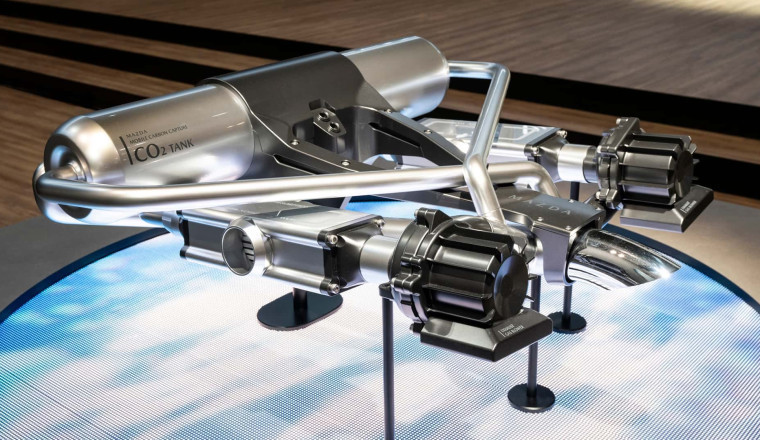

Mazda is pushing the boundaries of sustainable mobility with a concept that could change how we think about combustion engines forever. At the 2025 Japan Mobility Show, Mazda unveiled a prototype car powered by biofuel derived from microalgae and equipped with a proprietary carbon capture system dubbed “Mazda Mobile Carbon Capture.”
The concept is simple but groundbreaking: by combining algae-based biofuel which already boasts a 90% reduction in total CO2 emissions compared to fossil fuels with a device that captures a portion of the CO2 emitted during combustion, Mazda believes their combustion-engine car could achieve a net carbon-negative footprint. Essentially, the more you drive, the less carbon you add to the atmosphere.
How does it work?
The biofuel is produced by harvesting microalgae that absorb CO2 during growth, converting it into energy-rich oil refined into fuel. This already slashes emissions dramatically. But the real game-changer is the exhaust-mounted capture system that traps about 20% of the CO2 from tailpipe emissions before it escapes into the air. This captured carbon is stored in a small onboard tank with a zeolite-based substrate and can later be repurposed for industrial processes like making plastics or growing algae closing the carbon loop.
While the capture system adds a modest weight penalty and requires periodic maintenance (the CO2 tank needs swapping after roughly 50-200 km of driving), the technology represents a step beyond catalytic converters. Mazda sees this as a practical, scalable solution that extends the life of combustion engines in a world increasingly focused on zero-emission vehicles.
Mazda’s approach acknowledges the challenges facing EVs, particularly related to electricity grid emissions and resource supply. They envision a multi-path strategy where clean combustion, biofuels, and electrification coexist to deliver genuine carbon reduction.
As CEO Masahiro Moro summarized, “The joy of driving fuels a sustainable tomorrow.”
Mazda’s vision, blending the thrill of internal combustion with cutting-edge carbon management, offers a hopeful and innovative alternative in the race for climate-friendly transport.