

The researchers found that one tire will shed between two and fourteen pounds of rubber particles due to road wear from initial use to initial disposal. That's 2 to 14 pounds per tire. Multiply by four tires per car, billions of cars globally, and approximately 6.1 million tons of tire particles are released annually worldwide. In Europe alone, 1.3 million metric tons of tire wear particles are released annually.
Where does it go? Everywhere you don't want it. These particles may be small enough to be picked up by wind and carried for up to a month before they are deposited on land. Larger particles can be caught in stormwater runoff and transported along curbs and through stormwater systems where they are typically deposited into a local waterway. The air you breathe. The water you drink. The soil growing your food. Tire particles don't vanish. They just get smaller and more pervasive.
The Chemical Cocktail Nobody Warned You About
Production and use of tires generates multiple heavy metals, plastics, PAHs, and other compounds that can be toxic alone or as chemical cocktails. TWPs are composed of synthetic rubber polymers, reinforcing fillers, and chemical additives, including heavy metals such as zinc and copper and organic compounds like polycyclic aromatic hydrocarbons and N-(1,3-dimethylbutyl)-N′-phenyl-p-phenylenediamine, known as 6PPD.
Tire production uses roughly 400 chemicals, and as scientists learn more about their negative effects, concern about them is growing. Tire particles can cause heart, lung, developmental, and reproductive problems as well as cancer in humans, according to an Imperial College London report. Four hundred chemicals. In every tire. Grinding into microscopic particles with every mile driven.
The Salmon That Exposed the Problem
In the early 2000s, NOAA scientists discovered that at least 60 percent of coho salmon in Seattle's urban waters died before they had a chance to spawn, taking the next generation with them. Samples from waterways near the busiest roads had the highest levels of contaminants and the highest prespawn mortality rates.
A research team from the University of Washington and Washington State University then honed in on automobile chemicals as the likely culprit. It took nearly a decade to identify that the dust shed from tires contains 6PPD-quinone, an oxidized version of a chemical used to make tires more durable. One chemical. From tire wear. Killing 60 percent of an entire salmon population. That's not background pollution. That's ecosystem collapse triggered by commuter traffic.
EVs Make It Worse
The heavier the vehicle, the more particulate matter its tires release. That means electric vehicles, which weigh about 30 percent more than gas guzzlers, are worse offenders when it comes to tire pollution. Electric vehicles' batteries are responsible for the lion's share of their extra weight. Standard car batteries weigh between 25 and 50 pounds, whereas EV batteries average 1,000 pounds.
We celebrated EVs for eliminating tailpipe emissions while ignoring that their extra weight accelerates tire wear. A Tesla Model 3 weighs roughly 4,000 pounds. A Toyota Camry weighs 3,300. That 700 pound difference means more rubber grinding off with every acceleration, every corner, every brake application. The environmental savior vehicle is generating more tire pollution than the cars it replaces.
Worn Tyres Are Environmental Time Bombs
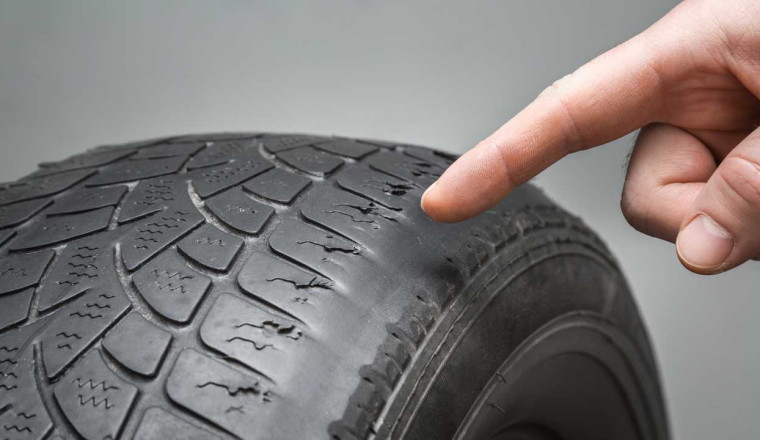
The most concerning stage comes when tires become severely worn beyond 70 percent of their usable tread. At this point, studies show dramatically increased particle emission rates, sometimes 200 to 300 percent higher than new tires, as the compromised structure and hardened rubber compound breaks down more readily.
Your bald tires aren't just unsafe. They're generating triple the pollution of new ones. Severely worn tires produce significantly more ultrafine particles PM0.1, which pose greater health risks due to their ability to penetrate deeper into respiratory systems and potentially enter bloodstreams. These particles bypass your lungs' defenses and enter your bloodstream directly. What they do once they're inside you? Research is ongoing. The early results aren't encouraging.
Where It Actually Ends Up
Tire wear particles enter the environment through multiple routes. Airborne dispersion carries smaller particles, sometimes for miles from their origin, before they settle on surfaces. Stormwater runoff washes accumulated particles from roadways into water systems, including rivers, lakes, and eventually oceans. There's also direct deposition on roadside soil and vegetation, creating concentrated zones of tire particle pollution along transportation corridors.
Constituents of these particles, pollutants such as microplastics, heavy metals, hydrocarbons, and other toxic chemicals can then pollute local water and soil. It bioaccumulates. Small particles enter small organisms. Larger organisms eat many small organisms. The concentration increases as it moves up the food chain. Eventually it reaches humans. You're eating tire particles. Not metaphorically. Literally.
The Scale Is Staggering
Studies from the Tire Industry Project show that TRWP typically consist of tire tread material combined with fragments from the road surface, along with other particles such as sand and road dust. These elongated wear particles are denser than water at 1.8 g/cm³ and average 100 µm in size, roughly the diameter of a human hair.
A typical mid-size car driving 15,000 kilometers per year produces around 2.25 kilograms of tire wear material with an average tire. That's one car. One year. 2.25 kilograms of rubber particles dispersed into the environment. Multiply by 1.4 billion cars globally and the numbers become incomprehensible.
Solutions Exist But Remain Inadequate
Continental claims its tires generate 11 percent less abraded material than the competitor average. A typical mid-size car driving 15,000 kilometers per year produces around 1.78 kilograms with Continental tires, a reduction of 470 grams per set. That's progress. Marginal, insufficient progress. An 11 percent reduction still means millions of tons of particles annually.
In 2023, the California Department of Toxic Substances Control began requiring manufacturers to evaluate nontoxic tire materials. The Washington State Department of Ecology has also been looking for alternatives. But chemicals similar to 6PPD that are most likely to be acceptable substitutes from a performance perspective are also likely to have similar hazard concerns from a human health and environmental perspective. Every alternative tested brings similar problems.
Seattle uses bioretention, bioswales, rain gardens, and green roofs to keep chemical pollutants from tires and many other human-made sources out of waterways. Infrastructure mitigation helps locally. It doesn't solve the global problem of billions of vehicles shedding millions of tons of toxic particles annually.
What You Can Actually Do
While you can't change the weight-related tire wear of your electric vehicle or the chemicals in those tires, you can cut down on tire shedding by changing your driving behavior. Aside from net-zero carbon emissions, one of the most appealing aspects of an EV is its ability to go from zero to 60 in three seconds. That acceleration also maximizes tire wear and particle release.
Drive smoothly. Brake gradually. Avoid aggressive acceleration. Replace worn tires before they reach that 70 percent threshold where emissions triple. These aren't revolutionary solutions. They're incremental damage reduction. The real problem requires fundamental changes in tire chemistry, vehicle weight, and transportation infrastructure that nobody's implementing at scale.
The Research Gaps Are Terrifying
The size, shape, and surface properties of tire particles can impact the methods of their emission and transport. Further research is also needed to characterize the toxicity of tire pollutants and their health effects, including determining alternative chemicals for use in the manufacturing process and conducting longer term studies on populations of sensitive species.
Translation: we know tire particles are everywhere, we know they contain hundreds of toxic chemicals, we know they're killing salmon and probably harming humans, but we don't fully understand long-term impacts or have viable alternatives. About 3 billion new tires are produced each year and about 800 million tires become waste annually. The experiment continues while we're all test subjects.
Every red light you stop at. Every corner you take. Every mile you drive. You're shedding rubber particles containing 400 chemicals into air, water, and soil. They're in your lungs. They're in your drinking water. They're in fish you eat. Six point one million tons annually, growing as vehicle fleets expand and EVs add weight. The rubber meets the road. Then it meets everything else. And we're just starting to understand what that means.