Great. Another pair of engines from the same manufacturer that are a cubic inch apart. Well, GM loves giving anti-kindred engines similar displacements (looking at you, Chevy 454 and Pontiac 455), so why not Ford? At least the 427 FE and 428 FE V8s are part of the same line of engines and share a 4.63-inch bore center spacing. Don't worry, it still gets confusing because of the actual dimensions of the 427 and 428 medium-block FE engines. Despite their close displacement, 385-series 429 big-blocks are entirely different, so we're ignoring them today.
The 428 FE has a 4.132-inch bore and a 3.984-inch stroke, which means it actually displaces 427.39 cubic inches. Boy, it sure is weird that Ford, of all companies, would round up displacement like that (cough, 4.9-liter Windsor 302, cough). In this case, though, Ford was just trying to differentiate it from the 427 FE. Except there was no need to do that, because the 427 FE isn't a 427, either. Thanks to a bore of 4.232 inches and a stroke of 3.784 inches, its actual volume is 425.82 cubes, which rounds up to a Chrysler Hemi-ish 426. So, really, the FE engines are 426 and 427 cubic inches, respectively.
As for the "FE" designation, it likely stands for "Ford-Edsel." Though it might stand for "Ford Engine," depending on who you ask. However, forum users apparently sourced a 1958 internal document that refers to the "Ford and Edsel engine," so the argument will likely rage on.
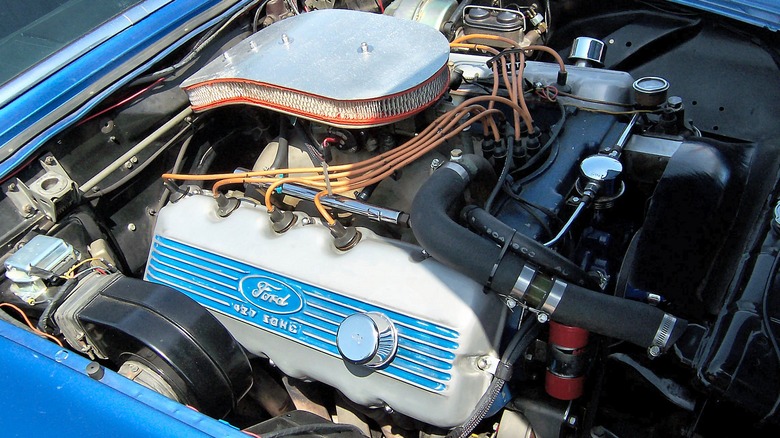
By 1957, Ford's Y-block V8s peaked at 312 cubic inches thanks to a 4.38-inch bore spacing. 1958 introduced the 332 FE, which grew to 426 (fine, "427") in 1963. 427s feature cross-bolted mains, thicker decks to accommodate higher compressions, heavy-duty connecting rods, forged aluminum pistons, and solid lifters. Street 427s made 410 horsepower in single four-barrel Q and W-Code cars, 425 hp in R-Code cars, and 390 hp in 427-powered 1968 Mercury Cougar GT-Es . And no, there weren't factory 427 Mustangs, though that rumor won't die.
Early 427s featured nodular iron cranks and were top-oilers, lubricating the cam and valvetrain before the crankshaft and starving the crank of oil with sustained lateral G-forces (like on a racetrack). In 1965, 427s got forged cranks and side-oiler systems that lubed the cranks first. 427s also had varying cylinder heads like the breathable high risers, the less-extreme low risers, and the middle-of-the-road medium risers. Regardless of head choice, 427s were stupendously powerful. Shelby Cobra 427s ripped from 0-100-0 in 13.8 seconds, 427-powered Ford GT40 Mark IIs finished 1-2-3 at the 1966 Le Mans, and lightweight 427-powered Galaxies were running 12-second quarter miles.
Speaking of heads, the exotic 650-plus horsepower single overhead-cam (SOHC) 427s are one of your favorite eight-cylinder engines, featuring a 6-foot-long timing chain, a hemispherical combustion chamber, and over 7,500 rpm. Ford yearned for racing domination in 1964, but NASCAR looked at the 427 "cammer" and went, "What? No." The officials wanted "stock car" races, not "special engine" races, and SOHC 427s weren't exactly going to be volume sellers. Eventually, just like with Chrysler's 426 Hemi, NASCAR relented, but only while also imposing severe weight penalties. Ford went, "What? No," and sold cammers to drag racers and land speed enthusiasts.
 Barry Blackburn/Shutterstock
Debuting for the 1966 model year, the 428 FE provided smooth, low-stress torque. Its bore was smaller than the 427's while the stroke was longer, so revs were a lower priority. You can feel the intent oozing from the Ford Galaxie 7-Litre, which wasn't interested in braggadocious acceleration, but rather effortless cruising with the kind of passing power that lets lesser cars know who's boss. Horsepower was a ho-hum 345, but torque was a steep-hill-ignoring 462 pound-feet.
Police Interceptor 428s made 360 hp and 459 pound-feet, which was somehow downgraded to 355 hp and 420 pound-feet when Carroll Shelby installed them in 1967 Ford Mustang Shelby GT500s. Pedestrian non-Shelby Mustangs were even more hamstrung, with weaker 390 V8s that got eaten alive by Chevy 396s. God bless Rhode Island Ford dealer Bob Tasca Sr., who slapped 427 low riser heads onto a 428, reground the cam, and installed an aluminum dual-plane intake, giving it a necessary breather.
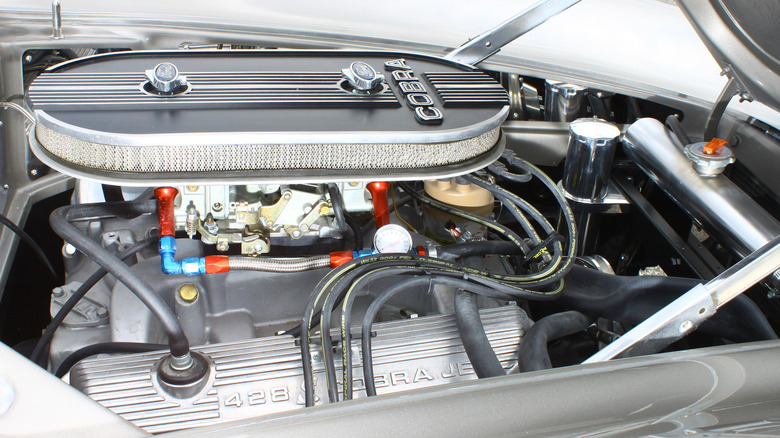
Ford noticed Tasca's work and decided the hot 428 should be factory equipment. After adding stronger main bearing caps, beefier cranks, and more muscular rods (plus aping Tasca's use of the 427 heads), the 428 Cobra Jet sprang to life. It made 335 horsepower, but could easily run with 390 hp 440 six-barrel Mopars and 375 hp L78 396 Chevies. GT500s eventually ditched the lazier 428 in favor of the Cobra Jet for the GT500KR "King of the Road," not to mention Carroll Shelby's personal 1968 Black Hornet Mustang.
If that wasn't extreme enough, buyers could get the also 335 hp Super Cobra Jet 428 (a $6.53 option!), which added ram air, GT40 connecting rods, even stronger cranks, forged pistons, external balancing, and an external oil cooler. Best 6½ bucks ever spent.